
Finally: OpenClips Turns a Single Product Link Into a Production-Ready Video Ad
Source: PR Newswire
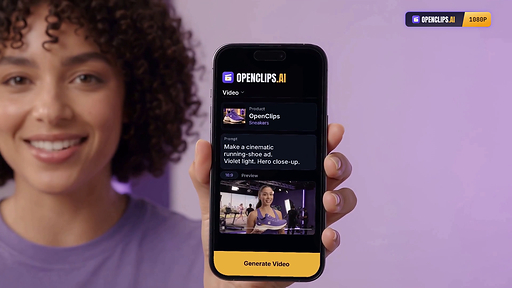
OpenClips launched a platform that converts a single product URL into a production-ready video advertisement, automatically generating scripts, storyboards and final renders. The service aggregates more than 45 video and image models into one interface, credit wallet and asset library, aiming to reduce the time and workflow complexity of creating performance-marketing ad variants. The company offers free workflows and commercial licenses on paid plans, though the announcement provides no financial metrics, customer adoption data or independently verified performance results.
Analysis
This is not yet an investable read-through for public AI-video vendors: it is a self-authored launch claim with no disclosed customer retention, cost-per-render, conversion lift, model-routing economics, or commercial scale. The relevant mechanism is nevertheless credible: reducing creative-production labor can shift performance-marketing budgets from agencies and SaaS creative tools toward platforms that own campaign workflow, asset libraries, and distribution integrations.
Near term, the announcement is more competitive pressure than revenue signal for Canva, Adobe (ADBE), and smaller AI-creative software vendors. The strongest structural beneficiaries remain model suppliers and cloud infrastructure only if aggregators materially increase render volume; otherwise, multi-model routing commoditizes underlying generation models and captures little durable margin because customers can switch providers as model quality converges.
The non-obvious risk is that URL-derived ads create brand-safety, product-claim, copyright, and localization failures at scale. That favors incumbents with enterprise governance, asset-rights management, and workflow integration—particularly ADBE—rather than a standalone interface. A meaningful negative catalyst for agency groups such as WPP and IPG would require independently verified adoption by mid-market advertisers and evidence that campaign-variant production falls without degrading conversion rates; this release provides neither.
Contrarian view: investors may overestimate the disruption from a "no-prompt" interface. Prompting is only a small component of enterprise creative approval; legal review, brand controls, audience segmentation, measurement, and platform-specific adaptation are the higher-friction steps. Watch for disclosed CAC payback, paid conversion from free users, gross margins after third-party model fees, and integrations with Meta (META), Alphabet (GOOGL), TikTok, or Shopify (SHOP) before treating this as a category inflection.
AllMind Terminal
AI-powered research, real-time alerts, and portfolio analytics for institutional investors.
Request TrialMarket Sentiment
Overall Sentiment
mildly positive
Sentiment Score
0.40
Key Decisions for Investors
- No standalone trade from this launch; place OpenClips on a watchlist for customer disclosures, pricing, paid-user conversion, and third-party model cost data over the next 1-3 months.
- Maintain a quality bias toward ADBE versus speculative AI-creative SaaS: its enterprise distribution, Firefly rights positioning, and Creative Cloud workflow can absorb URL-to-ad features. Reassess if Adobe reports accelerating Creative Cloud churn or materially weaker net-new ARR in the next two earnings cycles.
- Monitor WPP and IPG for a 6-18 month structural short thesis only if client commentary confirms AI-driven production headcount pressure and organic-growth guidance weakens. Absent those indicators, agency valuation and execution risk dominate the technology narrative.
- Use META, GOOGL, and SHOP as adoption proxies rather than direct beneficiaries: a measurable rise in advertiser creative volume or SMB ad spend could support platform monetization, but require evidence in quarterly ad-impression, pricing, and merchant-services disclosures before adding exposure.
More News
- China's AI leaders keep quiet despite U.S. 'publicity' on tech risks
- U.S. stock futures drift higher with Fed rate hike in focus
- AWS says it can't restore service to Bahrain, UAE facilities 6 months after Iran strikes
- Chinese investors rush into US stocks as Beijing opens wider path overseas
- Factbox-How AI leaders and world governments react to ’AI doom’ fears
- Is Amazon Stock a Buy After Its Best Quarter in Years?
From AllMind Research
- Anthropic IPO Preview: Valuation, Timing, and What to Watch
- Shein After the IPO: Venue, Valuation, and What Must Be Proved
- What AI Research Tools Should a Small Hedge Fund Buy First?
- Eli Lilly Q4 2025 Earnings: Revenue Surges 43% as Mounjaro and Zepbound Dominate the GLP-1 Market
- Investment Research Software Costs: A 2026 Budget Framework