
Sam Altman says OpenAI won't go public in 2026 amid AI safety concerns
Source: foxbusiness.com
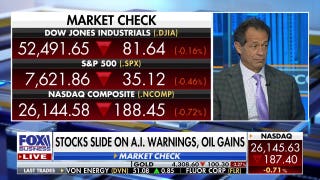
OpenAI CEO Sam Altman said the company will not proceed with an IPO in 2026, despite confidentially submitting an S-1 to the SEC in June. Altman cited AI safety and alignment risks, arguing that the company is better positioned to address societal, industry, and government coordination challenges while private. The delay removes a potential near-term public-market catalyst for one of the AI sector's most closely watched companies.
Analysis
The delayed liquidity event removes a near-term public-market price discovery catalyst for MSFT's most strategically important AI partner, but it is not intrinsically negative for Microsoft's economics. Private financing can preserve OpenAI's ability to spend aggressively on compute while avoiding quarterly-margin scrutiny; that likely sustains Azure AI demand and extends the useful life of Microsoft's preferred infrastructure relationship over the next 12-24 months. The key issue for MSFT shareholders is whether incremental capital needs are funded at valuations that dilute Microsoft's effective economic interest or require more vendor financing and capacity commitments.
The more consequential second-order effect is regulatory optionality. Remaining private may let OpenAI alter governance, model-release cadence, and safety spending without IPO disclosure constraints, but it also postpones audited segment-level evidence of monetization, inference costs, and customer concentration. This favors diversified AI exposure—MSFT, NVDA and hyperscaler capex beneficiaries—over any attempt to underwrite a standalone OpenAI valuation; it also marginally increases competitive runway for Anthropic-backed AMZN and Google/Alphabet to close product gaps before a public benchmark is established.
Consensus may frame the delay as a governance or safety negative. A more useful read is that management sees the value of flexibility as exceeding IPO proceeds, implying either adequate private funding access or a desire to avoid public scrutiny of unit economics. That becomes bearish for MSFT only if Azure growth decelerates while AI capex and depreciation continue rising, revealing that the partnership is consuming infrastructure faster than it monetizes it.
AllMind Terminal
AI-powered research, real-time alerts, and portfolio analytics for institutional investors.
Request TrialMarket Sentiment
Overall Sentiment
mildly negative
Sentiment Score
-0.15
Ticker Sentiment
Key Decisions for Investors
- Maintain MSFT rather than add on this headline; there is no standalone earnings catalyst. Reassess over the next 1-3 months after Azure growth, AI-services attach rate, and capex/depreciation guidance are reported.
- Use a relative-value basket for 6-12 months: long MSFT or NVDA versus an equal-weight short of lower-quality AI software proxies only if enterprise AI spending data remain firm. The thesis is infrastructure monetization, not an OpenAI IPO premium; exit if Azure growth misses guidance or hyperscaler capex plans are cut.
- Watch for OpenAI financing terms, especially new preferred issuances, guaranteed cloud-spend commitments, or revised Microsoft commercial rights. Evidence of material economic dilution to MSFT or multi-year capacity obligations without corresponding Azure revenue would be a catalyst to underweight MSFT.
- Do not position for a near-term IPO-related catalyst in MSFT. A later listing could ultimately create mark-to-market upside, but timing is now explicitly outside the actionable 2026 horizon and private valuation marks are not a reliable substitute for cash-flow evidence.
More News
- Wall Street’s AI doomsday trade is here: chipmakers sink while hyperscalers gain
- Palantir, Nvidia curb AI model use over data fears, The Information reports
- Google wants Spirit Airlines’ data. Micro1 wants to pay more.
- Microsoft sets limits for future AI models as industry throttles frontier development
- Microsoft AI chief: ‘Now’s the time’ for top labs to coordinate on safety
- Why is NVIDIA stock sliding today?