
Huawei Unveils New UnifiedBus Computing Architecture for SuperPoDs and Clusters
Source: PR Newswire
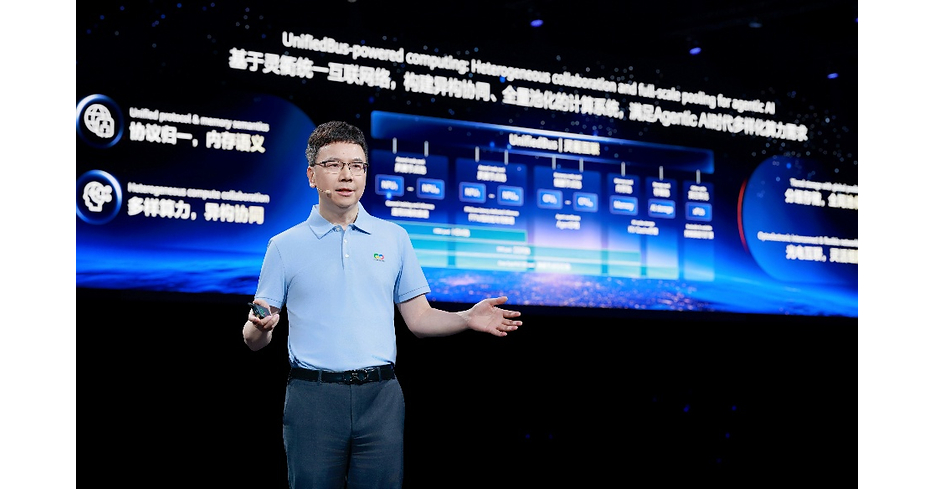
Huawei unveiled its UnifiedBus interconnect architecture and associated products, targeting AI compute scaling from single cabinets to clusters of up to 1 million NPUs. The company claims the architecture raises interconnect bandwidth from roughly 100 GB/s to TB/s levels and cuts round-trip latency from 7 microseconds to 2 microseconds. Its LinkDevice offers 176 ports at 1.6 Tbit/s per port, while the new agentic-AI SuperCluster combines TaiShan 950 and Atlas 960 SuperPoDs, OceanStor M900 storage, and Xinghe UBG switches. Huawei is also positioning smaller UnifiedBus appliances to enable local deployment of trillion-parameter models by SMEs.
Analysis
The investable implication is less about a near-term accelerator share shift than a potential change in the compute bill of materials inside China: if system-level pooling materially raises realized utilization, customers can defer incremental accelerator purchases while spending more on switching, optics, memory, storage, and integration. That is strategically adverse to NVIDIA's China addressable market over 6-18 months, but it is not automatically bullish for global networking vendors such as Arista (ANET), Broadcom (AVGO), Marvell (MRVL), or Ciena (CIEN), since a proprietary domestic fabric could localize that content as well.
The key unpriced issue is software portability. Hardware interconnect claims do not establish that training frameworks, fault tolerance, scheduling, and developer tools can deliver comparable time-to-train and total cost of ownership on production workloads. In the next 1-3 months, require independently disclosed customer deployments, model-training benchmarks using standard workloads, and evidence of repeat orders before assigning any share-loss probability to NVIDIA (NVDA) or AMD; this is a company-controlled product announcement, not a demand datapoint.
Contrarian view: the announcement may be more defensive than disruptive. Large-scale AI deployments are commonly constrained by power delivery, installation execution, memory supply, and software operations rather than theoretical fabric bandwidth; a more complex custom architecture can worsen availability and serviceability. Conversely, if credible utilization gains are demonstrated, the first financial beneficiary may be domestic semiconductor capacity and packaging demand—not the systems vendor—because customers will need to scale local component supply before architecture claims translate into revenue.
AllMind Terminal
AI-powered research, real-time alerts, and portfolio analytics for institutional investors.
Request TrialMarket Sentiment
Overall Sentiment
strongly positive
Sentiment Score
0.55
Key Decisions for Investors
- No directional NVDA or AMD trade on this release alone. Set a 90-day alert for independently reported Ascend cluster wins, reproducible training throughput, and customer evidence of framework migration; initiate a China-TAM hedge only if these show sustained production adoption rather than benchmark performance.
- Maintain a 6-12 month watchlist long in Semiconductor Manufacturing International (0981.HK) against a short SMH hedge only after evidence emerges that domestic accelerator and interconnect volumes are consuming incremental foundry capacity. Thesis is falsified if SMIC utilization, capex guidance, or mature-node pricing does not improve despite announced deployments.
- Avoid chasing ANET, AVGO, MRVL, or CIEN on the assumption that higher interconnect intensity converts into their revenue. Reassess only if Huawei discloses meaningful use of externally sourced optical DSPs, switches, or transceivers; a closed domestic stack would instead cap their China upside.
- For portfolios with concentrated NVDA exposure, consider buying 6-12 month downside protection rather than reducing core exposure immediately. The relevant risk trigger is a guidance revision tied to China or evidence that domestic alternatives are displacing imported accelerators at major cloud customers; absent that, the headline has limited impact on consolidated earnings.
More News
- All Iranian airlines to be 'shut down' from Wednesday, Bessent tells CNBC
- Taiwan benchmark Taiex rises to record intraday high as tech stocks advance
- AMD joins the $1 trillion club as chip rally surges - our AI Strategy saw it early
- Jamie Dimon says hyperscaler AI spending could hit $1 trillion next year
- Factbox-Key issues for this week’s Trump-Xi summit in Washington
- Here's who we know is going to the Trump-Xi dinner so far