
Connected Retail Is Widening the Cyber Attack Surface While Security Ownership Remains Fragmented, Info-Tech Research Group Warns
Source: PR Newswire
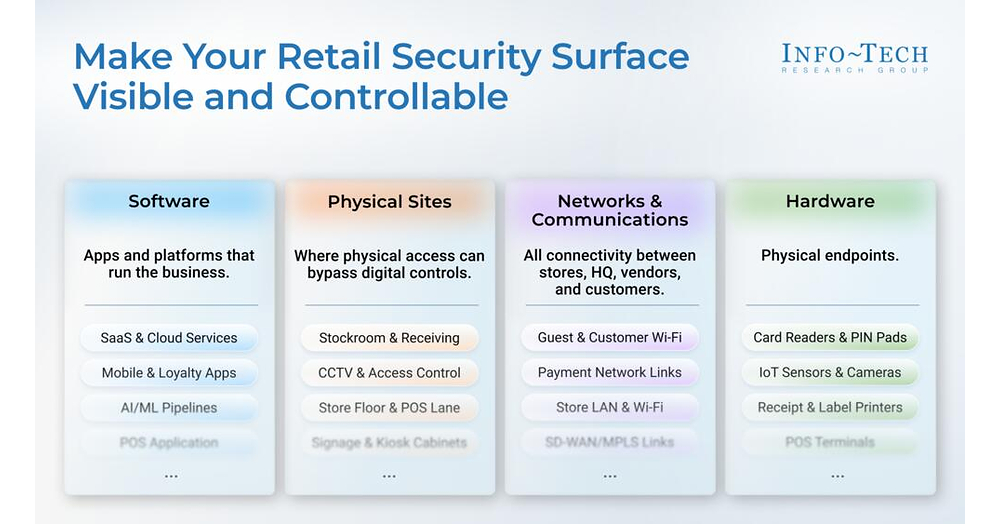
Info-Tech Research Group warns that connected retail expands the cyber attack surface across POS, cloud platforms, IoT devices, vendors, and customer apps, while security accountability remains fragmented. The firm’s “Build Cyber Resilience in Connected Retail” blueprint recommends a three-phase process to define risk, map exposure, and prioritize remediation using a structured threat/risk assessment tool, including guidance that generative AI can assist scenario development with expert validation.
Analysis
This reads less like an immediate spend catalyst and more like a procurement framework that helps retailers justify security budgets they were already under pressure to approve. The beneficiaries are the vendors that sit at the control plane—identity, segmentation, asset discovery, third-party access, and incident response—because the pain point is not detection quality but ownership ambiguity across teams. That favors platforms that reduce coordination cost over point tools that add another console, which is a subtle tailwind for integrated security suites versus niche specialists.
The bigger second-order effect is on services revenue. Large retail IT stacks are too fragmented to remediate with software alone, so consulting, managed detection/response, and implementation partners can capture more near-term budget than product vendors; the spend is likely to be phased over 1-3 quarters, not booked instantly. By contrast, retailers with thin margins will try to defer “nice-to-have” hardening until after a scare, so a broad sector rerating is unlikely without a headline breach.
Contrarian view: the market may already know retail is a soft target, but it may be underestimating how hard it is to translate that awareness into capex/opex. Governance fragmentation often slows conversion from board-level concern to vendor bookings, so the true upside for cyber names is delayed and event-driven. The clearest falsifier is the absence of an incident or a budget revision cycle; without either, the memo is more relevant as a watchlist than a trade signal.
AllMind Terminal
AI-powered research, real-time alerts, and portfolio analytics for institutional investors.
Request TrialMarket Sentiment
Overall Sentiment
mildly negative
Sentiment Score
-0.20
Key Decisions for Investors
- No direct trade in FCD.UN.TO or TCHC on this release; the signal is too generic and lacks a measurable revenue catalyst. Treat as a watch item for retail cyber budgeting, not a standalone position.
- Watch PANW, CRWD, FTNT, and ZS for a 1-3 month procurement tailwind if retailers start bundling identity, segmentation, and third-party access refreshes into FY27 budgets. Prefer a basket long over a single name because budget conversion will be uneven.
- Pair trade idea: long PANW / short a retail ETF proxy such as XRT or RTH only if a major retail breach hits and management teams start funding remediation from discretionary spend. Without an incident, the pair has weak carry and poor timing.
- Monitor MSSP/consulting beneficiaries like Accenture (ACN) and CGI (GIB) for implementation work; these are better second-order winners than pure cyber vendors if retailers need governance and integration help. This is a 6-18 month thesis, not a day-trade.
- Set an alert for any holiday-season breach in large-format retail or payment processing; that would be the catalyst that converts this from abstract awareness into urgent spend, with the strongest upside to identity and incident-response vendors.
More News
- AI rapidly improving, could vastly boost U.S. GDP, Anthropic's Clark tells policymakers
- Semiconductor market to remain solid ‘at least through next year,’ South Korea finance minister says
- Nasdaq Index: AI Selloff Deepens as Chips and CoreWeave Break
- States sue OpenAI, saying it gives life to ‘cyberhacking agents’ while ChatGPT hurts children and deceives adults
- Alphabet’s chief investment officer responds to Jefferies warning that the most likely outcome of the AI boom is massive U.S. capital destruction
- A 44-minute call and a memo: How Alexandr Wang won Mark Zuckerberg’s trust—and a $100 billion-plus AI bet
From AllMind Research
- Anthropic IPO Preview: Valuation, Timing, and What to Watch
- Shein After the IPO: Venue, Valuation, and What Must Be Proved
- What AI Research Tools Should a Small Hedge Fund Buy First?
- Can ChatGPT or Claude Replace a Research Platform?
- How the 2026 Milan-Cortina Winter Olympics Will Reshape Company Revenues and Stock Performance