
FQ-42 Vengeance Finds New Home at Creech Air Force Base
Source: Newswire
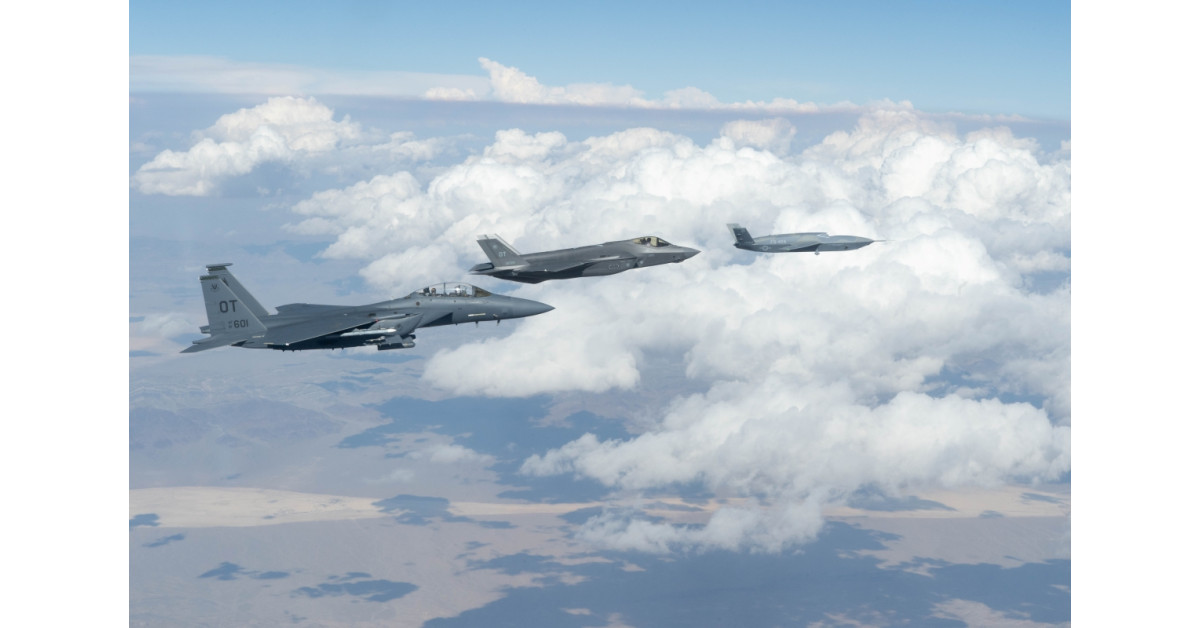
General Atomics delivered an FQ-42 Vengeance uncrewed fighter to Creech Air Force Base on Sept. 18 for U.S. Air Force Collaborative Combat Aircraft test and evaluation operations. The aircraft, which first flew in August 2025 and won an initial production contract in June 2026, has conducted autonomous and semi-autonomous operations alongside F-35s and F-15Es. GA-ASI says it has capacity to deliver six aircraft per month, with production underway using company funding while government funding plans mature.
Analysis
The investable read-through is less about the privately held airframe supplier than the emerging cost structure of manned-unmanned teaming. LMT is the clearest listed beneficiary if CCA deployment expands F-35 mission-system, datalink, software-integration and sustainment content; RTX benefits through sensors, effectors and electronic warfare. BA has a narrower but credible upside through the F-15EX ecosystem, while LHX and NOC are better second-order beneficiaries where resilient communications, autonomy payloads and mission networking become the procurement bottleneck rather than airframe capacity.
The near-term signal is weak for public equities: this is vendor-issued progress commentary without disclosed contract value, unit economics, appropriated funding, or independent operational-performance data. Over the next 1-3 months, the relevant catalyst is FY27 defense authorization/appropriations language that converts experimentation into procurement quantities; without it, listed-defense multiples should not rerate materially. Over 6-18 months, CCA scale could shift Defense Department spending from exquisite crewed-platform procurement toward cheaper attritable inventory, creating a relative headwind for standalone tactical-aircraft economics but a tailwind for weapons, networking, simulation and recurring software sustainment.
Contrarian view: the market may over-credit pure-play drone proxies such as KTOS and AVAV simply because the theme is autonomous aircraft. Their upside depends on winning production or subsystem roles, not on category validation; a prime-controlled architecture can concentrate the highest-margin integration and lifecycle revenue elsewhere. Conversely, broad defense-prime exposure may underprice the recurring mission-software and electronic-warfare attach rate if procurement evolves from small test lots to operational squadrons.
AllMind Terminal
AI-powered research, real-time alerts, and portfolio analytics for institutional investors.
Request TrialMarket Sentiment
Overall Sentiment
strongly positive
Sentiment Score
0.58
Key Decisions for Investors
- Maintain a 6-12 month overweight in LMT versus ITA: use weakness around quarterly results to enter, targeting a 10-15% relative return if CCA-related mission-system and sustainment content appears in backlog or long-range guidance. Falsify on evidence that the architecture is government-furnished/open-source with minimal prime integration revenue, or a material F-35 production reduction.
- Establish a small 3-6 month LMT/KTOS relative-value position (long LMT, short KTOS) only after confirming no meaningful KTOS production award or funded subsystem role. The trade captures the gap between platform-themed speculation and contracted lifecycle economics; cover the short if KTOS discloses a funded production lot, major autonomy payload award, or backlog acceleration.
- Add RTX on pullbacks for a 12-18 month horizon, focused on the expendable-weapons, sensing and electronic-warfare content per autonomous mission rather than airframe exposure. Risk is a budget outcome favoring low-cost uncrewed airframes without premium seekers/EW payloads; monitor classified-program commentary, missile orders and defense-margin guidance.
- Set an appropriation alert rather than chase drone equities: increase defense-autonomy exposure only when funded quantities, procurement timing, and unit-cost targets are published. A continuing resolution, quantity deferral, or a shift toward extended testing would likely cap the theme’s valuation upside despite positive flight-test headlines.
More News
- All Iranian airlines to be 'shut down' from Wednesday, Bessent tells CNBC
- Taiwan benchmark Taiex rises to record intraday high as tech stocks advance
- AMD joins the $1 trillion club as chip rally surges - our AI Strategy saw it early
- Jamie Dimon says hyperscaler AI spending could hit $1 trillion next year
- Factbox-Key issues for this week’s Trump-Xi summit in Washington
- Here's who we know is going to the Trump-Xi dinner so far
From AllMind Research
- Anthropic IPO Preview: Valuation, Timing, and What to Watch
- Shein After the IPO: Venue, Valuation, and What Must Be Proved
- What AI Research Tools Should a Small Hedge Fund Buy First?
- Weekly Update: Advanced Search Filters, Redesigned Ticker Dashboard, and Improved Search Experience
- How to Build an Automated Research Process for a Fund