
Intel Jumped, But The Reason Behind It Doesn't Add Up
Source: seekingalpha.com
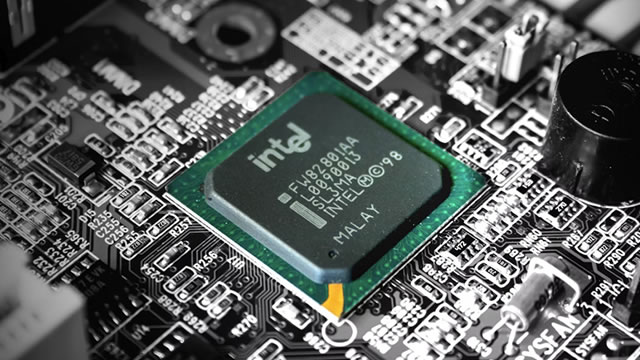
Intel retains a Buy rating as AI-driven demand supports multi-year supply agreements and improves revenue visibility. The company raised $22.6 billion in equity to fully fund new fabrication plants without additional debt, accepting 4.8% dilution; shares have risen 16%, lifting forward EV/EBITDA to 25.83x. The higher valuation is viewed as justified by expected data-center margin recovery and disciplined capital allocation.
Analysis
The key underwriting issue is not headline AI exposure but conversion of customer commitments into economically protected utilization. Unless agreements include prepayments, take-or-pay terms, or minimum wafer-volume obligations, they provide limited downside protection against an AI capex pause; pricing concessions could fill fabs while delaying gross-margin recovery. The equity-funded buildout removes a near-term financing tail risk, but it also raises the hurdle for per-share returns: management must demonstrate that incremental fab capacity earns above its cost of capital rather than merely supporting strategic scale.
Over the next 1-3 months, the equity issuance creates a natural technical overhang and makes margin guidance—not revenue commentary—the relevant catalyst. A sustained rerating requires evidence that data-center mix, yields, and utilization are improving together; revenue growth with weak factory absorption would instead validate the bear case. The most exposed adjacent names are mature-node foundry and equipment suppliers: incremental Intel capacity can pressure GF and UMC over the 2027-29 period, while ASML, AMAT and LRCX benefit earlier from buildout spending but face order-risk if customer commitments lack deposits.
Consensus may be underweight the strategic value of a domestically located, defense-qualified manufacturing alternative to TSMC, particularly if geopolitical risk reprices supply-chain resilience. But that optionality should not be capitalized as near-term earnings until disclosed external foundry backlog, customer prepayments, and segment-level profitability support it. The thesis is falsified by another reduction in gross-margin outlook, weak data-center order conversion, or capex remaining elevated without a corresponding increase in external customer funding.
AllMind Terminal
AI-powered research, real-time alerts, and portfolio analytics for institutional investors.
Request TrialMarket Sentiment
Overall Sentiment
moderately positive
Sentiment Score
0.58
Ticker Sentiment
Key Decisions for Investors
- Do not chase INTC on AI-contract commentary alone; build a 6-12 month long only after the next earnings release confirms sequential data-center gross-margin expansion and discloses binding customer economics. Target a 2:1 upside/downside profile, with exit discipline if management cuts margin or utilization guidance.
- For a defined-risk expression, buy 9-12 month INTC call spreads with strikes roughly 5% and 25% above spot rather than owning stock outright. This captures a credible margin-recovery rerating while limiting exposure to dilution-related technical pressure and execution slippage.
- Use a small long INTC / short SOXX pair after a post-earnings margin confirmation to isolate company-specific execution from broad AI-semiconductor beta. Reassess if SOXX outperforms by more than 10% without an improvement in Intel's disclosed backlog, external foundry funding, or gross-margin trajectory.
- Place a 2027-29 watch on GF and UMC: initiate relative underweights only if Intel announces meaningful external foundry volume at nodes overlapping their addressable market. The missing evidence is customer-specific capacity allocation and pricing; absent that, capacity-pressure risk remains an alert rather than a trade.
More News
- Raspberry Pi Desktop proves old PCs aren't past it
- Here’s the ‘core economic flaw’ in the AI bull case as stock and bond trades unravel, according to a top economist
- Biotech stocks are surging. How investors can play the new drug innovation boom
- AI funding fears rattle Wall Street. Here's how we're adjusting our portfolio
- Braskem creditors, shareholders near deal on $11bn debt restructuring
- Instacart reportedly discussed selling itself with DoorDash and Uber
From AllMind Research
- Anthropic IPO Preview: Valuation, Timing, and What to Watch
- Shein After the IPO: Venue, Valuation, and What Must Be Proved
- What AI Research Tools Should a Small Hedge Fund Buy First?
- Weekly Update: Sector Analysis, Improvements on Research Data, and Performance Enhancements
- Choosing an AI Copilot for Equity Research