
ICP DAS-BMP, COMPAMED 2026'da Tıbbi TPU Alanındaki Yeniliklerini Sergileyecek
Source: PR Newswire
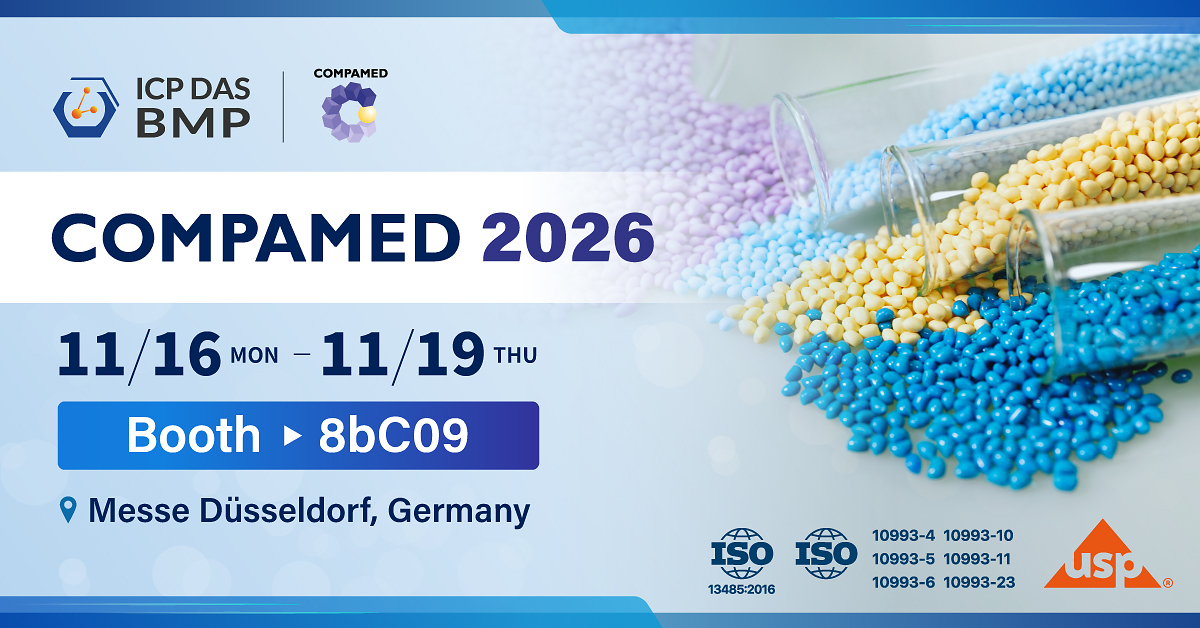
ICP DAS-BMP will showcase its medical-grade TPU portfolio and introduce the newly formed Taiwan TPU Alliance at COMPAMED 2026 in Düsseldorf, November 16–19. Featured products include an ISO 10993-compliant low-migration TPU suitable for implantation for up to 90 days, a low-friction catheter material, and radiopaque grades containing 20–40% barium sulfate or 40–60% tungsten; the announcement provides no financial outlook or sales figures.
Analysis
Analysis
Near-term investment signal is weak: this is a trade-show and product-positioning announcement, not evidence of customer qualification, volume orders, or earnings impact. The commercially relevant hypothesis is that low-migration TPU could help device makers reduce material-risk and validation friction for longer-contact applications, while intrinsically low-friction TPU could remove coating or finishing steps. If validated in production, that could shift value from coating/finishing suppliers toward specialty polymer suppliers and simplify OEM sourcing. The counterpoint is that biocompatibility standards and stated use durations do not establish regulatory clearance, customer adoption, or superiority in finished devices; qualification cycles can be lengthy.
The Taiwan TPU Alliance may lower coordination costs across materials, tubing, molding, and equipment, but a trade-show coalition is not yet proof of integrated capacity or defensible economics. Any benefit to equipment partners is likely indirect and contingent on incremental customer programs. For the November 16–19 event, watch for named OEM evaluations, design wins, capacity commitments, or independently verifiable performance data—not booth presence or portfolio breadth.
Over 1–3 months, customer qualification and order disclosures are the key catalysts; over 6–18 months, the thesis depends on repeat adoption and whether simpler processing translates into OEM cost or performance advantages. No listed-company identity or financial data is supplied, so there is no grounded single-name trade. A catalyst-driven read-through to medical-device materials is possible, but likely too diffuse to trade absent commercial evidence.
AllMind Terminal
AI-powered research, real-time alerts, and portfolio analytics for institutional investors.
Request TrialMarket Sentiment
Overall Sentiment
mildly positive
Sentiment Score
0.20
Key Decisions for Investors
- No immediate position: treat the announcement as a watch item rather than a revenue catalyst; the article provides no customer wins, volumes, pricing, or public-company mapping.
- At COMPAMED, seek evidence of OEM qualification, production-scale orders, and validated comparisons against coated alternatives. Upgrade the thesis only if adoption and repeat demand become independently verifiable.
- Track coating and specialty-polymer suppliers for substitution risk, but do not short the category on this announcement alone: competing materials, customer qualification timelines, and actual process-cost savings are unknown.
- Falsification / risk trigger: if subsequent disclosures show no customer evaluations or commercial orders, or if device makers retain existing coated materials after qualification, discount the alliance and product claims as non-incremental marketing.
More News
- AMD stock jumps 7% on earnings as data center revenue nearly doubles
- Marvell-Lumentum Deal Puts Optical Networking at the Center of the AI Boom
- Marvell Technology could plunge on latest multibillion-dollar acquisition
- AI Inference Startup Fal Raises Capital at $16 Billion Valuation
- AMD’s OpenAI, Meta chip deals trigger $1 billion quarterly charge
- North Korean fake job interview led to $6.3B Binance heist