
Costco Q4 Earnings Call Highlights Expansion and Digital Growth
Source: zacks.com
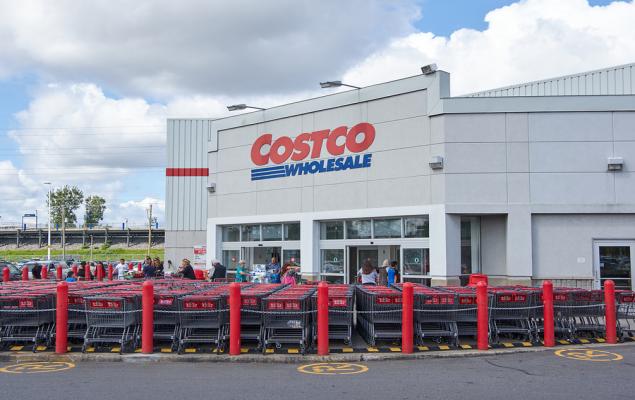
Costco reported fiscal Q4 adjusted EPS of $6.60 versus $6.48 consensus and revenue of $95.72 billion versus $94.82 billion expected. Management plans 33 warehouse openings in fiscal 2027 and about $7.5 billion of capex, up from $6.4 billion, targeting a sustainable pace of 30 net new locations annually. Digitally enabled sales exceeded $33 billion and grew more than 20% in fiscal 2026, while paid membership rose 3.8% to 84.1 million and executive memberships increased 9.4%. Gross margin declined 11 bps to 11.02% including gas inflation, but rose 20 bps excluding it; Costco will reinvest most tariff refunds, including $184 million received in Q4, into member price reductions.
Analysis
The investable issue is not the earnings beat but whether incremental physical capacity can sustain per-share growth without eroding Costco's scarcity premium. The higher capex run-rate creates a near-term free-cash-flow conversion headwind, while new units typically require a ramp period; therefore, the next 1-3 quarters are more likely to be governed by comp-sales and renewal/upgrade data than by unit-count optimism. If comparable sales remain near the level needed for expense leverage, the fixed-cost absorption from the expanded network can support EBIT growth beyond the initial investment phase.
Reinvesting import-cost recoveries into pricing is strategically accretive but suppresses the immediately visible gross-margin benefit. It raises the competitive burden on Walmart (WMT), Target (TGT) and BJ's Wholesale (BJ): Costco can use its membership economics to pass through savings selectively, forcing rivals to choose between traffic defense and merchandise-margin protection. The more important second-order effect is that price investment in consumables can deepen executive-member retention, making later fee, mix and wallet-share monetization more valuable than the one-time refund contribution.
Delivery partnerships are positive for convenience-led purchase frequency, but not yet a thesis-changing profit pool: third-party fulfillment can dilute unit economics if the mix shifts from warehouse baskets to smaller, lower-margin orders. DASH and UBER gain modest order-density and merchant-selection benefits, but Costco's scale gives it negotiating leverage; neither deserves a material estimate revision absent disclosed order volume, take rates, or evidence of net incremental spend. A contrarian concern is that slowing paid-member growth relative to footprint makes the premium valuation vulnerable if renewals or executive penetration cease offsetting weaker member acquisition.
Over 6-18 months, international unit maturation and younger-household cohort spending offer a credible earnings-duration extension, but the market should demand proof in sales per warehouse and membership fee income rather than extrapolate digital growth. Falsifiers are two consecutive quarters of sub-target comps, deterioration in renewal rates or executive-member mix, or capex rising again without corresponding SG&A leverage; any of these would turn expansion from a multiple-supporting runway into a return-on-invested-capital debate.
AllMind Terminal
AI-powered research, real-time alerts, and portfolio analytics for institutional investors.
Request TrialMarket Sentiment
Overall Sentiment
moderately positive
Sentiment Score
0.48
Ticker Sentiment
Key Decisions for Investors
- Maintain a neutral-to-underweight COST position into the next 1-3 months rather than chase the post-print strength; initiate a tactical long only if monthly comparable sales and renewal disclosure confirm demand durability. The key risk/reward is asymmetric at a premium multiple: modest upside from execution versus sharper compression if unit productivity or member growth disappoints.
- Express the competitive effect as a 6-12 month pair: long COST / short TGT, sized modestly. Costco's ability to fund value through membership economics should pressure Target's discretionary and everyday-value margin trade-off; exit if TGT demonstrates sustained traffic acceleration without gross-margin giveback, or if Costco's reported comp trend weakens materially.
- Do not add directional DASH or UBER exposure solely on the partnership expansion. Set an alert for quantified incremental delivery order growth, average order economics, or a disclosed expansion of fulfillment terms; without those data, the likely financial contribution remains too small relative to both companies' broader mobility and delivery drivers.
- Monitor COST's next two quarters for sales per warehouse, executive-member penetration, renewal rate and SG&A leverage. Reduce any long exposure if comparable-sales deceleration coincides with declining renewal/upgrade metrics, since that combination would undermine the case that elevated capex earns above-cost-of-capital returns.
More News
- Shares of Akamai surge after deal with Anthropic. What Wall Street is saying
- China's Economy Unbalanced, AI Deal Hard to Envision, Stephen Roach Says
- Nike’s stock is one of the worst in the S&P 500 — and BofA says it’s not done sliding
- Costco just reported strong earnings. Goldman Sachs sees a sharp move higher for the stock
- One key part of the AI trade has decoupled from the rest. Why that is, and whether it can come back
- Costco Beat on Earnings. About $0.15 a Share of It Was a One-Time Tariff Refund.