
The National Police Association Supports Senate Passage of the Combating Organized Retail Crime Act
Source: PR Newswire
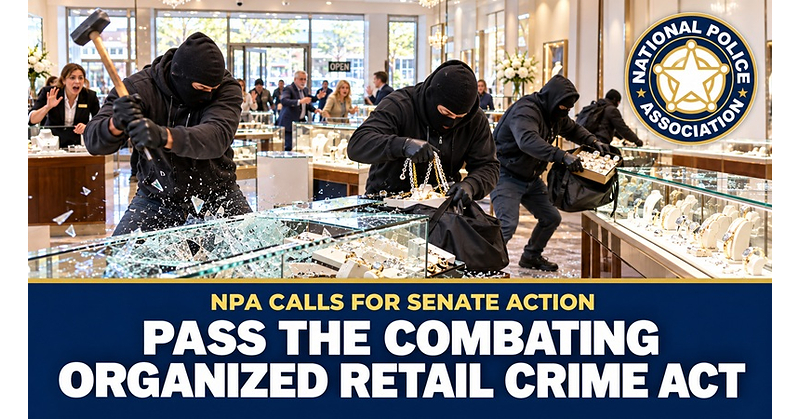
The National Police Association endorsed the bipartisan Combating Organized Retail Crime Act, which would create a DHS-based Organized Retail and Supply Chain Crime Coordination Center and expand federal prosecutorial tools against interstate theft networks. The House passed its version, H.R. 2853, 348-60 on May 12, 2026; the Senate companion, S. 1404, remains in committee and is being proposed as an amendment to the FY2027 NDAA. The measure could marginally improve coordination against organized retail theft and related supply-chain losses, though its commercial impact depends on Senate enactment and implementation.
Analysis
This is not yet an earnings-moving event: Senate timing, amendment survival, appropriations, and agency implementation make any operational impact a 6-18 month proposition. Even enactment would not directly reduce shrink; the investable mechanism is improved cross-jurisdiction case-building against professional networks, which could eventually lower repeat-loss rates and security spend for large-format retailers. The market should discount company and advocacy estimates until quarterly shrink disclosures, inventory-reserve trends, and store-opening/closure decisions independently confirm a change.
The asymmetric beneficiaries are retailers with concentrated high-theft categories, broad geographic footprints, and relatively thin operating margins: TGT, WBA, ULTA, BBY and dollar-store formats. A modest reduction in markdowns, damaged inventory, private security, and locked-merchandise labor could matter disproportionately to EPS at TGT and ULTA; by contrast, WMT, COST and AMZN have greater scale but less incremental valuation sensitivity. Electronic-article-surveillance, video analytics and loss-prevention vendors could see a nearer-term demand benefit if retailer participation in information-sharing expands, but there is no clean public pure-play and no basis to underwrite revenue acceleration today.
Consensus likely overstates the link between federal prosecution tools and near-term retail margins. Theft has become an all-purpose explanation for underperformance, while retailer shrink includes process failures, self-checkout leakage, damaged goods, and inventory-accounting noise; aggressive enforcement can also shift activity rather than eliminate it. The relevant falsifier is not passage alone: if TGT/WBA/ULTA fail to show sequential shrink improvement or reduce loss-prevention expense within two to three reporting periods after implementation, any multiple-expansion thesis should be abandoned.
AllMind Terminal
AI-powered research, real-time alerts, and portfolio analytics for institutional investors.
Request TrialMarket Sentiment
Overall Sentiment
mildly positive
Sentiment Score
0.20
Key Decisions for Investors
- No immediate directional trade on the endorsement or procedural developments; treat Senate floor scheduling or NDAA inclusion as an alert, not a catalyst, because the financial transmission path is too long and unquantified.
- Build a 6-12 month watchlist for long TGT and ULTA versus short XRT only after management quantifies shrink improvement or security-cost leverage in earnings materials; target a 200-400 bp relative return if gross-margin guidance rises without demand deterioration. Exit if gross-margin improvement is driven solely by clearance/inventory normalization rather than loss reduction.
- Avoid using WBA as a crime-policy long: potential shrink relief is unlikely to offset pharmacy reimbursement pressure, restructuring execution, and balance-sheet risk over the next year.
- For existing retail longs, monitor quarterly gross margin, inventory write-downs, store-closure commentary, and SG&A security expense. A material rise in reported organized-crime incidents without corresponding margin improvement would favor reducing exposure rather than assuming eventual legislative remediation.
More News
- Trump says Iran war could end after U.S. elections as Hormuz tensions persist
- Mark Ruffalo says Paramount’s $111 billion Warner Bros. deal ‘Will stifle creativity, weaken free speech, and cost people their jobs’
- States, cities sue U.S. agencies over weaker vehicle fuel economy rules
- G7 Leaders’ Statement on global energy security and market stability
- Trump vs Europe as US presses for release of emergency diesel stocks
- Anthropic warns government attitudes may hurt customer ties, IPO prospectus shows: Reuters
From AllMind Research
- Anthropic IPO Preview: Valuation, Timing, and What to Watch
- Shein After the IPO: Venue, Valuation, and What Must Be Proved
- What AI Research Tools Should a Small Hedge Fund Buy First?
- Weekly Update: Live Event Center, In-App Documents, and Faster Transcripts
- How to Automate Equity Research Workflows: A Control-First Guide