
New KeaBabies Survey Finds Nearly Half of Parents Say Babywearing Gives Them Back an Hour or More Each Day
Source: PR Newswire
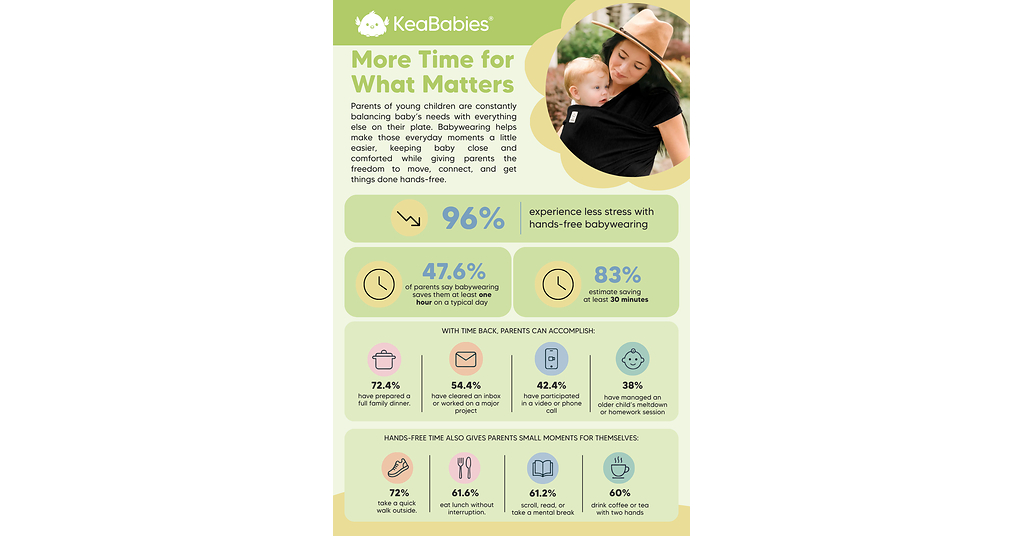
In a KeaBabies-commissioned September 2026 survey of 250 parents and guardians of children ages 0–2, 96% said hands-free babywearing reduced their stress. Additionally, 83% estimated it saved at least 30 minutes on a typical day, and 47.6% said it saved at least one hour. The findings are company-sponsored survey results about reported parent experiences, not evidence of a measured change in sales or financial performance.
Analysis
This is a weak commercial signal, not evidence of a category demand inflection. A brand-commissioned survey of 250 caregivers is useful as marketing research but cannot establish incremental purchases, willingness to pay, retention, or share gains. The practical implication is primarily for customer acquisition: a credible convenience message may improve conversion for carriers, but any benefit could be competed away through discounts and paid marketplace placement. That leaves the key economic question—whether conversion gains exceed acquisition and promotion costs—unanswered.
Potential beneficiaries are carrier brands such as Ergobaby, BabyBjörn, Tula, and Moby if the convenience proposition resonates beyond KeaBabies; the same message also risks commoditizing products if shoppers see carriers as interchangeable. Retailers and marketplaces may capture more of any demand through traffic and placement economics than brands capture in margin. The survey does not identify a public-market exposure with a clean read-through.
Near term, expect little fundamental repricing absent sell-through or distribution data. Over 1–3 months, watch for independent retailer rankings, review velocity, promotion intensity, and product availability. Over 6–18 months, sustained category growth could support adjacent baby-gear demand, but birth-cohort trends and household budgets may dominate this small product niche. Contrarian view: the emotional appeal of “time back” may generate engagement without durable willingness to pay; the 96% stress response is self-reported and not proof of product-specific efficacy. Product-safety concerns or an incident involving carrier use could reverse the narrative and raise reputational or liability exposure.
AllMind Terminal
AI-powered research, real-time alerts, and portfolio analytics for institutional investors.
Request TrialMarket Sentiment
Overall Sentiment
mildly positive
Sentiment Score
0.20
Key Decisions for Investors
- No trade on this release alone: there is no mapped public-company exposure or independently verified sales impact.
- Treat this as a low-cost positioning signal, not a forecast. Reassess only if brands or retailers disclose carrier sell-through, market-share gains, or repeat-purchase data alongside promotion and acquisition costs.
- Monitor competing carrier brands and retailer rankings over the next 1–3 months; rising unit sales with stable pricing would strengthen the demand thesis, while rankings improving only during discounting would weaken it.
- Falsification/watch item: safety warnings, recalls, or adverse publicity tied to carrier use would likely outweigh the modest convenience-marketing benefit; verify any such event before assigning category-wide impact.
More News
- Why is SK Hynix stock gaining today?
- Former world No. 1 Jon Rahm's lawyer tells court Spaniard is done with LIV Golf after three seasons
- Anthropic will be 'most ridiculous IPO' of year, analyst says
- Levi Strauss hikes profit guidance after tariff refunds, but its sales outlook is less optimistic
- Weston Family, Fairfax Financial’s Watsa Acquire Boots in $8.9 Billion Deal
- Brazil is having its Argentina moment. How to play it