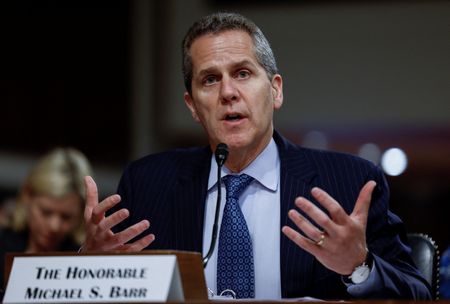
Federal Reserve Governor Michael Barr criticized the Fed's regulatory rollback on Wall Street lenders, warning it could reduce aggregate capital requirements for the largest banks by 6% and leave $60 billion less in loss-absorbing capital. He also said supervisory changes have weakened oversight of the 36 largest institutions, with critical warnings falling to about half of 2024 levels. The remarks point to a meaningful banking-sector risk backdrop and underscore a growing divide inside the Fed over deregulation.
The market is likely reacting less to this single speech than to the signal that bank capital relief is becoming a political rather than purely prudential variable. That matters because any perceived weakening of bank buffers lowers the marginal cost of balance-sheet expansion, but it also raises the probability of a future credit event that forces a much harsher supervisory reset. In other words, the near-term beneficiary is bank equity and bank credit supply, while the medium-term loser is the quality of the financial system’s shock absorber.
Second-order, the biggest competitive winner may be private credit and nonbank lenders. If regulated banks get more flexibility, they can defend share in lower-risk lending, but the more important effect is that weaker oversight can compress spreads and encourage banks to re-enter riskier pockets they previously avoided, setting up another round of margin competition. That dynamic is bad for spread lenders with looser funding and worse for junior capital providers if underwriting standards deteriorate across the ecosystem.
For markets, the key issue is timing: the downside from this theme is not immediate and likely shows up over months, not days, unless a credit shock exposes hidden losses. The most actionable near-term expression is to fade the rally in bank equities on any further deregulation headlines, especially where valuations already discount higher ROE from lower capital requirements. The contrarian view is that the move could be overdone if the actual implementation remains incremental; speeches can move sentiment, but binding capital relief may be delayed or diluted by internal Fed resistance and political pushback.
Tail risk is a regime shift in risk appetite: if easier supervision coincides with a credit cycle rollover, the same banks that benefit from lighter capital could become the epicenter of repricing. That makes longer-duration bank debt and preferreds more vulnerable than common equity if spreads widen. The cleaner trade is not to short the sector outright, but to buy protection against a policy-driven “everything is fine” narrative that can unwind violently when losses surface.
AI-powered research, real-time alerts, and portfolio analytics for institutional investors.
Request TrialOverall Sentiment
mildly negative
Sentiment Score
-0.35
