
Macabacus integriert die KI-gestützte Inhaltsprüfung direkt in PowerPoint-Präsentationen
Source: PR Newswire
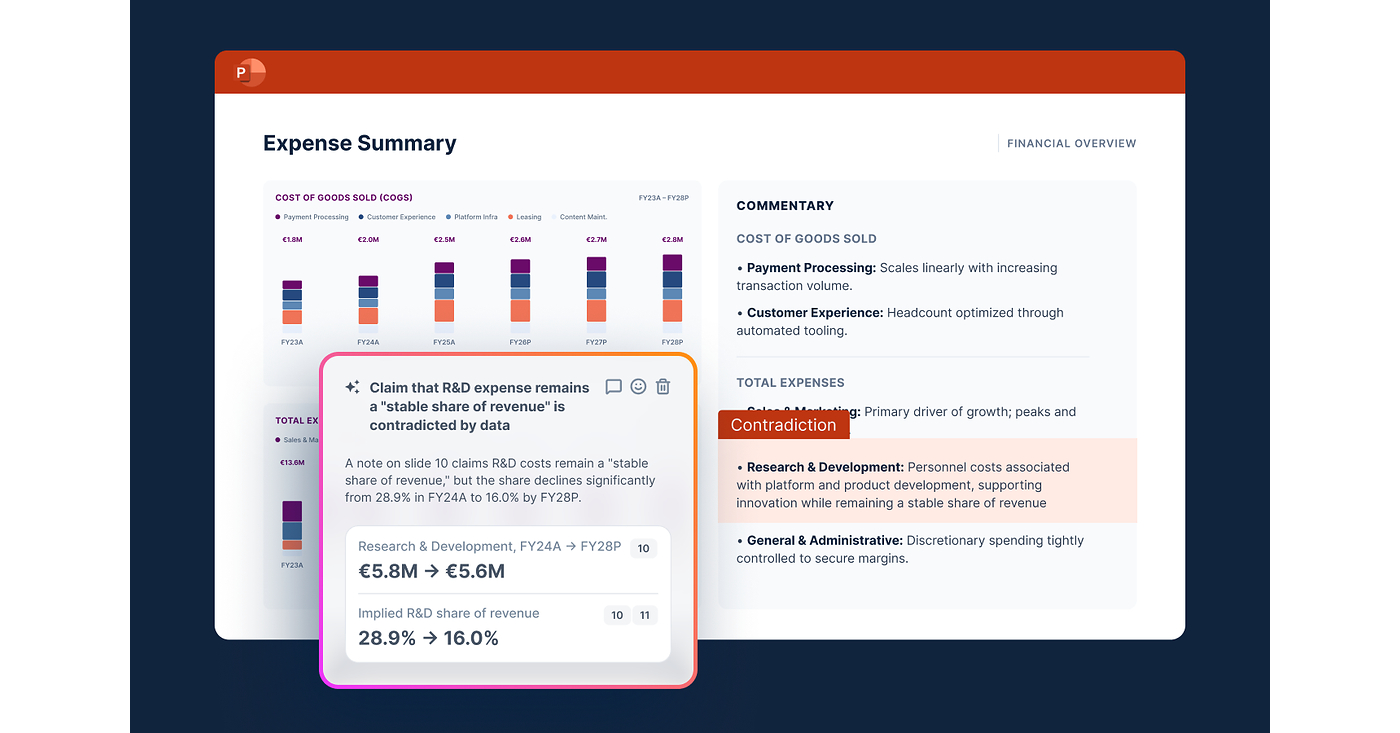
Macabacus launched Deck Check AIR, a generative-AI presentation-review tool integrated directly into PowerPoint for financial and professional-services teams. The product identifies calculation errors and logical inconsistencies in pitch books, investment-committee materials, M&A analyses and board presentations, addressing a Macabacus-reported 62% of teams that have sent AI-generated errors to clients. Deck Check AIR supports Anthropic, OpenAI and Gemini models, is available as an add-on to Enterprise deployments, and Macabacus says it neither trains on nor stores customer intellectual property.
Analysis
This is incrementally constructive for the Microsoft 365 ecosystem, but not material to MSFT earnings: Macabacus is a niche workflow vendor, and any benefit accrues through higher PowerPoint/Office stickiness rather than meaningful incremental seat revenue. The more relevant signal is that regulated finance workflows are moving from AI generation toward AI verification, a category likely to command higher willingness-to-pay because errors create reputational, compliance, and transaction-execution risk.
Over the next 1-3 months, the launch is primarily a channel-validation data point for Microsoft Copilot and enterprise AI vendors rather than a tradable MSFT catalyst. Macabacus's model-agnostic architecture reduces platform lock-in and suggests OpenAI, Anthropic, and Gemini may compete on reliability, governance, and inference cost—not merely model capability. That dynamic modestly limits the near-term monetization upside implied by a winner-take-all Copilot narrative.
The 6-18 month second-order implication is stronger for governance, audit-trail, and secure enterprise-deployment vendors than for content-generation tools. If financial institutions formalize AI review requirements, software embedded in existing analyst workflows can displace manual review hours, but adoption will depend on false-positive rates, explainability, and liability allocation. The company-reported error statistic should not be treated as independently verified demand evidence; conversion, attach rate, and renewal data are absent.
Contrarian view: investor attention remains concentrated on AI creation products, while verification may become the monetizable control layer once institutions restrict ungoverned AI use. However, native Copilot functionality or internally built review workflows could commoditize standalone add-ons, making this more a watch signal for enterprise-AI procurement than a basis for a direct public-equity trade.
AllMind Terminal
AI-powered research, real-time alerts, and portfolio analytics for institutional investors.
Request TrialMarket Sentiment
Overall Sentiment
moderately positive
Sentiment Score
0.42
Ticker Sentiment
Key Decisions for Investors
- No standalone directional MSFT trade on this announcement; the implied revenue contribution is immaterial relative to Azure, M365, and Copilot. Maintain existing MSFT exposure only if broader Copilot seat-growth and Azure AI consumption data remain intact through the next earnings cycle.
- Add an enterprise-AI governance watchlist: MSFT, NOW, PANW, CRWD, and GRC-oriented software exposure. Look for 1-2 quarters of disclosed financial-services AI-control wins, higher attach rates, or management commentary linking governance products to net retention before increasing risk.
- For MSFT, treat evidence that customers favor model-agnostic overlays over Copilot-native tools as a modest multiple-risk signal rather than an earnings risk. Reassess a long thesis if Copilot paid-seat growth decelerates while enterprise AI spend shifts toward third-party governance and orchestration layers.
- Watch for native Microsoft PowerPoint/Copilot auditing features or pricing bundles over the next 6-12 months. A native release would likely pressure niche productivity vendors, while validating workflow-level AI verification as a broader software spending category.
More News
- Goldman says these top tech stocks have plenty of upside ahead of earnings
- The AI graveyard: a running list of projects and startups that didn’t make it
- As AI Labs Burn Cash, the Real Question Is Which Suppliers Get Paid
- Microsoft's $50 Billion Gamble: Can Microsoft's Azure Growth Justify Its Exploding AI Budget?
- The PHP Meltdown Shows How AI Makes Bugs More Exploitable
- 'Father of the PlayStation' Ken Kutaragi sides with Sony on the physical discs debate