
PsychAssist.ai Launches The First Clinical Reasoning Engine for AI Psychological Assessment and Report Writing
Source: PRWeb
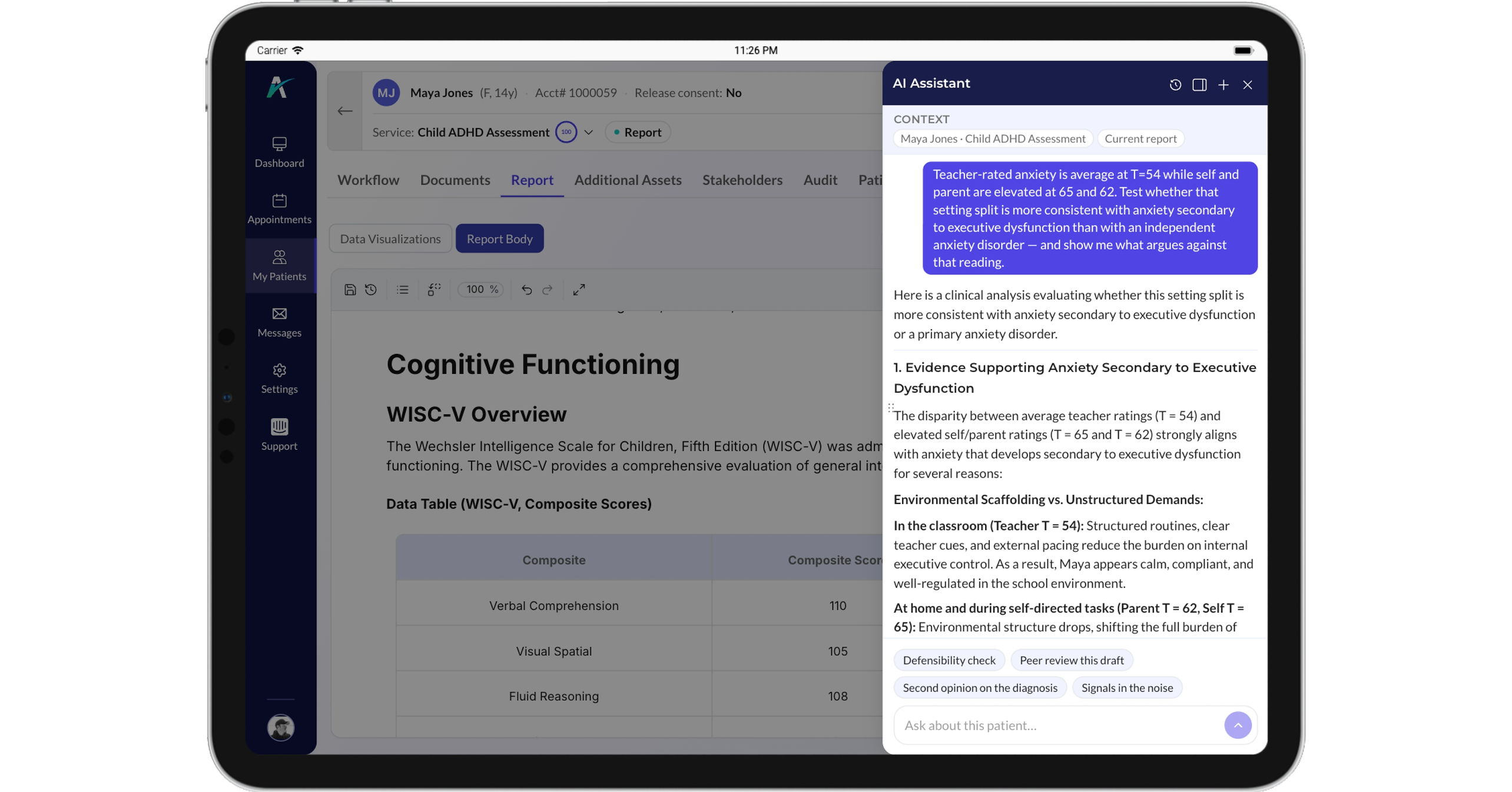
PsychAssist.ai launched an AI-assisted clinical reasoning and report-writing platform for psychological, ADHD, autism, and neuropsychological evaluations, targeting report preparation that can take longer than the underlying testing and diagnostic waitlists extending six months or more. The platform integrates psychometric scores, histories, intake data, and session observations into source-cited reports while retaining clinician approval over diagnoses and conclusions. It supports data from major assessment publishers and states that it operates under HIPAA Business Associate Agreements with no patient data retained for model training.
Analysis
This is not investable for PSO: the named company is private, and its publisher-agnostic architecture is more competitively disruptive to assessment incumbents than accretive to Pearson. If workflow adoption scales, it weakens the historical value of proprietary scoring/reporting ecosystems by making cross-vendor data interoperability the clinician-facing control point. The nearer public read-through is modestly negative for assessment publishers with software-adjacent revenue—PSO, MHS-related private assets, and WPS/PAR peers—but too immaterial to alter estimates absent evidence of enterprise deployments or pricing traction.
The key economic question is whether the product reduces report completion time enough to expand clinician throughput rather than merely lower administrative burden. In independent practices, recovered capacity can translate into incremental evaluations and revenue with limited fixed-cost growth; in hospital settings, value capture may accrue primarily to employers through shorter waitlists and lower staffing pressure. The claimed audit trail and clinician approval workflow address the principal adoption barrier, but are company assertions rather than independent evidence of diagnostic reliability, malpractice defensibility, or EHR integration quality.
Over the next 1-3 months, monitor customer wins at multi-site clinics, integration announcements with EHRs or assessment-data platforms, and disclosed pricing/retention. Over 6-18 months, the structural risk to publishers rises only if AI workflow vendors become the default interface through which test data are interpreted, creating bargaining power over publishers and potentially compressing software attachment rates. A major privacy incident, regulator guidance requiring more stringent validation, or clinician liability concerns would materially slow adoption and reinforce incumbent closed ecosystems.
Contrarian view: this category may be more constrained by clinical liability and fragmented data rights than by model quality. If publishers restrict data portability or bundle compliant AI reporting tools into existing workflows, private point solutions can be relegated to smaller practices; that outcome would be neutral-to-positive for PSO's ecosystem despite the apparent disintermediation risk.
AllMind Terminal
AI-powered research, real-time alerts, and portfolio analytics for institutional investors.
Request TrialMarket Sentiment
Overall Sentiment
moderately positive
Sentiment Score
0.42
Key Decisions for Investors
- No directional PSO position on this announcement; impact is below the threshold for an earnings-relevant trade. Reassess only if PSO discloses assessment-software attach-rate pressure, AI product response, or material customer churn over the next 2-4 quarters.
- Set an alert for enterprise deployment evidence: hospital-system contracts, EHR integrations, independently validated time savings, or pricing above a low-cost documentation-tool budget. Two or more credible multi-site wins would support a watchlist of long healthcare workflow software beneficiaries rather than a PSO short.
- For holders of PSO, monitor Education/assessment digital-services commentary at the next earnings release. A deterioration in recurring digital growth or incremental AI-related product investment without monetization would be the falsification trigger for the currently neutral view.
- Avoid extrapolating this release into broad long AI-healthcare exposure: without reimbursement linkage, revenue-recognition visibility, or a public pure-play, the immediate catalyst is promotional rather than financial.
More News
- Next week brings major risks for the stock market, just as the AI trade keeps faltering
- AI Doubts Spread Cracks in Equities, Credit Markets: Evening Briefing Americas
- Stocks Fall as Oil Rally Keeps a Lid on Treasuries
- Looters hit 3,000 French businesses. Within hours, the haul was trending on Vinted under the riot’s date
- Kinder Morgan, Energy Transfer and Williams could benefit from cheap natural gas
- CrowdStrike CEO's alarming prediction — plus, the sell-off spreads beyond tech