
Robust credit market liquidity powers increasingly competitive transactions market
Source: PR Newswire
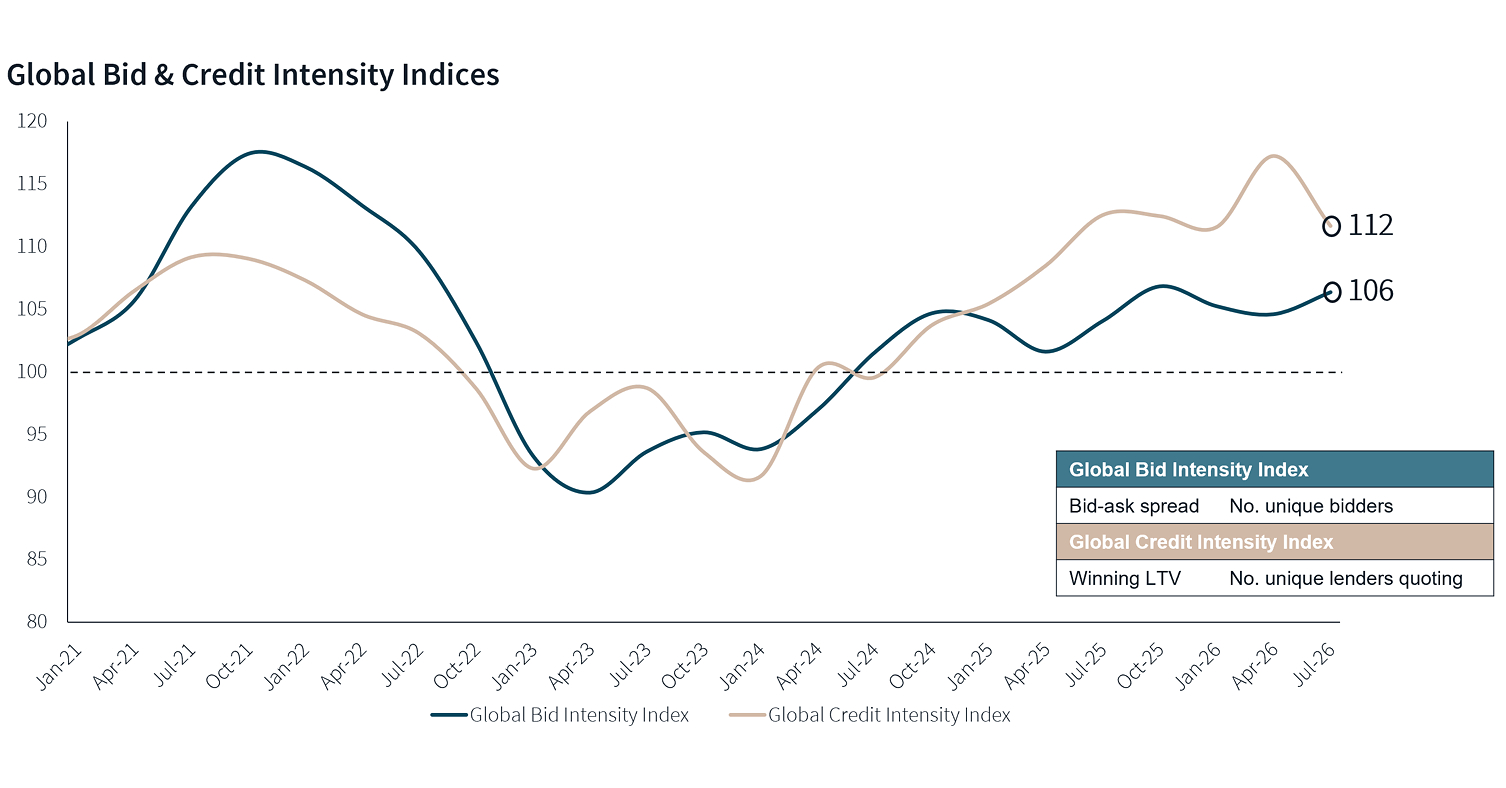
JLL reports liquidity is “back—and building,” with June showing the sharpest monthly improvement in its Global Bid Intensity Index (BII) in a year and July registering the second-highest count of unique bidders in index history. Credit remains exceptionally strong, with the Global Credit Intensity Index (CII) at 112 in July and lender competition still above 2021 record highs, though lender intensity eased slightly versus April. The bid-versus-credit intensity gap that peaked in May is now compressing, signaling a healthier pathway from financing into deal completions, even as rising U.S. bond yields continue to pressure bid-ask spreads.
Analysis
This is more a liquidity signal than a fundamental re-rate, and the first beneficiaries are the transaction toll-takers: JLL, CBRE, and to a lesser extent CWK/NMRK. Their upside is convex because a modest pickup in deal volume can translate into outsized fee growth, while the adverse selection problem in CRE eases as bid depth returns. The second-order winner is the credit intermediation chain — private credit, debt funds, CMBS placement, and refinancing desks — because a more liquid market reduces the penalty for underwriting new paper.
The losers are owners still trying to clear stale assets, especially office and tightly priced multifamily, where higher rates can still force cap-rate expansion even as more capital appears. This matters for regional banks and CRE lenders: more “liquidity” can paradoxically delay recognition of credit stress by allowing refis and extend-and-pretend structures, which is supportive in the next quarter but can prolong the overhang into 2027 if yields stay elevated. If the 10Y keeps drifting higher, the deal rebound may show up in counts before it shows up in economics.
Contrarian view: consensus may be too quick to equate better bid intensity with durable price recovery. The market can clear more transactions at lower margins for buyers and lenders without meaningfully improving net asset values, so the stock reaction in brokers may outrun the true earnings setup. The key falsifier is a re-widening in bid-ask spreads or a flat-to-down next-quarter capital markets/backlog commentary from JLL; that would mean the “liquidity” is still mostly talk, not closing flow.
AllMind Terminal
AI-powered research, real-time alerts, and portfolio analytics for institutional investors.
Request TrialMarket Sentiment
Overall Sentiment
moderately positive
Sentiment Score
0.35
Ticker Sentiment
Key Decisions for Investors
- Long JLL on pullbacks over the next 1-3 months: best direct leverage to a deal-volume rebound, with catalyst coming from capital markets and advisory fee visibility; cut if U.S. 10Y yields move to new cycle highs and CRE spreads re-widen.
- Pair trade: long JLL / short VNQ or IYR for 1-3 months — brokers monetize transaction turnover immediately, while REIT ETF exposure still faces cap-rate pressure and lower NAV support if borrowing costs stay sticky.
- Add to a broker basket (JLL, CBRE) on confirmation of better transaction comps next earnings cycle; if only one name is preferred, JLL has the more pronounced operating leverage to a marginal pickup in larger-ticket deals.
- Avoid chasing multifamily/office REITs solely on this liquidity signal; treat them as a watch item, not a buy, unless financing costs fall or same-store valuation marks stabilize.
- Set an alert on JLL next-quarter capital markets revenue and backlog: if those metrics do not inflect, the market is likely overpricing the durability of the liquidity rebound.
More News
- Gap sees executive exit as catalyst to rebuild struggling Athleta unit
- Pilot killed in attacks by Iran-backed Houthis on Riyadh airport; Saudi-led coalition vows 'firm' response
- Why is T-Mobile stock tumbling today?
- This exchange stock is a buy on renewed options deal, Morgan Stanley says
- The AI race may be decided by financing—not just better chips
- Why is Verizon stock sliding today?
From AllMind Research
- Anthropic IPO Preview: Valuation, Timing, and What to Watch
- Shein After the IPO: Venue, Valuation, and What Must Be Proved
- What AI Research Tools Should a Small Hedge Fund Buy First?
- The Great Divergence: North American Banking at the Crossroads of Monetary Policy and Agentic AI (Q4 2025 Bank Earnings)
- AI for M&A Target Screening: From Universe to Deal File