
Seoul National University of Science and Technology Researchers Develop AI Framework for Optimizing Solid Oxide Electrolysis Cells
Source: PR Newswire
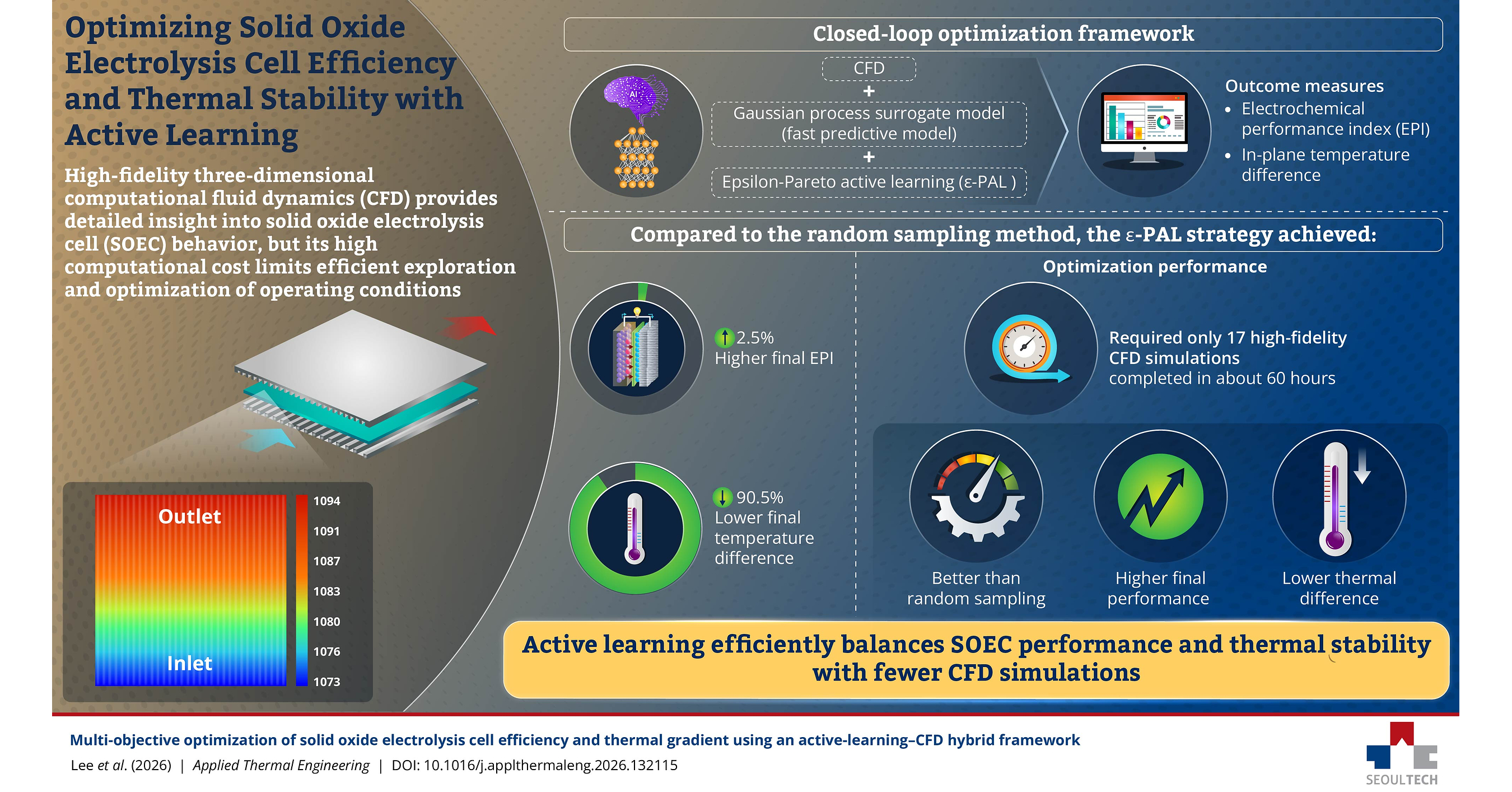
Researchers at Seoul National University of Science and Technology developed an AI-guided optimization framework for solid oxide electrolysis cells that improves the electrochemical performance index (EPI) by 14% while cutting in-plane temperature differences by 80% versus a baseline. The approach uses only 17 high-fidelity CFD simulations (about 60 compute hours) versus 6,561 simulations (~22,963.5 compute hours) for an exhaustive search, while still achieving a 2.5% higher final EPI and a 90.5% lower final temperature difference. While not a commercial deployment, this significantly reduces development-cycle costs for green hydrogen systems and could accelerate related clean-energy engineering.
Analysis
This is more meaningful for the engineering stack than for hydrogen end-demand. The near-term market impact is likely muted because the bottleneck in green hydrogen is still power cost, stack durability, and project financing; shaving simulation time does not change the economics of a merchant hydrogen plant by itself. The first-order beneficiary is whoever monetizes the design workflow: simulation software, digital-twin vendors, and HPC/AI infrastructure that gets embedded into materials and process optimization.
Second-order, the framework lowers the barrier to entry for smaller electrolyzer developers by shrinking the cost of iterating toward a viable operating envelope. That is negative for moat and pricing power across the SOEC niche over a 6-18 month horizon, because faster optimization narrows the advantage of teams with large internal modeling budgets. It also modestly favors large industrial incumbents and project developers with the balance sheet to move from lab optimization to pilot deployment once the physics looks good.
The contrarian view is that the market may over-read this as a hydrogen commercialization catalyst when it is really a productivity improvement in R&D. If anything, the thesis is stronger for software/AI-enabled engineering than for hydrogen hardware; the latter still needs cheap electrons and bankable offtake contracts before the capex cycle turns. What would falsify even that modest positive read is continued evidence that deployment decisions are driven by electricity prices and policy subsidies rather than engineering iteration speed.
AllMind Terminal
AI-powered research, real-time alerts, and portfolio analytics for institutional investors.
Request TrialMarket Sentiment
Overall Sentiment
moderately positive
Sentiment Score
0.45
Key Decisions for Investors
- No immediate trade in hydrogen hardware; keep BE/PLUG/Ceres-style exposures on a watchlist until there is evidence of commercial pilots or procurement tied to SOEC performance rather than academic optimization.
- Small long bias in engineering simulation software over 6-18 months: ANSS or SNPS on the thesis that AI-guided CFD/workflow automation expands addressable spend faster than it displaces it; risk/reward improves if management starts talking about energy/materials design wins.
- Pair trade: long LIN / short high-burn hydrogen OEM basket (e.g., PLUG, BE) for a 3-12 month horizon. If green hydrogen economics improve, the low-cost-capital incumbent should capture project scale-up; if the thesis stalls, the shorts retain financing risk.
- Set an alert for the next major SOEC pilot, utility-scale offtake, or government grant announcement. If none appears within 1-2 quarters, treat this as a productivity story rather than an investable demand catalyst.
- Falsifier for any constructive hydrogen read: falling natural-gas-linked hydrogen costs or continued stack degradation headlines. If project economics don’t improve versus incumbent gray hydrogen, the optimization gain is likely to stay in the lab.
More News
- Nvidia GPUs are everywhere. Here are the ways companies are accessing them
- India unveils tough curbs on dollar demand to defend rupee
- Bank of America is bullish on these top stocks ahead of earnings
- Stocks were up this week. Here are the names that are now overbought
- As companies pour billions into Earth-based AI infrastructure, Google is taking the data center race off-planet
- AI's Supercharging a Scam Economy Bigger Than the Cocaine Trade
From AllMind Research
- Anthropic IPO Preview: Valuation, Timing, and What to Watch
- Shein After the IPO: Venue, Valuation, and What Must Be Proved
- What AI Research Tools Should a Small Hedge Fund Buy First?
- Bitcoin's 52% Crash Proves It's a Tech Stock: Here's What That Means for Portfolio Construction
- What Is an AI Investment Research Platform?