
Sirolimus-Coated Balloon Matches Drug-Eluting Stent at One Year in Large International TRANSFORM II Trial
Source: PR Newswire
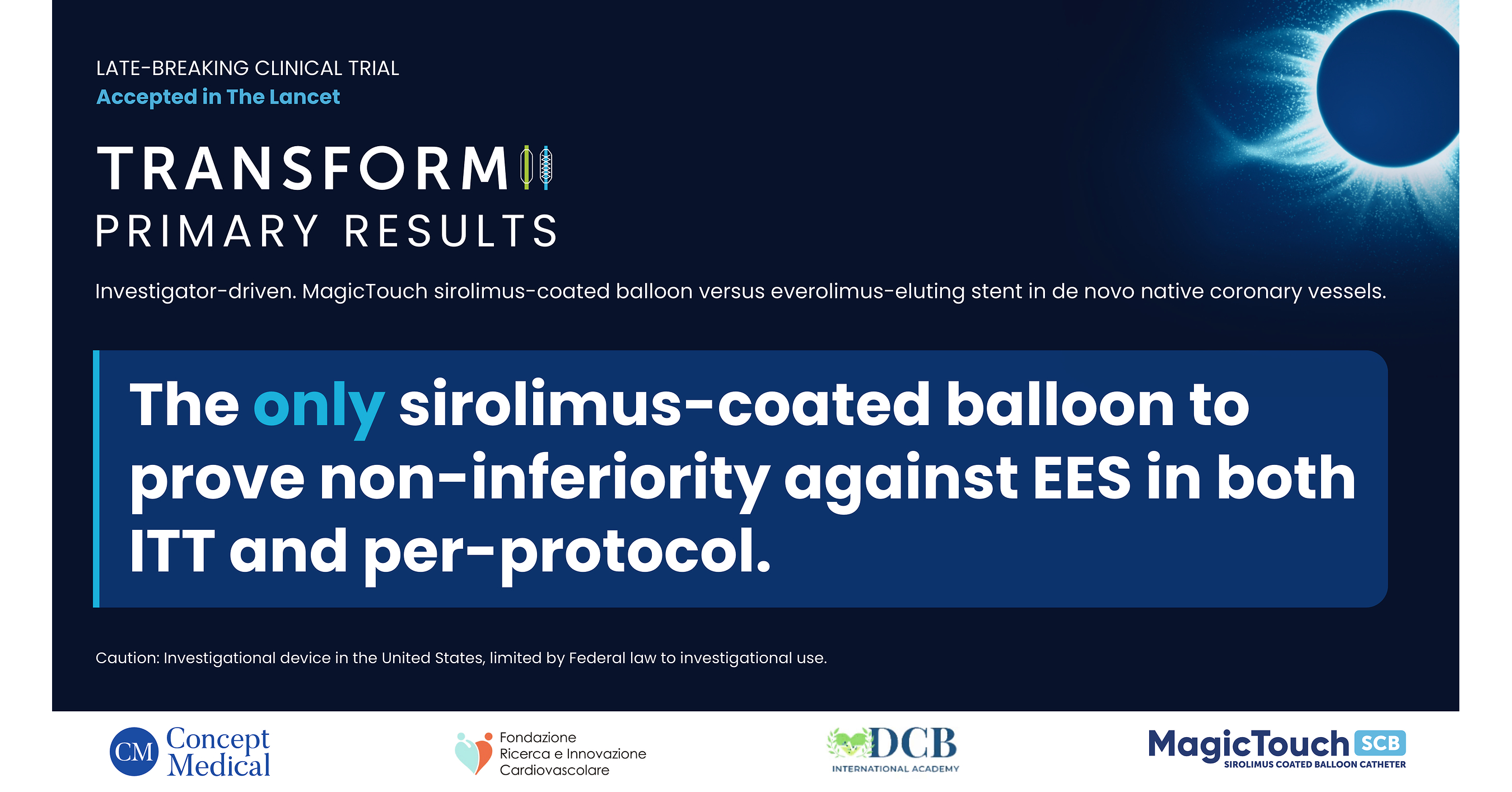
In the 1,842-patient TRANSFORM II trial, the MagicTouch sirolimus-coated balloon strategy was non-inferior to everolimus-eluting stents for 12-month target lesion failure: 2.1% vs 2.4%, with a risk difference of −0.40 percentage points and P=0.004 for non-inferiority. Bailout stenting was required in 7.6% of balloon-assigned patients; any target lesion revascularisation was higher with the balloon (2.5% vs 1.1%), while ischaemia-driven revascularisation was similar. Results apply to lesions suitable for successful preparation; five-year follow-up is planned, and the device remains investigational in the United States.
Analysis
The result improves the credibility of drug-coated balloons as a treatment strategy, but it does not yet establish broad stent displacement. The key commercial constraint is selection: randomization followed successful lesion preparation, and participating centers were experienced. That limits near-term adoption outside specialist operators and makes training, lesion-preparation workflow and bailout-stent readiness part of the product proposition—not just the balloon itself.
For established DES suppliers such as Abbott, Boston Scientific and Medtronic, the immediate revenue risk appears limited: the trial does not show a clinical advantage, and the studied population excludes several challenging lesion types. The longer-term risk is erosion of stent use in lesions suitable for preparation, particularly if five-year follow-up confirms fewer late device events or practice guidelines endorse the strategy. Conversely, the broad confidence interval, low event rates and higher rate of any target-lesion revascularization with the balloon leave meaningful uncertainty; the similar ischemia-driven revascularization rates are more reassuring but do not settle durability.
The claimed bleeding-related appeal should not be capitalized into a DAPT-duration thesis yet: major bleeding was low and similar, and the numerical net-adverse-event difference was not conclusive. U.S. commercial impact also requires a regulatory pathway beyond the current investigational status. With no supplied public-company mapping for Concept Medical, this is a category signal rather than a direct listed-equity catalyst.
AllMind Terminal
AI-powered research, real-time alerts, and portfolio analytics for institutional investors.
Request TrialMarket Sentiment
Overall Sentiment
mildly positive
Sentiment Score
0.25
Key Decisions for Investors
- No immediate trade in diversified stent makers on this release alone. Avoid shorting Abbott, Boston Scientific or Medtronic absent evidence of meaningful balloon adoption or revised coronary-device guidance.
- Over the next 1–3 months, track full Lancet publication and conference details for protocol, lesion-preparation criteria, bailout rates by subgroup, antiplatelet regimens and any evidence of operator-selection effects.
- Treat five-year follow-up and U.S. regulatory progress as the material 6–18 month catalysts. Reassess only if durable clinical separation, guideline changes or adoption data indicate a credible shift in procedure mix.
- Falsifiers for the displacement thesis: no reduction in late events at extended follow-up, persistent excess in clinically driven revascularization, limited use beyond expert centers, or a U.S. regulatory delay.
More News
- Marvell to buy Lumentum in $115 billion deal in AI data-center bet
- Marvell, Lumentum tout historic $115B deal to create ‘category leader' in AI connectivity
- Palantir reports booming U.S. commercial revenue growth, topping government for first time
- Anthropic releases amended IPO prospectus with third-quarter financials
- Coinbase has been battered over the past month. Morgan Stanley says steer clear
- The AI boom is facing another supply crunch. This time it’s the amount of capital available to feed Silicon Valley’s endless need for cash
From AllMind Research
- AllMind Platform Feature Updates - Fall 2026
- AI Credit Covenant Monitoring: From Clause to Review
- AI-Led Expert Interviews vs. Transcript Libraries
- Augmented Intelligence: AllMind, Elevate Human Judgement With an Accessible, Powerful, Data-Driven Financial AI Toolkit
- Choosing an AI Copilot for Equity Research