
Trump Remains Bullish on AI, Even as White House Debates Regulation and Risk
Source: Bloomberg
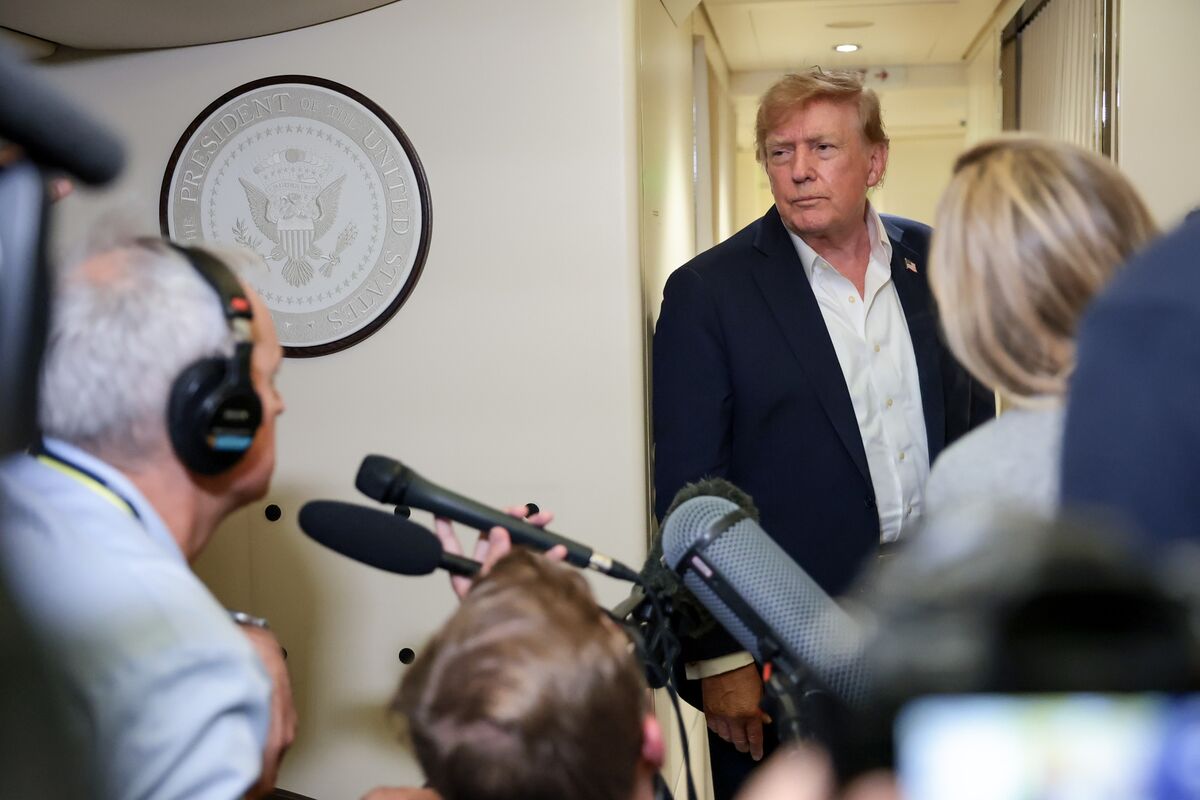
Donald Trump remains supportive of continued AI development despite warnings from technology executives that humanity could lose control of the technology. The White House is debating AI regulation, creating policy uncertainty, but Trump’s stance suggests limited near-term restrictions on the sector.
Analysis
The relevant equity transmission is not broad "AI optimism" but a lower near-term probability of binding federal constraints on model deployment, data-center buildout, and enterprise adoption. That favors the capex beneficiaries with already-contracted demand—NVDA, AVGO, VRT, ETN, GEV and CEG—more than software companies whose AI revenue remains largely embedded in premium valuations. The second-order beneficiary is U.S. power infrastructure: regulatory permissiveness can accelerate load interconnection requests, but it also raises congestion and power-cost risk for hyperscalers (MSFT, GOOGL, AMZN, META) over the next 12-24 months.
The market may underprice the political asymmetry: a permissive federal posture does not eliminate state privacy, consumer-protection, copyright, procurement, or antitrust exposure. A high-profile safety incident, election-related deepfake episode, or evidence of labor displacement could rapidly shift the debate toward targeted liability rules; application-layer names with consumer-facing exposure would be more vulnerable than component suppliers. Over 1-3 months, the cleaner catalyst remains hyperscaler capex guidance and utility interconnection updates, not Washington headlines; over 6-18 months, the key question is whether AI revenue monetization catches up with infrastructure depreciation.
Contrarian risk is that reduced regulation may worsen the return profile for model developers by lowering barriers to entry and accelerating open-source substitution. This makes a blanket long of AI software less attractive than owning bottleneck assets—networking, power conversion, cooling, generation and grid equipment—where physical capacity and qualification cycles preserve pricing. The thesis is falsified if hyperscaler 2027 capex guidance is cut, data-center power projects are delayed, or NVDA/AVGO order commentary points to inventory digestion rather than supply constraint.
AllMind Terminal
AI-powered research, real-time alerts, and portfolio analytics for institutional investors.
Request TrialMarket Sentiment
Overall Sentiment
mildly positive
Sentiment Score
0.15
Key Decisions for Investors
- Maintain a 3-6 month overweight in AI physical bottlenecks via long VRT and ETN, funded by a relative short in the IGV software ETF. Target 10-15% relative upside if data-center capex remains intact; exit if either company cuts data-center order growth or if hyperscaler capex guidance declines by more than 10%.
- Prefer long GEV and CEG over a broad long in hyperscalers for a 6-18 month power-demand expression. Use staged entries around utility/interconnection announcements; principal risk is project-delay inflation or regulatory resistance to rate-base recovery.
- Do not add directional exposure solely on political rhetoric. Establish an alert around MSFT, AMZN, GOOGL and META quarterly capex guidance: sustained aggregate growth above 20% supports infrastructure longs, while a synchronized moderation would warrant reducing NVDA, VRT and ETN exposure.
- For a defined-risk hedge against an AI regulatory shock, consider 6-month put spreads on IGV or a long IGV-put/short SOXX-put ratio only after a sharp AI-software rally. Consumer-facing software has greater policy and litigation beta than semiconductor infrastructure, but this is a hedge rather than a base-case short.
More News
- What investors need to know about Alphabet's stock-busting earnings report
- Our next steps for Alphabet stock after earnings disappoint at nearly every turn
- Budget 2026 speech
- The UK cuts energy bills, taxes banks and boosts defense in high-stakes budget
- Microsoft's Big Bets on AI Start to Pay Off
- Asian shares fall as Alphabet earnings miss drags Wall St futures lower