
QuantalRF Samples DPD-Efficient Linear Wi-Fi 7 and Wi-Fi 8 FEM with Up to 3dB More Mask-Compliant Power at 160 and 320 MHz
Source: PR Newswire
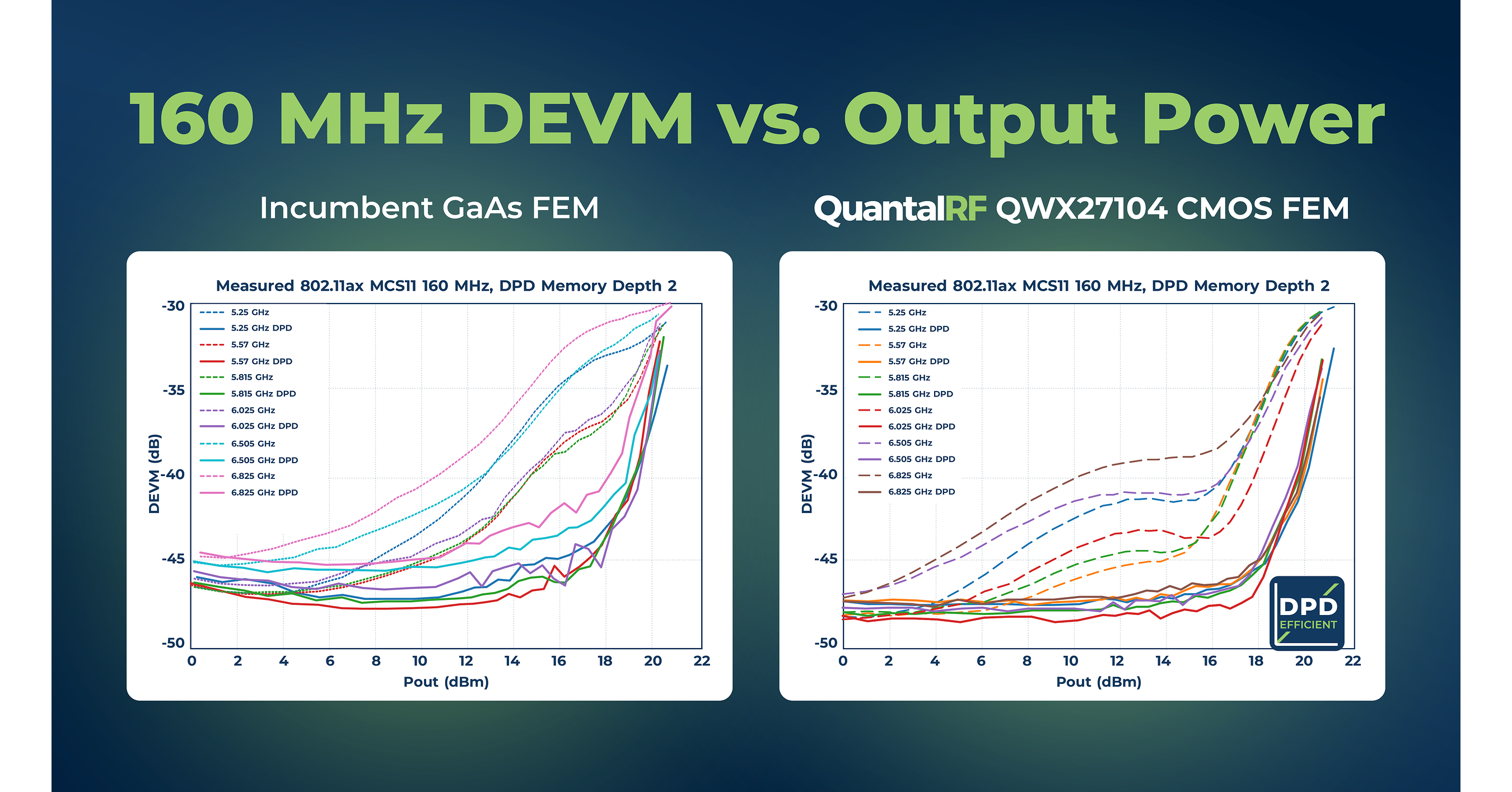
QuantalRF announced the QWX27104 linear CMOS RF-SOI FEM aimed at Wi‑Fi 7/8 (5150–7125 MHz), claiming up to 3 dB more mask-compliant output power versus conventional GaAs FEM approaches while requiring a lower-order DPD engine. It reports <0.5 dB EVM variation across channels at 160 MHz and, at 320 MHz, <−47 dB EVM up to 16 dBm with spectral-mask limitation at 19.5 dBm (~3 dB higher where conventional designs drop below −40 dB EVM). Samples and evaluation kits are available now, with volume production scheduled for Q1 2027.
Analysis
The economic value is not the press release itself; it is the potential to shift RF front-end economics away from GaAs incumbents toward OEMs and platform vendors that care about battery life, thermal headroom, and board area. If the claimed linearity holds outside the lab, the first-order losers are QRVO and SWKS-style incumbent FEM suppliers, because the industry can tolerate less DPD complexity and still hit compliance at wider channels. That means the market risk is margin compression before unit share loss: OEMs will use this architecture as a pricing lever even if adoption is slow.
Near term, this is a qualification story, not a revenue story. The real catalyst window is 6-18 months, gated by handset/router design wins, certification, and whether performance survives temperature, mismatch, and channel-to-channel variability in production silicon. A false positive here would be if competing GaAs vendors close the gap with incremental process tuning or if OEMs decide the integration trade-off is not worth requalifying late-cycle platforms.
Contrarian view: consensus may be overestimating how quickly a technically superior front end displaces entrenched supply chains. More likely, the announcement becomes a negotiating tool that squeezes incumbent pricing before it meaningfully changes mix. There is no direct read-through to TGT; the actionable signal is in RF component margins, not retail demand.
AllMind Terminal
AI-powered research, real-time alerts, and portfolio analytics for institutional investors.
Request TrialMarket Sentiment
Overall Sentiment
mildly positive
Sentiment Score
0.25
Key Decisions for Investors
- No immediate trade in TGT; there is no direct earnings sensitivity from this RF front-end development.
- Put QRVO and SWKS on a 6-12 month negative watch: if either reports Wi-Fi FEM mix down or gross-margin pressure tied to next-gen Wi-Fi ramps, initiate a small short with a 2:1 downside-to-upside setup.
- Preferred relative-value expression: long AVGO / short QRVO on first evidence of tier-1 OEM design wins, since the value transfer is more likely to accrue to integrated platform vendors than to concentrated FEM suppliers.
- Do not buy puts now on the announcement alone; wait for qualification evidence. If a major OEM confirms adoption, consider Jan-2027 QRVO or SWKS put spreads as a slower-burn structural hedge.
- Set a falsifier alert: if incumbents keep guideposts stable through the next two reporting cycles, assume the architecture is still a bargaining chip rather than a substitution threat.
More News
- Here are Friday's biggest analyst calls: Nvidia, SpaceX, Tesla, Apple, Mobileye, EchoStar, Toll Brothers & more
- Amid rising streaming subscription costs, here are 3 strategies CNBC staffers use to save
- Christine Lagarde: IMFC Statement
- Palantir patient data tech rejected by many NHS trusts in England
- Why did CoreWeave stock get crushed this week? Look to this corner of the debt market for clues
- Diageo's Toxic Spill Hits Pristine River in Scottish Whisky Country