
Global Zero Trust Security Heads for USD 162.08 Billion by 2034 as New Maximize Market Research Analysis Tracks 16.4% Growth
Source: PR Newswire
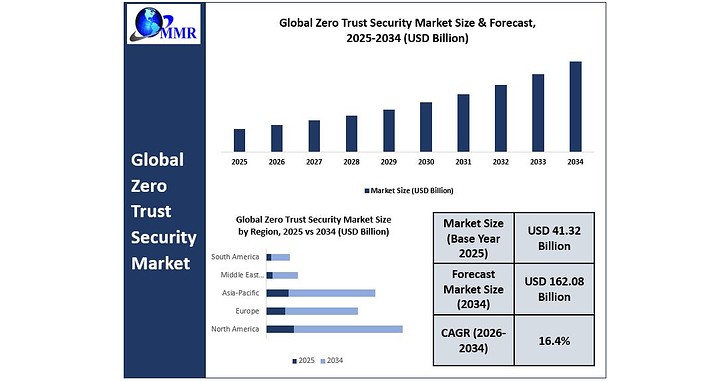
Maximize Market Research forecasts the global Zero Trust Security market will grow from $41.32 billion in 2025 to $162.08 billion by 2034, a 16.4% CAGR. Demand is being driven by cloud migration, remote and hybrid work, rising cyber threats, and adoption of identity-first controls, MFA, endpoint protection, AI security analytics, and automated incident response. North America remains the largest market, while Asia-Pacific is expected to be a key growth region; implementation complexity and legacy-system integration remain restraints.
Analysis
This is not a near-term earnings catalyst: third-party TAM forecasts are promotional, broad, and too distant to alter estimates. The investable question is whether zero-trust spend consolidates into platforms or remains fragmented. Procurement teams facing integration and staffing constraints are likely to favor vendors that bundle identity, endpoint, SASE, cloud posture, and automation into an existing control plane—supporting attach rates and retention for PANW and MSFT more than pure-play point solutions.
PANW is the clearest operating beneficiary if platformization persists: displacement of multiple tools can convert security-budget reallocation into larger multi-year commitments and lower sales friction. MSFT has the strongest distribution advantage through Microsoft 365, Entra, Defender and Azure; its security gains are financially immaterial at the consolidated level but can pressure standalone identity and endpoint vendors' net retention. The second-order loser is OKTA, where identity remains strategically essential but bundle competition raises discounting risk unless it demonstrates durable independent-workload and privileged-access expansion.
Over 1-3 months, the relevant catalysts are billings/RPO, remaining performance obligations, and NRR commentary—not market-research headlines. Over 6-18 months, AI-driven security operations may favor vendors with proprietary telemetry and automated remediation, but also compress differentiation for dashboard-only products. The bullish platform thesis is falsified by renewed best-of-breed buying, declining PANW platform deal sizes, or material security-suite price concessions; a broad IT-spending slowdown would defer implementation-heavy projects despite elevated breach risk.
Contrarian view: the market may over-credit zero trust as incremental spend. Much of the budget is a migration from legacy VPN, firewall, and endpoint tools, so revenue upside accrues only where vendors capture displaced spend rather than merely relabel installed products. No standalone trade should be initiated from this release; use it as a framework for upcoming earnings and channel checks.
AllMind Terminal
AI-powered research, real-time alerts, and portfolio analytics for institutional investors.
Request TrialMarket Sentiment
Overall Sentiment
moderately positive
Sentiment Score
0.42
Ticker Sentiment
Key Decisions for Investors
- Maintain a 6-12 month long PANW / short OKTA pair, sized beta-neutral. Thesis is security-platform consolidation and identity bundle pressure; target 15-20% relative return, with exit if PANW reports two quarters of weakening platform ARR/deal-size trends or OKTA reaccelerates NRR and large-customer growth.
- Accumulate PANW on post-earnings weakness only if next-quarter billings and RPO remain above consensus while management confirms consolidation-driven wins. Prefer cash equity over options given the absence of a dated catalyst; risk is a multiple reset if federal/enterprise deal timing slips.
- Use MSFT as a lower-volatility cybersecurity exposure rather than a pure security trade over 6-18 months. Add only on evidence that Entra/Defender attach is expanding without incremental discounting; security upside alone is unlikely to move consolidated earnings materially.
- Place an alert on OKTA for guidance revisions, dollar-based net retention, and large-customer additions at its next two reports. A long becomes actionable only if retention stabilizes and management shows wins against bundled suites; otherwise avoid catching a structurally pressured multiple.
- Avoid treating CRWD, ZS, NET, FTNT, CHKP, CSCO, AKAM, RPD, and VRNS as direct beneficiaries without company-specific evidence. Monitor their billings, pricing, and platform-attach disclosures for confirmation of incremental budget capture versus replacement spending.
More News
- How Meta took the lead in the race for the post-smartphone world
- Meta's standoff with Amazon over Muse could be a sign of things to come
- Why ASEAN’s coming digital economy trade agreement deserves your attention
- Wall Street falls as oil prices, Treasury yields rise
- Meta is having a ChatGPT moment with Muse. What is it and what makes it so special
- Microsoft to Spend $10 Billion in Gulf Through 2030