
OAV: Used-Vehicle Asking Prices Cut an Average 2.5% Over Four Weeks Across 1.43 Million U.S. Dealer Listings
Source: PRWeb
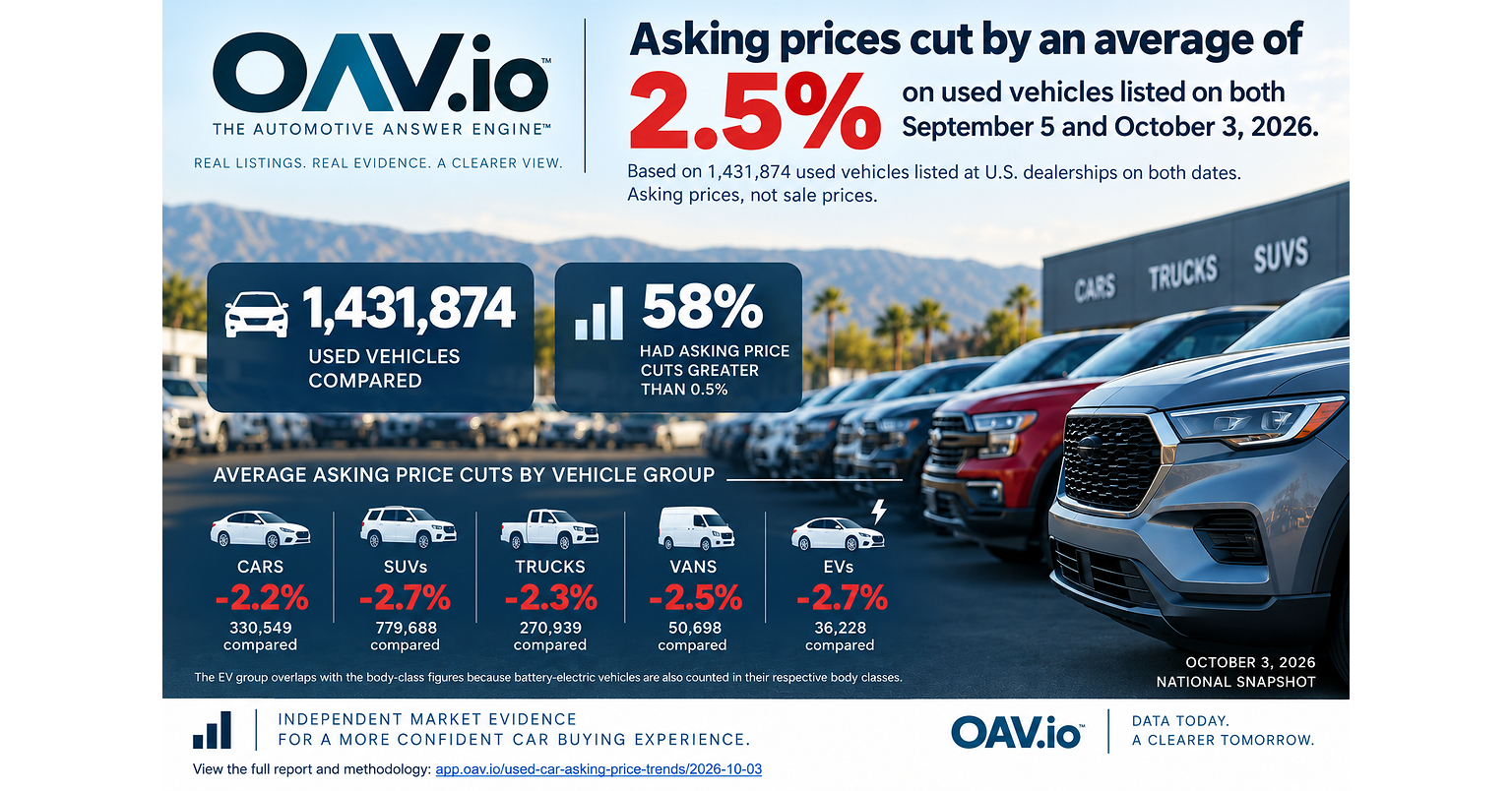
OAV.io found that asking prices for 1,431,874 used vehicles listed on both September 5 and October 3, 2026, fell an average 2.5% over four weeks; 58% had cuts greater than 0.5%. SUVs and battery-electric vehicles each averaged 2.7% cuts, while vans fell 2.5%, trucks 2.3% and cars 2.2%. The figures cover dealer asking prices—not sale prices—and exclude vehicles no longer listed on October 3.
Analysis
The useful signal is breadth, not the headline average: markdowns across body classes are consistent with dealers using price to clear or reposition inventory, but this is not evidence that transaction prices or unit demand fell. The panel includes only vehicles listed at both endpoints; cars that sold, were withdrawn, or otherwise disappeared are excluded. Asking-price changes can therefore diverge materially from market-clearing prices and dealer economics.
If this pattern persists alongside rising days’ supply and weaker auction values, used-car retailers face a two-sided squeeze: markdowns pressure gross profit per unit, while falling wholesale values impair inventory bought at higher marks. Conversely, faster repricing and cheaper replenishment could limit the damage. CarMax, Carvana, AutoNation, Lithia Motors and Penske are exposed through different mixes of used, new and wholesale activity; do not treat this snapshot as equivalent company-level evidence. A second-order risk is weaker used-vehicle collateral and residual values, relevant to auto lenders and lessors, especially if delinquencies also rise. Lower used prices may help affordability and support demand, so this is not uniformly bearish for automotive volumes.
Near term, the report is a sentiment input, not a standalone catalyst. Over 1–3 months, confirm against auction-value indices, dealer inventory days, realized used-car gross profit and company commentary. Over 6–18 months, persistent EV markdowns could weigh on residual assumptions and lease economics, but this small EV sample and asking-price-only measure do not establish that trend. The contrarian point: broad markdowns may reflect active price discovery and improve future inventory costs rather than signal collapsing demand.
AllMind Terminal
AI-powered research, real-time alerts, and portfolio analytics for institutional investors.
Request TrialMarket Sentiment
Overall Sentiment
mildly negative
Sentiment Score
-0.25
Key Decisions for Investors
- No directional trade on this release alone. Keep used-auto retailers on watch rather than shorting the group: the report lacks sale prices, inventory-turn data and company-level margin exposure.
- Treat a short thesis on CarMax or Carvana as conditional: require corroboration from weaker auction values plus rising inventory days or falling realized used-car gross profit. Reassess if those measures stabilize or retailer guidance indicates lower acquisition costs are offsetting markdowns.
- Monitor auto lenders and lessors for a second-order signal, not an immediate short: deterioration in used collateral values becomes actionable only if accompanied by rising delinquencies, loss severity, or lower residual-value assumptions.
- Use the next several weekly snapshots as a persistence check. A reversal in markdown breadth, or evidence that price cuts are concentrated in listings that remain unsold, would weaken the demand-downshift interpretation.
More News
- GIC Private Ltd, Medline 10% owner, sells over $721m in shares
- A 32% beat, a +6% jump: the IT solutions name our models picked in July
- Nvidia Is on the Verge of a $6 Trillion Market Value
- Controversial $110 billion mega-merger of Paramount and Warner Bros. finally closes
- What Marvell's rosy long-term guidance means for our AI chip stocks
- Analysis-Vietnam’s banks tap investors for $7 billion as economy runs red hot
From AllMind Research
- Anthropic IPO Preview: Valuation, Timing, and What to Watch
- Shein After the IPO: Venue, Valuation, and What Must Be Proved
- What AI Research Tools Should a Small Hedge Fund Buy First?
- Choosing an AI Copilot for Equity Research
- Weekly Update: Advanced Search Filters, Redesigned Ticker Dashboard, and Improved Search Experience