
Santé Raises $15M Series A to Expand the First AI Operating System for Wine & Spirits Retail
Source: PR Newswire
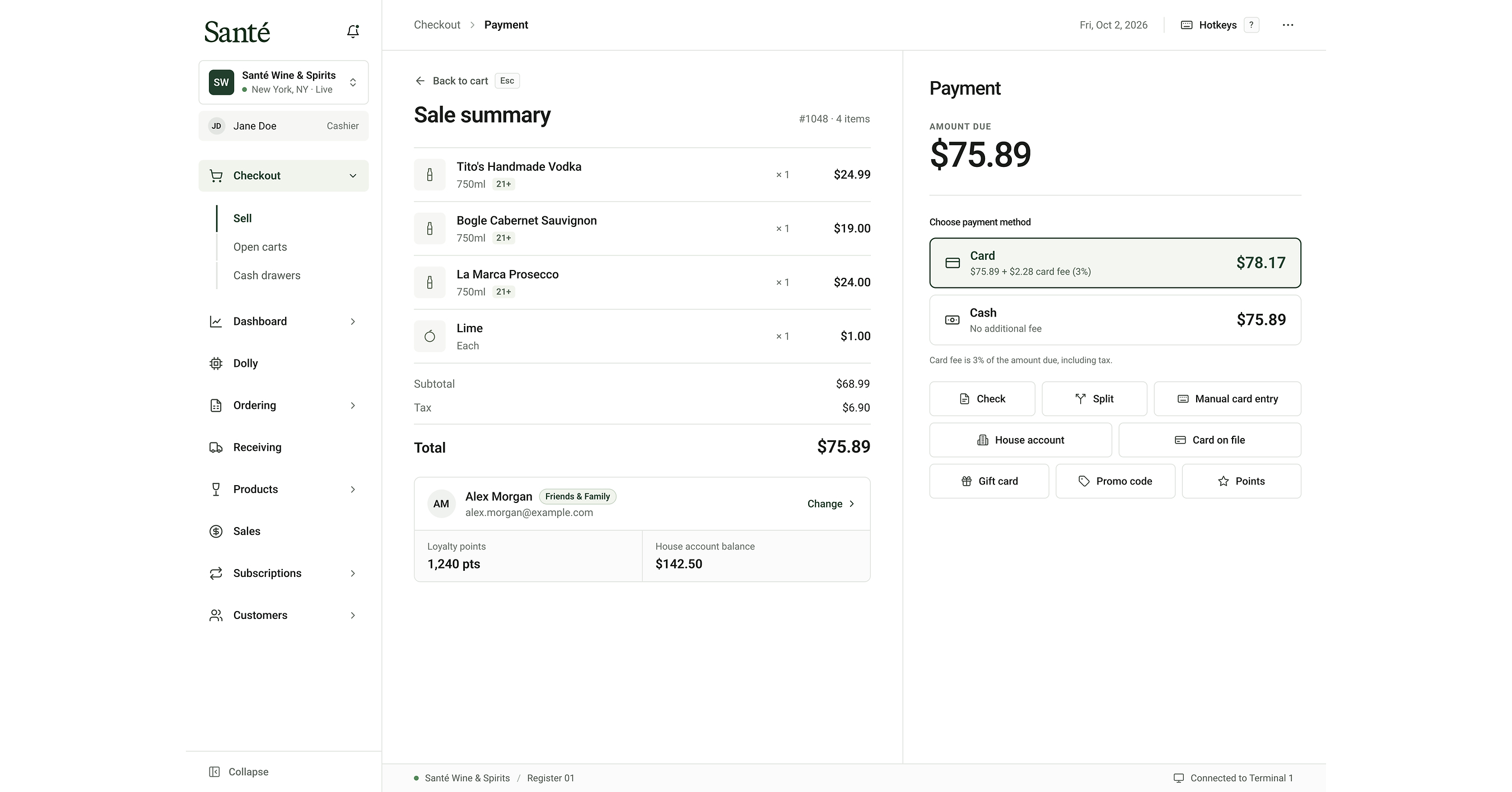
Santé raised a $15 million Series A led by FINTOP, six months after its $7.6 million seed round. The company says it grew 500%, now serves nearly 1,000 retailers, and processes $2 billion in annual GMV; it plans to expand its AI tools for wine and spirits retailers. The financing and reported growth are positive for the privately held company, with limited direct public-market impact.
Analysis
Investment view: This is a private-company validation signal, not a standalone catalyst for the mapped public names. Santé’s retailer GMV is not its revenue: the release gives no ARR, take rate, retention, customer-acquisition cost, or independently verified store-level economics. The headline growth rate is also undefined by metric and base period, so it should not be capitalized as recurring software growth.
Competitive effects: If the platform becomes a system of record, item-level sales and inventory data could improve ordering and reduce retailers’ dependence on manual distributor workflows. That may strengthen retailer purchasing discipline while shifting some influence from distributor reps toward software recommendations. The advantage depends on accurate catalogs, distributor integrations, and state-by-state compliance; each can make rollout costly and limit margins despite attractive software economics. Delivery integrations could lower ordering friction and add alcohol orders for DoorDash (DASH), Uber Technologies (UBER), and Instacart (CART), but the release offers no evidence of incremental volume or favorable platform economics. The more consequential risk for delivery platforms is a POS layer gaining customer and transaction context—not a demonstrated near-term displacement.
Timing and contrarian view: Near term, treat the announcement as venture-marketing evidence rather than a listed-equity earnings catalyst. Over 1–3 months, verify retailer additions, paid product adoption, and whether “AI” features drive measurable sell-through or labor savings. Over 6–18 months, successful workflow ownership could create switching costs and enable payments or financing monetization, but embedded-fintech revenue and credit exposure are unquantified. The market may overread GMV as revenue; conversely, vertical-specific compliance and inventory data could create a durable niche moat if retention is strong. Thesis weakens if adoption stalls, integrations prove unreliable, or retailers do not realize measurable margin or labor benefits.
AllMind Terminal
AI-powered research, real-time alerts, and portfolio analytics for institutional investors.
Request TrialMarket Sentiment
Overall Sentiment
moderately positive
Sentiment Score
0.55
Key Decisions for Investors
- No direct public-equity trade on this release: Santé is private, and disclosed operating metrics do not establish monetizable revenue or unit economics.
- Keep DASH, UBER, and CART as watch-only exposures; look for verifiable alcohol-order growth and evidence that POS aggregation expands orders rather than merely reroutes existing demand before attributing earnings impact.
- For a private-market diligence screen, request ARR and growth definitions, gross retention/net revenue retention, paid AI attach rates, retailer cohorts, implementation costs, and payments/credit contribution; treat GMV and company-reported growth as insufficient proxies.
- Reassess over the next 1–3 months if Santé discloses customer retention or measured inventory/labor outcomes; a lack of such evidence, or weak retailer adoption, would undercut the software-moat thesis.
More News
- Uber is spending $2.3B to get into catering
- Uber delivery workers will pick up bigger restaurant orders as it enters catering
- RAG Foundation May Hold the Key to a German Chemicals Champion
- Uber to buy ezCater for $2.3bn to bring workplace catering to Uber Eats
- Lucid production falls 38% as the EV maker clears inventory
- Uber to buy catering platform ezCater in $2.3 billion all-cash deal
From AllMind Research
- Anthropic IPO Preview: Valuation, Timing, and What to Watch
- Shein After the IPO: Venue, Valuation, and What Must Be Proved
- What AI Research Tools Should a Small Hedge Fund Buy First?
- AI Vendor Landscape for Institutional Investment Teams
- AllMind Fixed Income Compass for October 2025: Navigating Policy Divergence and Political Risk