
Pronto Corporation Launches Fan-Responsive, Guaranteed-Seat University of Nebraska Huskers Shuttle Service
Source: PR Newswire
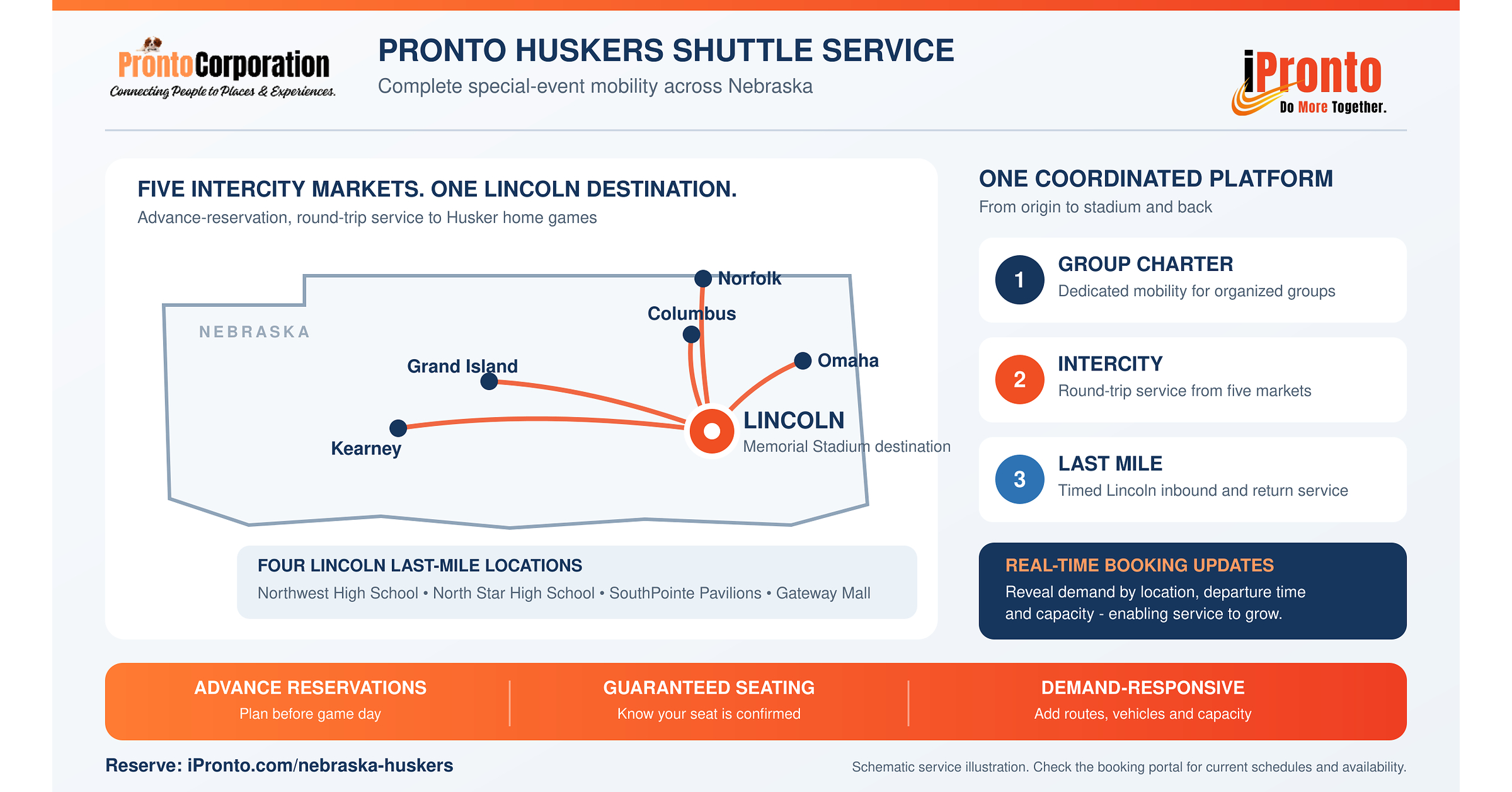
Pronto Corporation launched the Pronto Huskers Shuttle Service for Nebraska home games at the Memorial Stadium, with advance reservations and guaranteed seats available via iPronto.com. The service adds intercity shuttle routes from Omaha, Kearney, Grand Island, Norfolk, and Columbus, with round-trip fares initially set at $59–$79, and Lincoln inbound-only pricing at $10 ($15 delayed return / $20 immediate return). The rollout transitions services from the long-running Big Red Express and cites the FTA Charter Rule (49 CFR Part 604) as enabling private operators to reduce public transit agencies’ estimated $800M+ annual operating losses.
Analysis
This is best read as a proof-of-concept for a niche, contract-driven mobility platform rather than a market-moving transportation shift. The economics are too localized to matter for public equities today, but the operating model is interesting: advance-booked event transport converts highly variable demand into pre-sold capacity, which should improve vehicle utilization and reduce empty return miles for the operator. The real winner is likely not the university or city, but any private fleet owner/affiliate that can monetize excess capacity on event weekends without building a dedicated route network.
The second-order effect is on competitive process, not share price: if Pronto can repeatedly win these deals, it pressures traditional charter operators and municipal event shuttles on service flexibility, not price alone. That said, the regulatory angle is being overstated in the release; the charter-rule framework already exists, so this is not a fresh policy catalyst. I would not extrapolate one campus rollout into a nationwide secular shift without evidence of repeatable margins, utilization, and renewal rates.
Contrarian view: the market should probably ignore this as PR unless it becomes a repeatable enterprise contract story. The most important missing data are gross margin per trip, affiliate take-rate, and customer acquisition cost versus lifetime value. If those are not attractive, the model is just a low-barrier booking layer sitting on top of commoditized bus capacity. Time horizon for any investable signal is months to years, not days; near-term the only real catalyst would be additional multi-campus or city-wide wins that demonstrate scalability.
AllMind Terminal
AI-powered research, real-time alerts, and portfolio analytics for institutional investors.
Request TrialMarket Sentiment
Overall Sentiment
mildly positive
Sentiment Score
0.25
Key Decisions for Investors
- No direct listed-equity trade: treat this as a private-company operating update, not an investable public-market catalyst.
- Watchlist alert for transportation-services names with contract-heavy revenue: if management teams at public operators start citing winning event-shuttle or campus mobility work with better utilization, reassess the setup over the next 1-3 quarters.
- If you want a proxy trade, use IYT only on a broader transportation-demand thesis; do not size it off this release alone. Falsifier: no follow-on contract announcements or no evidence of repeat booking growth by year-end.
- Set a diligence trigger on Pronto-style economics: if disclosed margins on event shuttles are structurally above standard charter work, that would support a longer-duration bullish view on software-enabled mobility platforms; otherwise ignore.
- Avoid shorting municipal transit or transportation ETFs on this headline. The implied displacement is too small and too localized to justify risk unless a larger city/university network starts migrating within 6-18 months.
More News
- Brian Sullivan: Why the 'real' price of oil is likely $30-$40 higher than where it is now
- Blackstone President Jon Gray Bets Big on AI Boom
- Ukraine to resume strikes on Russian refineries, shattering hopes of an 'energy ceasefire'
- What's behind the sell-off in AI neocloud stocks like CoreWeave and Nebius
- How the Houthis are helping Iran turn Saudi Arabia into a pressure point
- SK Hynix plunges 8% amid Asia tech rout as Fed rate hike fears, AI funding worries mount