
Survey Reveals Majority of Capitol Hill Aides Plan to Change Jobs Following 2026 Midterm Elections
Source: PR Newswire
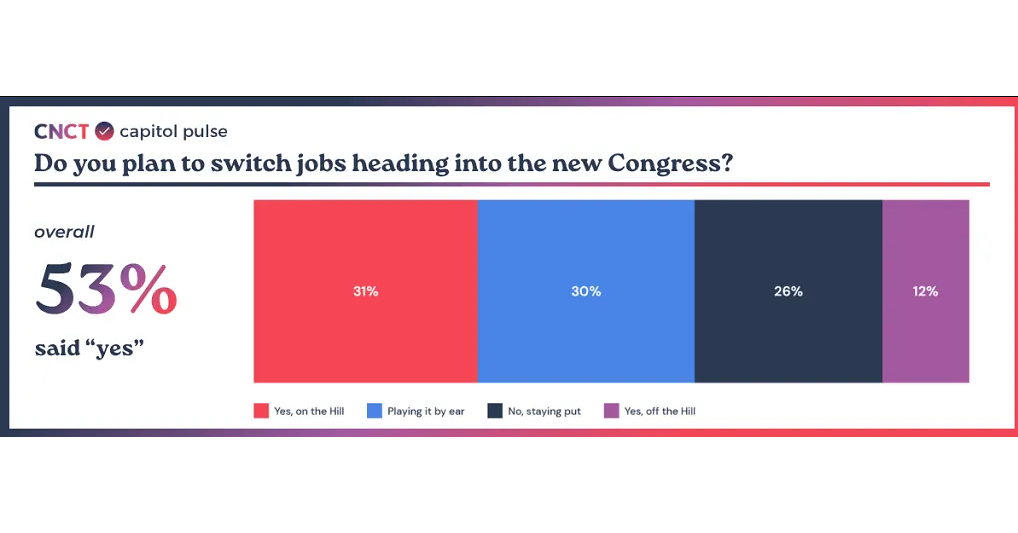
A CNCT Capitol Pulse survey found 53% of surveyed congressional aides plan to move to new jobs following the 2026 midterms, while 81% expect to remain on Capitol Hill in some capacity. The reported plans include 26% staying in their current office, 26% returning in a different role, 31% undecided and 12% leaving the congressional campus.
Analysis
This is a weak, indirect signal—not an investable measure of government capacity. The key economic distinction is between staff changing roles within the Hill and leaving government: internal moves can briefly disrupt committee and office workflows, but are unlikely by themselves to change legislative outcomes or agency timelines. If departures concentrate in policy specialists, regulated sectors could face slower advocacy and less predictable implementation; any benefit to outside government-relations or legal advisers would be diffuse and too small to underwrite a trade on this survey alone.
The survey also does not establish that planned moves will occur, identify the policy areas affected, or provide a representative measure of staffing. The apparent churn may reflect routine election-cycle reshuffling rather than loss of institutional knowledge. Immediate market impact should be negligible. Over the next 1–3 months, actual election results and subsequent committee/staff appointments are more relevant catalysts; over 6–18 months, sustained attrition in specific committees could matter for policy execution, but that requires confirmation. A broad “brain drain” interpretation is therefore likely overstated.
AllMind Terminal
AI-powered research, real-time alerts, and portfolio analytics for institutional investors.
Request TrialMarket Sentiment
Overall Sentiment
neutral
Sentiment Score
0.00
Key Decisions for Investors
- No trade from this item alone. Do not translate reported career intentions into earnings or valuation changes for regulated-sector companies.
- Track post-election committee and senior-staff appointments, plus observed departures in policy-heavy offices; these are more decision-useful than aggregate intent data.
- For positions exposed to regulatory timing, treat delays as a conditional scenario rather than a base case. Reassess only if agency or congressional calendars slip and company guidance or policy milestones change.
- Falsify any staff-disruption thesis if actual turnover is limited, key committee expertise is retained, or the relevant policy timetable proceeds without delay; first verify the survey sample and whether planned moves materialize.
More News
- Trump says Iran war will end 'when I want it to' as costs reportedly balloon to $47 billion
- Iran’s calculations as US escalation looms: Trust, midterms, Hormuz
- Fed expected to hold rates steady, but Warsh may point way to more hikes
- RBNZ holds rates at 2.75% in split vote, signals further hikes likely
- Latest Oil Market News and Analysis for Oct. 28
- Trump administration may let more Russian diesel onto market, energy secretary tells CNBC
From AllMind Research
- AllMind Platform Feature Updates - Fall 2026
- AI Credit Covenant Monitoring: From Clause to Review
- AI-Led Expert Interviews vs. Transcript Libraries
- The Great Divergence: North American Banking at the Crossroads of Monetary Policy and Agentic AI (Q4 2025 Bank Earnings)
- How to Extract KPIs From Earnings Transcripts With AI