
Bloomin' Brands Surges 49% in 6 Months: How to Play the Stock Now?
Source: zacks.com
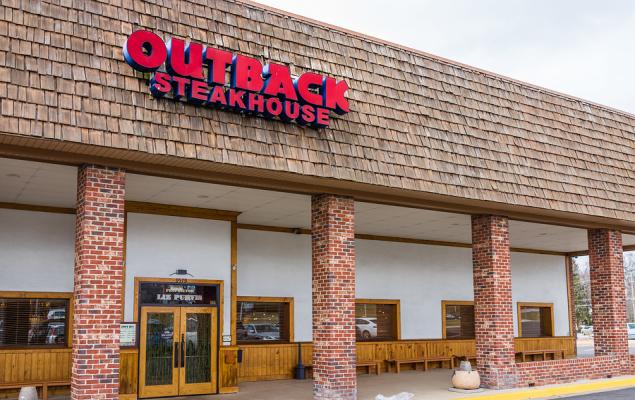
Bloomin' Brands' shares have risen 49.2% over six months as its Outback Steakhouse turnaround supported Q2 fiscal 2026 revenue of $1.02B (+1% YoY), U.S. comparable sales growth of 2.3%, and adjusted EPS of $0.39 versus $0.32 a year earlier. The company raised fiscal 2026 adjusted EPS guidance to $0.90-$1.00 from $0.75-$0.90 and cut expected turnaround investment to $36M from $50M, while analysts lifted their EPS estimate to $0.98 from $0.86. Risks remain: Outback traffic fell 2.8%, quarterly commodity inflation was 5.7%, and fiscal-year earnings are still projected to decline 14% YoY despite the improved outlook.
Analysis
BLMN’s re-rating now requires traffic—not further check growth—to validate the turnaround. The labor-intensive service redesign can improve conversion and repeat visits, but it also raises fixed labor per guest; with negative traffic, the model only deleverages further if guest counts fail to inflect. The near-term earnings beat path is therefore narrower than the headline valuation suggests: commodity costs, advertising and labor must all be absorbed while price is largely exhausted.
The refresh program is a staggered, location-level test rather than an immediate chain-wide catalyst. If refreshed units sustain incremental traffic after the initial novelty period, BLMN can shift from a cost-control story to a unit-economics/multiple-expansion story over 6-18 months. Conversely, a 100-200bp lift that merely offsets broader traffic erosion would create capex without meaningful consolidated sales leverage; investors should demand disclosed cohort traffic, sales and four-wall-margin returns rather than relying on guest-satisfaction metrics.
DRI is the cleaner defensive expression within full-service dining: its scale and higher-margin brands provide greater capacity to absorb food inflation and reinvest in value. SHAK faces a different risk—premium fast-casual consumers are less dependent on steak-price affordability—but its earnings sensitivity to traffic deceleration and labor remains high. The contrarian view is that BLMN’s low headline P/E is not necessarily cheap: it embeds a depressed earnings base and elevated execution risk, while consensus has already moved materially higher after the share-price run.
Over the next 1-3 months, the critical catalyst is evidence that traffic stabilizes before incremental marketing and service labor become permanent costs. A renewed commodity spike, weekly restaurant-industry traffic slowdown, or next-quarter traffic remaining below zero would likely halt estimate revisions and compress the turnaround premium; positive traffic with stable restaurant margin would falsify the bearish case.
AllMind Terminal
AI-powered research, real-time alerts, and portfolio analytics for institutional investors.
Request TrialMarket Sentiment
Overall Sentiment
moderately positive
Sentiment Score
0.48
Ticker Sentiment
Key Decisions for Investors
- Do not chase BLMN after the sharp six-month rerating; initiate only on a post-earnings pullback if U.S. traffic turns positive and restaurant margin holds or expands sequentially. Target a 6-12 month long only if refreshed-unit cohort data demonstrate durable traffic gains; exit on another quarter of negative traffic or EPS guidance below the current $0.90-$1.00 range.
- Establish a 1-3 month relative-value pair: long DRI / short BLMN in equal dollar amounts. The trade isolates the risk that BLMN’s labor-and-marketing investment fails to create traffic while DRI better protects margins in an elevated food-cost environment; cover the short if BLMN reports positive traffic and material restaurant-margin expansion.
- Set an earnings alert around beef and broad protein inflation: if management’s pricing no longer covers food inflation, avoid BLMN regardless of nominal forward P/E. The sensitivity is asymmetric because traffic weakness limits additional menu pricing without damaging value perception.
- Keep SHAK neutral rather than using it as the direct BLMN hedge. Its customer base and format differ materially; use it as a read-through on discretionary restaurant traffic, with a negative SHAK traffic/guidance reset increasing conviction in the DRI/BLMN pair.
More News
- Nasdaq Index and S&P500: US Stocks Retreat From Record Highs as Oil and Yields Rise
- Is Sterling's $130M-$140M CapEx Plan Fuel for Its Next Growth Leg?
- D-Wave Quantum stock rises on CGI partnership deal
- Burlington's Beauty & Accessories Categories Lead Sales Trends
- Will OPRX's OpenPath Deal Help TTD Capture More Healthcare Ad Dollars?
- Bond yields spike and stocks drop — plus, why Boeing is bucking the trend