
Hanshow Unveils Nebular Lux at NRF 2026 Europe, Advancing More Responsive and Low Carbon Shelf-Edge Infrastructure
Source: PR Newswire
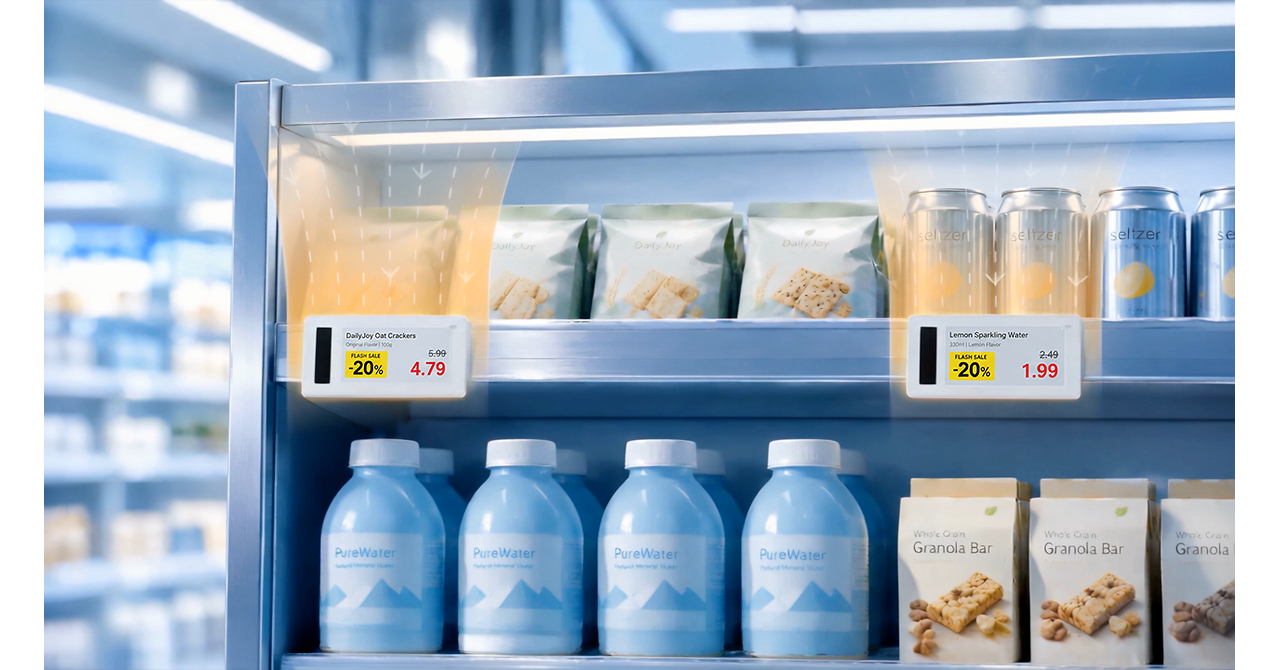
Hanshow launched Nebular Lux, a hybrid-energy electronic shelf label that harvests indoor ambient light and is claimed to reduce daily energy consumption by approximately 46% versus conventional ESL deployments. For a rollout of 1 million labels, the company estimates the product could avoid roughly 202 metric tons of CO2 emissions from battery production and replacements over 10 years, while supporting more frequent shelf-edge positioning and LED signaling. The product is positioned to lower retailers' battery replacement costs and improve store operations, including picking, replenishment and product-location services.
Analysis
The relevant read-through is competitive rather than a direct earnings event: a credible reduction in maintenance and power burden raises the threshold for incumbent ESL vendors to defend premium pricing. VusionGroup (VU.PA) and Pricer (PRIC-B.ST) face the greatest risk if the architecture translates into longer field life under high-update conditions, because service/replacement economics—not label hardware ASP alone—are central to retailer ROI models. The more consequential second-order effect is that lower power constraints can expand the addressable use case from dynamic pricing into labor workflows, making ESL platforms more comparable to store-operating-system infrastructure and potentially increasing switching costs for retailers.
The company’s energy and carbon claims are not independently validated and are unlikely to affect procurement before multi-store pilots establish light-harvesting performance across dim aisles, refrigerated cases, and seasonal lighting conditions. Over the next 1-3 months, watch for named European retail pilots, installation volumes, and disclosed update-frequency/maintenance data; absent these, this is not a tradable catalyst. Over 6-18 months, successful deployment could compress ESL hardware margins industry-wide while increasing recurring software, positioning, and workflow revenue—favoring vendors with broad installed bases and integration capabilities rather than the lowest-cost device supplier.
Consensus may overvalue the sustainability framing. Retail buyers will underwrite the product primarily on avoided truck rolls, labor disruption, battery replacement rates, and uptime; a modest battery-life improvement without materially better high-frequency workflow performance will not alter tender outcomes. Conversely, if power harvesting enables reliable LED-guided picking and real-time inventory-location functions, the value proposition becomes labor productivity, which carries a meaningfully larger budget pool than ESG procurement.
AllMind Terminal
AI-powered research, real-time alerts, and portfolio analytics for institutional investors.
Request TrialMarket Sentiment
Overall Sentiment
moderately positive
Sentiment Score
0.42
Key Decisions for Investors
- No immediate position: treat this as a competitive watch item, not a catalyst, until Hanshow discloses a named retailer pilot and deployment scale exceeding 100,000 labels.
- Monitor VusionGroup (VU.PA) for tender commentary and gross-margin guidance over the next two reporting cycles; a guidance cut tied to pricing or battery-maintenance economics would support a tactical short, while accelerating recurring software attach would falsify the bear case.
- Use Pricer (PRIC-B.ST) as the higher-beta competitive-risk proxy only if evidence emerges that high-frequency, energy-harvesting labels win European tenders; its smaller scale makes it more exposed to ASP and R&D pressure than VU.PA.
- For retailers with large ESL programs, watch Walmart (WMT) and Kroger (KR) for disclosed labor-productivity metrics rather than ESG claims. A measurable reduction in shelf-replenishment or picking labor would be a 6-18 month margin-positive signal; lack of operational KPI disclosure should limit any valuation read-through.
More News
- US official says upcoming spectrum auctions could generate more than $100 billion
- 'Science fiction': Transport companies — the backbone of economy — are sounding alarm on fuel prices
- What to know about US Federal Reserve’s first interest rate hike in 3 years
- Investors react to Fed hike and market sell-off: Brace for 'higher for longer' rates
- AI Buildout Hits Inflation as Fed Hikes Rates
- Fed Rate Hike Looms as Retail Sales Surge