
98% of Job Seekers Say Adapting to Workplace Culture Is Important, but More Than Half Call It Unfair
Source: PR Newswire
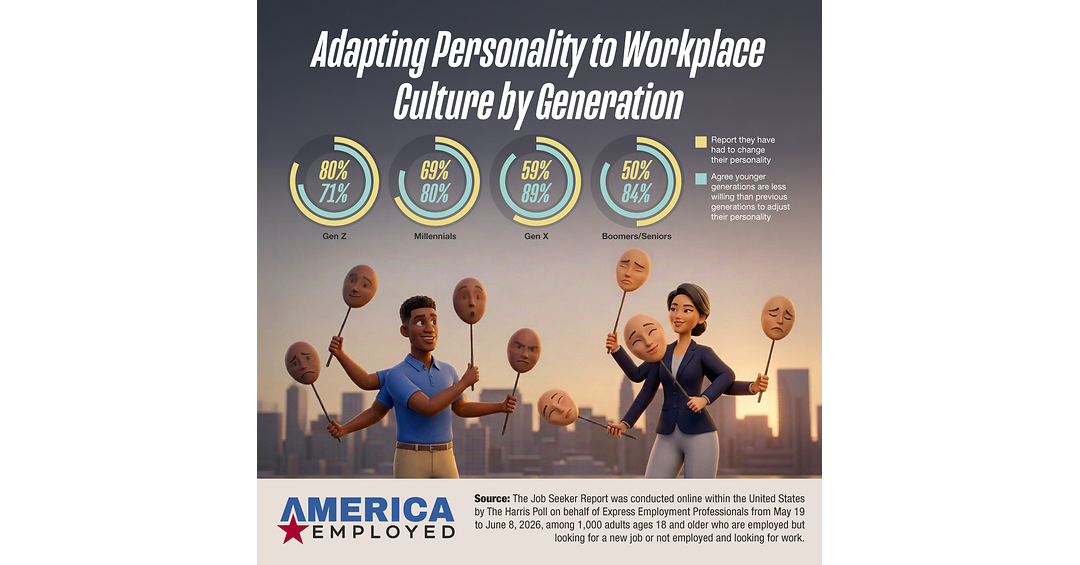
A Harris Poll for Express Employment Professionals found 67% of job seekers have changed aspects of their personality to fit workplace culture, rising to 80% for Gen Z, while 63% say their workplace persona differs from everyday life. Although 86% view adaptability as a core professional skill, 56% say personality should not affect job performance assessments, and only 50% report receiving employer guidance. The survey highlights workplace-culture and retention risks but has limited direct market implications.
Analysis
This is a weak standalone market signal and primarily serves as a qualitative indicator of labor-market friction rather than a catalyst for public equities. Because the sample is restricted to active job seekers and sourced by a staffing franchisor, it likely overstates dissatisfaction versus the employed population; there is no basis to extrapolate an immediate change in hiring volumes, wage inflation, or corporate earnings.
The investable second-order issue is retention cost. If cultural-fit screening becomes a greater source of voluntary churn, employers with high frontline turnover and thin unit-level margins—restaurants, retail, logistics and call centers—could face incremental recruiting, training and lost-productivity expense. That is directionally unfavorable for XRT constituents, restaurants such as SBUX and QSR, and labor-intensive operators such as AMZN, but the effect is too diffuse to isolate from wage growth, consumer demand, or automation investment.
Over 6-18 months, the more relevant beneficiary would be workflow and HR software that converts subjective management practices into scalable onboarding, feedback and scheduling processes: DAY, PAYC, ADP and UKG (private). The thesis requires evidence that employers translate stated culture concerns into higher HR-tech budgets rather than simply tightening hiring criteria. In a softer labor market, employers gain bargaining power and voluntary turnover usually falls, which would weaken both staffing demand and the urgency of retention-software spend.
Contrarianly, perceived culture mismatch can increase candidate willingness to use intermediaries, modestly supporting staffing firms if job switching remains elevated. But public staffing exposure is better expressed through broad labor-demand indicators—temporary-help employment, job openings and placement spreads—than this survey. No position is warranted absent corroboration in retention metrics, staffing guidance, or HR-software bookings.
AllMind Terminal
AI-powered research, real-time alerts, and portfolio analytics for institutional investors.
Request TrialMarket Sentiment
Overall Sentiment
mixed
Sentiment Score
-0.05
Key Decisions for Investors
- No immediate trade: treat this as a watch item, not an earnings catalyst, given low quantified impact and sponsor-sample bias.
- Monitor DAY, PAYC and ADP over the next 1-3 quarters for accelerated net-new bookings, retention-module attach rates, or raised subscription guidance; consider a long basket only if these metrics improve while valuation remains supported by recurring-revenue growth.
- Watch temporary-help employment, JOLTS quits and unemployment claims for 1-3 months. A sustained deterioration would be more actionable for a short bias in staffing cyclicals such as RHI and KFY than the survey itself; cover if job openings reaccelerate or placement-fee guidance stabilizes.
- For labor-intensive consumer holdings, require disclosure of rising turnover, training expense, or store-level labor deleverage before reducing exposure to SBUX, QSR or XRT. The thesis is falsified if turnover declines while labor productivity and operating margins improve.
More News
- How Pepsi fell behind in the cola wars—and then lost KFC
- The experience economy keeps defying expectations. Maybe we’ve been looking at it all wrong
- ‘We like to be first to be second’: How True Religion’s CEO is rebuilding the denim brand for Gen Z and millennials
- Instacart reportedly discussed selling itself with DoorDash and Uber
- France Faces New Protests After Week of Violence
- Sudan’s soaring fuel prices make getting by harder for workers