
How India and China Took Steps to Reset Ties At BRICS: Live Q&A
Source: Bloomberg
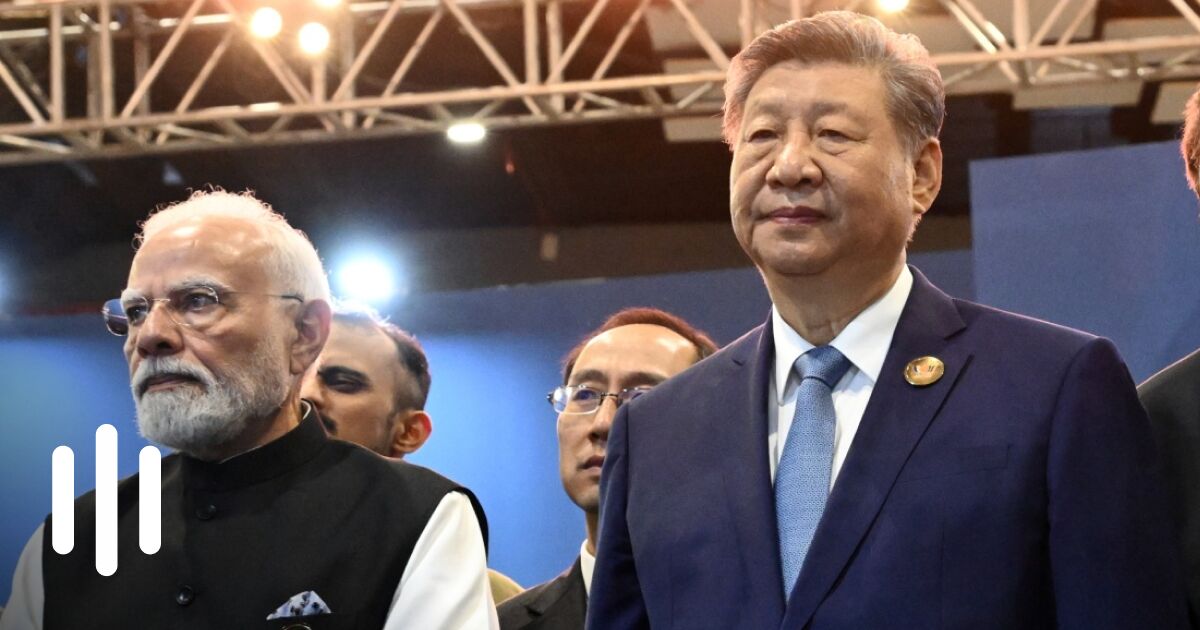
Chinese President Xi Jinping and Indian Prime Minister Narendra Modi signaled a tentative thaw in bilateral relations at the BRICS summit, Xi’s first visit to India since the 2020 border conflict. Both leaders emphasized mutual support despite differing national circumstances, but unresolved flash points leave the détente fragile. Improved China-India ties could modestly reduce regional geopolitical and supply-chain risk, though no concrete agreements were announced.
Analysis
The investable implication is a lower near-term geopolitical risk premium on India-China trade channels, not a wholesale reversal of supply-chain diversification. Indian importers of Chinese capital goods and intermediate inputs—especially solar modules, electronics components, APIs and industrial machinery—could see fewer customs or licensing disruptions over the next 1-3 months. That modestly supports margins for Indian manufacturers and renewable developers, while reducing a tailwind for alternative suppliers in Taiwan, Vietnam and South Korea.
The more consequential second-order effect is on India’s negotiating leverage with Washington and its incentive to subsidize domestic substitution. A durable thaw could slow the pace of punitive restrictions or domestic-content mandates, pressuring high-cost Indian localizers whose valuations embed protected-market economics. Conversely, Chinese firms gain little unless dialogue produces verifiable changes in border deployments, visa policy, investment screening or market access; rhetoric alone should not change earnings estimates.
Base case is that this is a diplomatic volatility suppressant rather than a structural trade reset. The immediate market reaction should be limited, but a sequence of follow-through measures over 1-3 months could tighten India sovereign risk spreads and support INR-sensitive domestic cyclicals. The thesis fails if border incidents recur, India maintains restrictions on Chinese FDI and equipment imports, or US-China trade escalation forces India to harden alignment with the US; each would quickly restore supply-chain fragmentation premia.
AllMind Terminal
AI-powered research, real-time alerts, and portfolio analytics for institutional investors.
Request TrialMarket Sentiment
Overall Sentiment
mildly positive
Sentiment Score
0.20
Key Decisions for Investors
- No directional index trade on the meeting alone; treat it as a watch catalyst for India exposure rather than an earnings-revision event. Require evidence of formal easing in Chinese investment approvals, import licensing, or border-management arrangements before adding risk.
- Monitor a relative-value basket: long Indian solar developers/manufacturers with meaningful Chinese module and inverter procurement versus short domestic-content beneficiaries whose margins depend on import barriers. Activate only after policy confirmation; missing data are each company’s China sourcing mix and contracted module costs.
- For a 1-3 month risk-on expression following concrete follow-through, favor long INDA or NIFTY-linked exposure versus short EEM, where lower India-specific geopolitical risk and domestic-capex sensitivity could outperform. Exit if INR weakens materially despite stable DXY or India 10-year sovereign yields widen by more than 20-25 bp.
- Avoid extrapolating the thaw into a short on Vietnam or Taiwan supply-chain beneficiaries. Multinationals’ diversification decisions are driven by resilience, US trade policy and labor economics over 6-18 months; a bilateral diplomatic gesture does not reverse committed capacity migration.
More News
- China’s tech darlings are losing their shine. Here’s what’s behind the sell-off
- Can Southeast Asia pitch itself as an ‘all-in-one’ chip hub?
- Alphabet Disappoints as Microsoft’s Cloud Brightens
- Russia’s alleged sabotage campaign in Europe raises fears of escalation
- Wall Street looks past Fed pause to tech earnings and AI rebound
- SK Hynix says the memory-chip shortage will last until 2030—and more than half its production is booked for the next two years