
Fastino Labs Releases GLiDE, the First Thinking Decision Model, Leading the Decision Index's Top Model by 6.9 Points
Source: PR Newswire
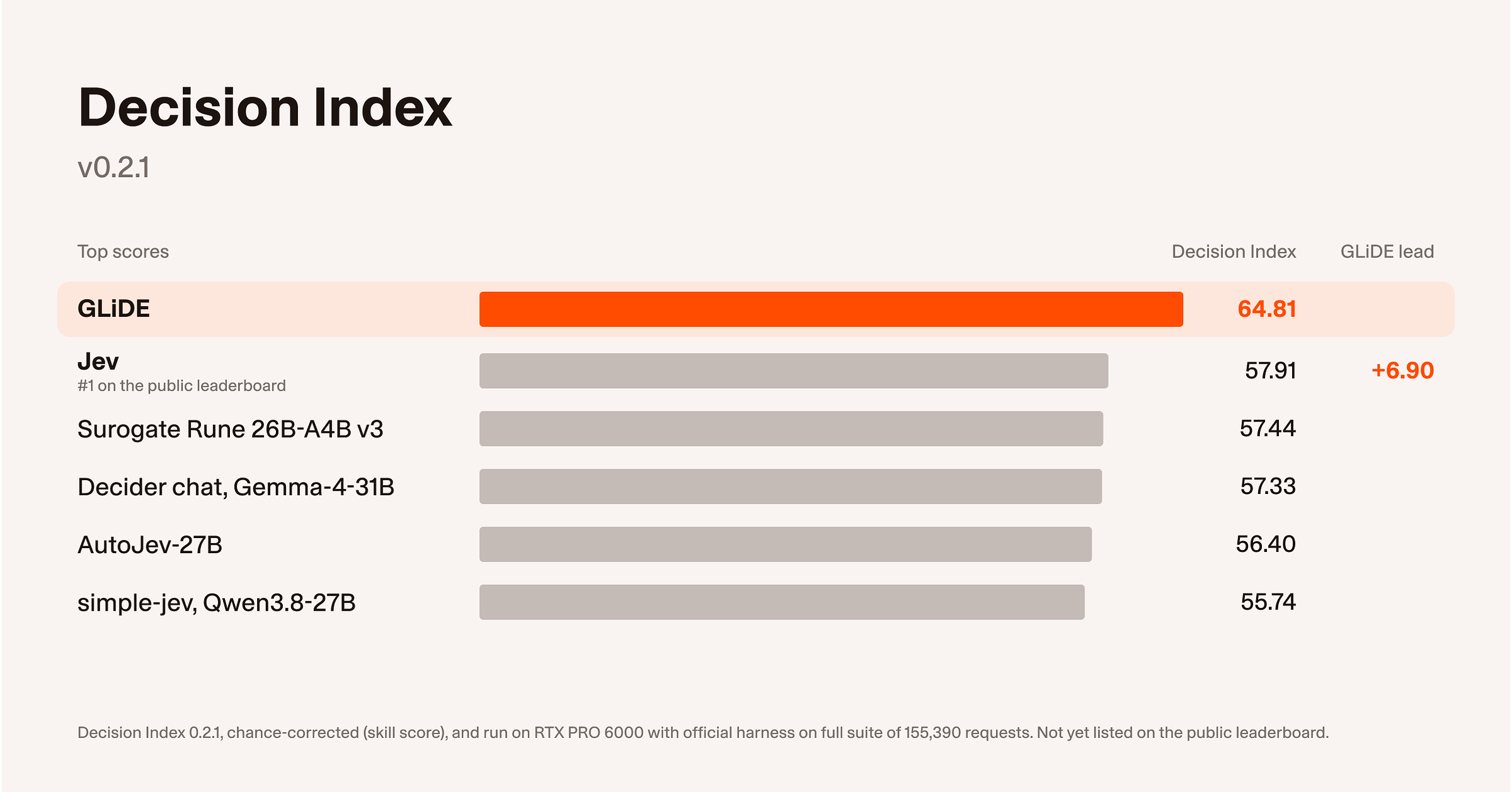
Fastino Labs launched GLiDE, an adaptive-reasoning decision model available through its API, reporting a 64.81 score on Decision Index 0.2.1 versus Jev's 57.91—a 6.90-point lead. GLiDE led Jev on 31 of 38 benchmarks, including an 11.5-point advantage in knowledge and reasoning and 92.6% versus 73.0% accuracy on CRUXEval code reasoning. The release expands Fastino's AI-agent tooling with structured action selection, confidence scoring, and adaptive inference for higher-complexity operational workflows.
Analysis
This is not directly investable public-equity news, but it reinforces a potentially important architecture shift: agent deployments may separate low-cost action selection and policy enforcement from expensive frontier-model generation. If adoption proves real, the near-term economic pressure falls on inference-heavy model providers and cloud GPU demand per completed workflow, while beneficiaries are enterprise software vendors that can monetize safer automation without carrying frontier-model token costs.
The key issue is whether a specialized decision layer materially reduces escalation to large models while preserving accuracy in production. If so, API pricing power for general-purpose inference could weaken at the margin over the next 6-18 months, particularly for routine customer-service, IT-operations and back-office agent workflows. Conversely, NVIDIA (NVDA) is not necessarily a clean loser: lower unit compute can expand the addressable agent market and ultimately increase total inference volume, though it would shift demand toward smaller-model serving and latency-optimized infrastructure.
Treat the benchmark claims as unverified marketing until independent testing establishes latency, cost per successful decision, error rates under adversarial inputs, and customer retention. The more immediate public-market read-through is modestly positive for software firms with proprietary workflow data and embedded distribution—ServiceNow (NOW), Salesforce (CRM), Microsoft (MSFT), and Palantir (PLTR)—because a reliable decision layer improves ROI on agent features where liability and approval controls have limited adoption.
Consensus is focused on ever-larger models; the underappreciated risk is that agent economics are governed by decision reliability and auditability rather than raw model intelligence. That favors vertical workflow incumbents over standalone model vendors, but only if deployment evidence shows reduced human-review rates rather than simply adding another inference call.
AllMind Terminal
AI-powered research, real-time alerts, and portfolio analytics for institutional investors.
Request TrialMarket Sentiment
Overall Sentiment
moderately positive
Sentiment Score
0.62
Key Decisions for Investors
- No standalone trade on this private-company launch; create a 1-3 month diligence watch item for disclosed enterprise deployments, API pricing, independently reproduced benchmark results, and measurable reductions in human escalation rates.
- Maintain a relative long bias in NOW versus a basket of lower-margin IT-services automation exposure over 6-12 months: NOW has the workflow control plane to capture incremental agent adoption. Falsify if Pro Plus/AI product attach and subscription RPO commentary fail to improve over two reporting cycles.
- For AI software exposure, prefer MSFT over pure-play model-inference narratives on a 6-18 month horizon: modular smaller models can improve Copilot unit economics across Azure and enterprise applications. Reassess if Azure AI consumption growth decelerates despite broader agent-feature rollout.
- Do not infer a near-term NVDA short from efficiency claims. Instead, monitor hyperscaler commentary on tokens per task and small-model inference mix; a sustained reduction in GPU-hours per deployed agent without offsetting workload growth would be the relevant 2027 multiple-risk signal.
More News
- US job growth expected to slow in September; unemployment rate likely steady
- SoftBank completes final phase of $30 billion investment in OpenAI
- Trump launches midterms campaign blitz amid record low approval ratings
- Amazon seeks to offload $8 billion of Nvidia chips to investors, FT reports
- Amazon seeks to offload $8 bln of Nvidia chips to investors- FT
- Fed’s Cook sees AI buildup as top inflation risk for 2027