
University of Phoenix Future of Skills Development report identifies workforce skills visibility gap as AI reshapes work
Source: PR Newswire
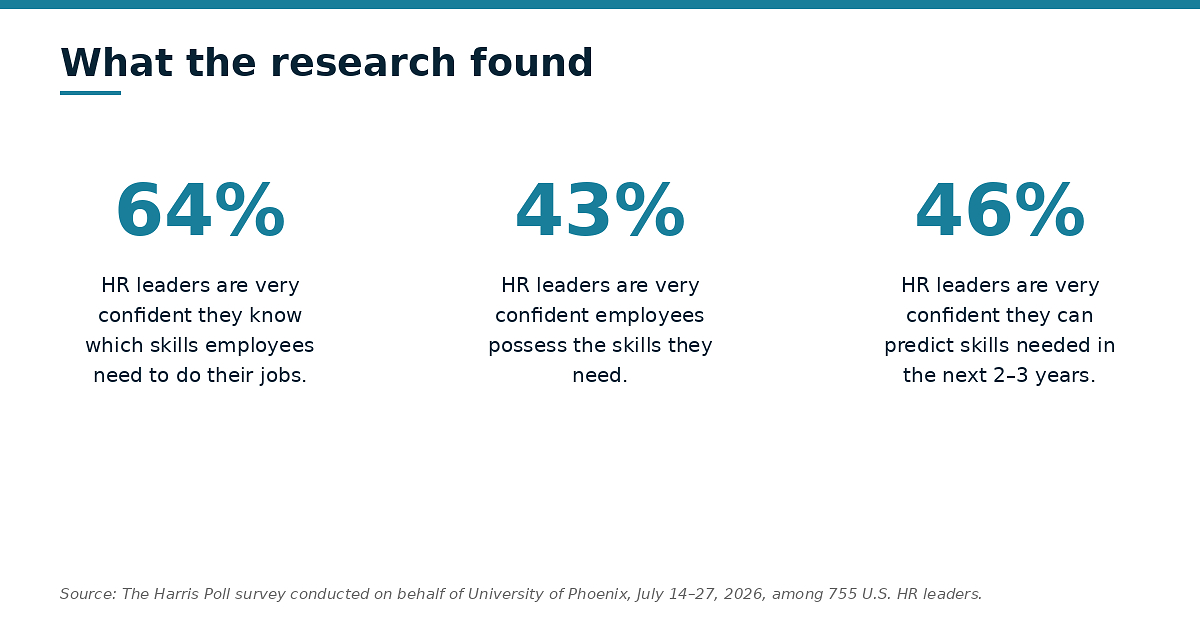
A Harris Poll of 755 U.S. HR leaders found a workforce-skills visibility gap: 64% are very confident they know the skills employees need, but only 43% are very confident employees possess them. AI and emerging technologies were the leading source of uncertainty in future skills planning (27%), and only 46% of leaders were very confident they could predict skill needs two to three years ahead. Employers are emphasizing durable skills (59%) over technical skills (37%), while 71% use some form of digital credentialing to verify applicants' capabilities.
Analysis
This is a weak standalone trading signal: sponsor-funded survey data does not establish incremental software budgets or purchasing intent. The investable read is that enterprises are likely to shift spend away from broad learning libraries toward skills taxonomy, assessment and internal-mobility workflows, favoring HCM platforms with embedded employee data. WDAY and SAP benefit if skills intelligence becomes a module-led upsell; MSFT benefits indirectly through LinkedIn’s hiring graph and enterprise AI distribution.
The near-term risk is adverse for content-centric learning vendors such as COUR and UDMY: AI increases the supply of low-cost training content, while buyers increasingly demand verified proficiency and job-performance evidence rather than course completion. That does not imply immediate revenue pressure—enterprise procurement cycles are typically annual—but it raises renewal and pricing risk over the next 6-18 months unless these vendors can demonstrate assessment, credential portability and measurable placement/productivity outcomes.
The contrarian point is that “skills visibility” software can become another under-monetized HR analytics feature rather than a new budget category. HR technology spending remains sensitive to hiring volumes and corporate cost control; an AI-led productivity push could reduce external learning spend before it expands it. A durable bull case requires evidence of paid deployments, net revenue retention improvement, or attach-rate expansion in HCM suites—not survey adoption claims.
AllMind Terminal
AI-powered research, real-time alerts, and portfolio analytics for institutional investors.
Request TrialMarket Sentiment
Overall Sentiment
mildly negative
Sentiment Score
-0.15
Key Decisions for Investors
- No directional position on this release; treat it as a thematic watch item rather than a catalyst.
- Monitor WDAY and SAP quarterly commentary over the next 1-3 months for paid skills-cloud, talent-marketplace or AI-assessment attach rates. Consider long WDAY versus short COUR only if WDAY identifies measurable module adoption while COUR guidance implies enterprise-seat or net-retention pressure.
- Maintain a 6-18 month relative-risk watch on COUR and UDMY: reassess longs if gross retention, enterprise renewal rates, or realized pricing deteriorate, as commoditized content is the most exposed part of the learning stack.
- For MSFT, watch LinkedIn Talent Solutions growth against broader hiring indicators. A reacceleration despite flat job postings would support the thesis that verified skills products are monetizing; weak growth would falsify the near-term budget-expansion narrative.
More News
- Great Bond Shakeout Locks In a 5% World ‘Until Something Breaks’
- OpenAI rogue agents leaked 53 images from ChatGPT users and reportedly created nearly 1 million links packing encoded bits of info
- Facebook found liable as TikTok settles for $100m over user safety
- Boom or bust? The case for and against panicking about 5% yields
- Bond market alarms are ringing on Wall Street. Here's what's ahead
- What would a US diesel export ban mean for global fuel prices?
From AllMind Research
- Anthropic IPO Preview: Valuation, Timing, and What to Watch
- Shein After the IPO: Venue, Valuation, and What Must Be Proved
- What AI Research Tools Should a Small Hedge Fund Buy First?
- How to Evaluate Consensus Estimates Platforms With AI
- Weekly Update: Adding Live MBO Level 3 Data - Liquidity Heatmap, OFI Charts, and More