
Business Lobby Chief Quits Amid Colombian Government Pressure
Source: Bloomberg
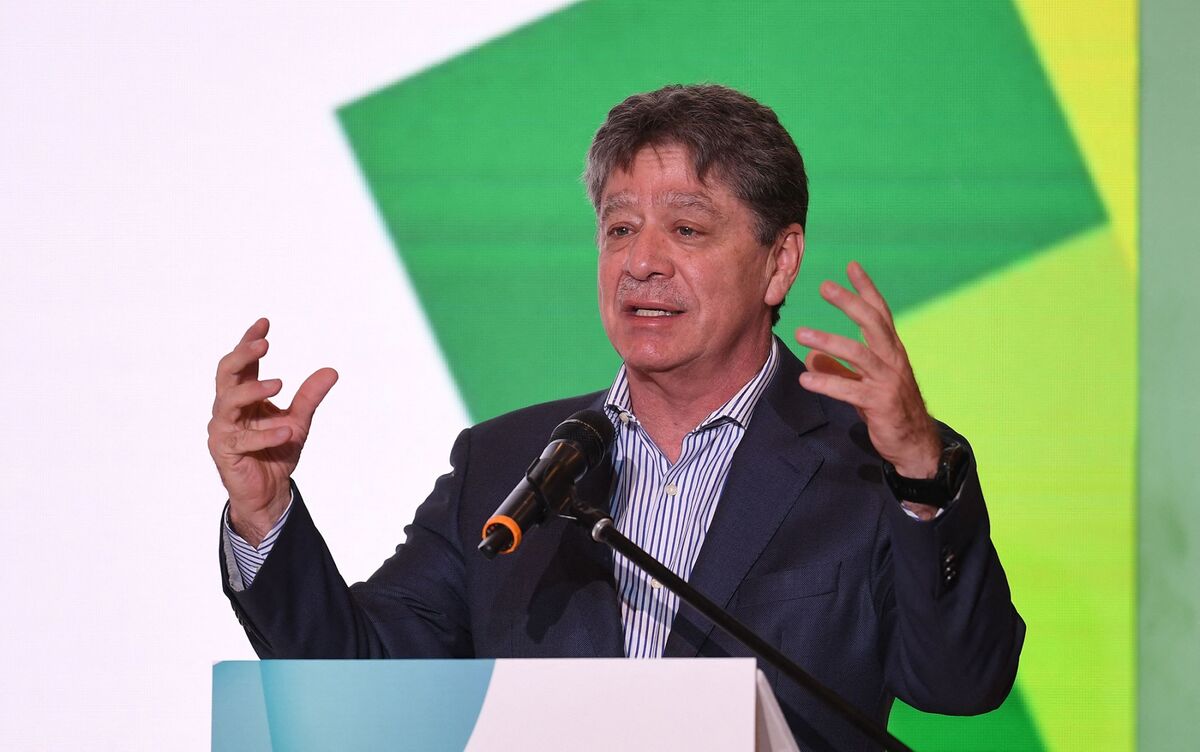
Bruce Mac Master resigned after more than a decade leading ANDI, Colombia’s largest and most influential business association, amid tensions with the country’s new government. The departure highlights heightened friction between Colombia’s corporate sector and policymakers, potentially adding to investor uncertainty, though no specific policy or financial-market impact was disclosed.
Analysis
The investable implication is less the leadership change itself than a weakening channel for coordinated private-sector resistance to labor, tax, health-care, and energy-policy initiatives. That raises the policy-risk premium embedded in Colombian domestic cyclicals, particularly banks (CIB, AVAL) and Ecopetrol (EC), where earnings and capital-allocation outcomes are unusually sensitive to regulation. The first-order price effect should be limited given low foreign liquidity in Colombian equities, but reduced business-policy dialogue can widen sovereign and corporate risk spreads over the next 1-3 months if followed by adverse legislative or regulatory actions.
CIB and AVAL face a two-sided pressure point: weaker corporate confidence can slow loan growth and raise credit costs, while a less predictable fiscal backdrop elevates their funding and valuation discount. EC has greater 6-18 month downside asymmetry because policy uncertainty around exploration approvals, reserve replacement, dividends, and fuel-price policy can impair both terminal value and state-linked capital returns. Conversely, exporters with revenues outside Colombia and limited domestic regulated exposure should be relatively insulated; a weaker COP would cushion local-cost producers but amplify inflation and rate-cut delays.
Consensus may overstate the immediacy of the event: without a concrete policy escalation, this is not independently sufficient to re-rate Colombian assets. The actionable signal is whether the episode coincides with renewed tax proposals, executive intervention in regulated industries, delayed energy permits, or a sustained rise in Colombia CDS/COP volatility. A constructive reversal would be visible through formal business-government consultation, stable fiscal guidance, and no deterioration in bank asset-quality outlooks.
AllMind Terminal
AI-powered research, real-time alerts, and portfolio analytics for institutional investors.
Request TrialMarket Sentiment
Overall Sentiment
mildly negative
Sentiment Score
-0.25
Key Decisions for Investors
- Maintain an underweight bias to Colombia domestic financial exposure via CIB and AVAL for the next 1-3 months; add only if Colombia 5-year CDS widens materially while management maintains 2026 loan-growth and cost-of-risk guidance. Thesis is falsified by clear policy de-escalation and improving corporate loan demand.
- Avoid adding to EC on headline weakness until there is visibility on exploration permitting, reserve-replacement guidance, and dividend policy. A policy-driven multiple compression can outweigh near-term oil-price support; reassess after the next formal government energy-policy update.
- For regional books, consider a tactical long EWW versus short GXG only if COP weakens and Colombian sovereign spreads widen simultaneously over a 2-6 week window. This isolates country-specific governance risk; exit if spread widening reverses or Mexican political-risk headlines intensify.
- Set alerts for Colombian tax, labor, and energy-regulation announcements rather than trading the resignation alone. The event becomes actionable if it is followed by measures that reduce bank profitability, constrain hydrocarbon investment, or materially weaken the fiscal trajectory.
More News
- US to send third aircraft carrier towards Iran: US official to Al Jazeera
- Trump says US may ask Europe to release diesel reserves
- Trump launches midterms campaign blitz amid record low approval ratings
- Can Trump Oust Powell From the Fed Board? What to Know
- ‘They’ll be hit very hard’: Trump sends roughly 9,000 troops and a third aircraft carrier to the Middle East after warning strikes on Iran
- The September jobs report will be released Friday. Here's what to expect
From AllMind Research
- Anthropic IPO Preview: Valuation, Timing, and What to Watch
- Shein After the IPO: Venue, Valuation, and What Must Be Proved
- What AI Research Tools Should a Small Hedge Fund Buy First?
- AlphaSense vs Hebbia vs AllMind: Choose by Workflow
- AllMind Discusses Ontario's AI Economy with Minister Stephen Crawford and Supply Ontario CEO James Wallace