
CISOs Risk MDR Buyer's Remorse Without Clear Procurement Requirements, Says Info-Tech Research Group
Source: PR Newswire
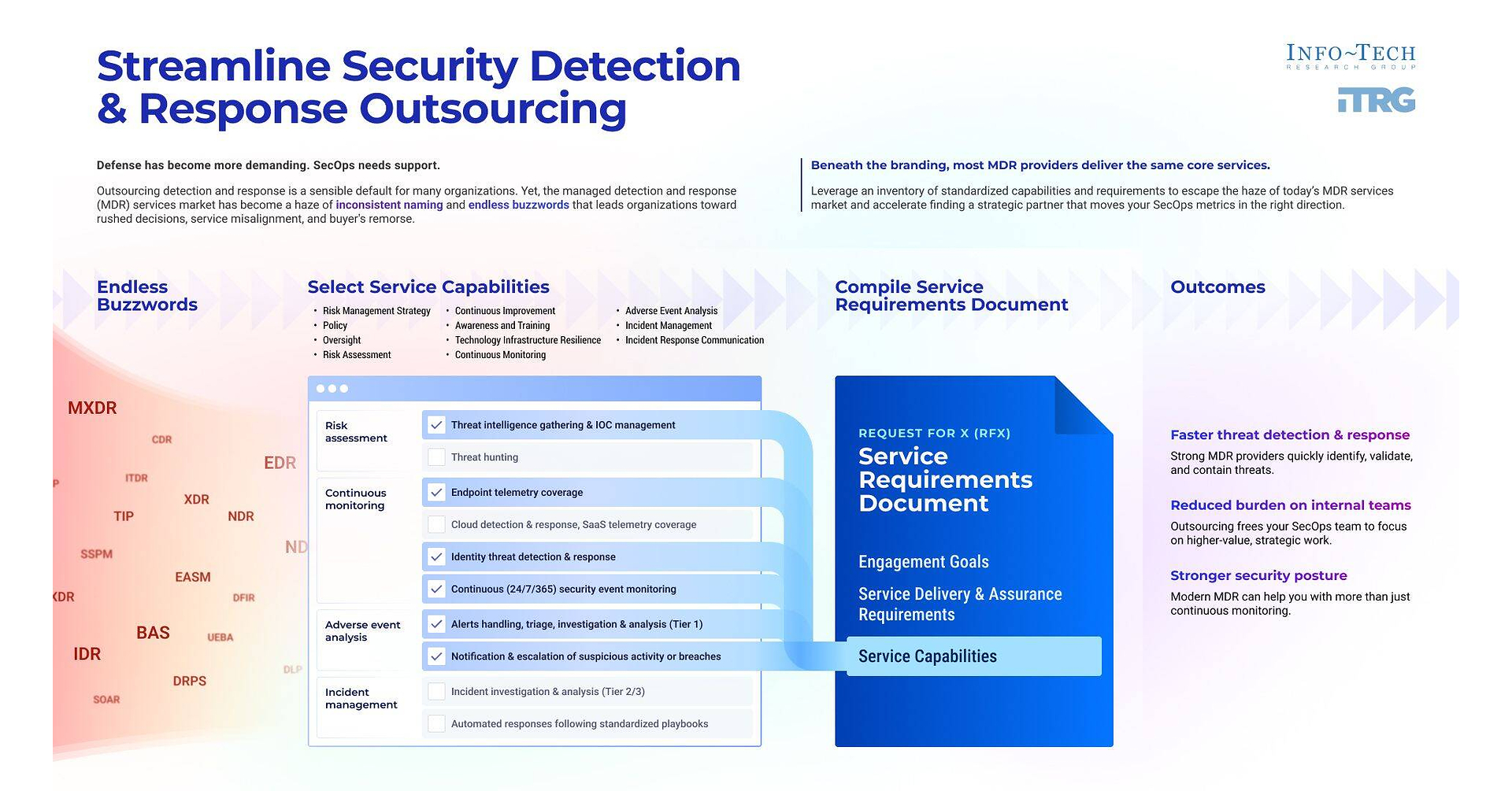
Info-Tech Research Group warns that CISOs face “buyer’s remorse” risk when procuring MDR (managed detection and response) due to inconsistent vendor terminology, branded packaging, and rushed requirements gathering. The firm’s Streamline Security Detection & Response Outsourcing blueprint recommends a four-phase process—define scope and capabilities, set measurable outcomes/KPIs and SLRs, procure against consistent criteria, then implement and actively govern performance—to align services with measurable security coverage and reduce operational gaps.
Analysis
This is not a demand shock; it is a buying-process filter. Outcome-based procurement and standardized requirements tend to favor vendors that can bundle telemetry, workflow, and response into one platform, because they reduce internal coordination costs and make it easier to satisfy SLA language. That is constructive for CRWD, PANW, and MSFT Defender, and more challenging for smaller standalone MDR providers or services-heavy names such as S, where every renewal must prove incremental value.
The near-term market effect is on sales efficiency, not current revenue. Over the next 1-3 quarters, expect longer deal cycles, higher competitive tension, and more down-selection to one or two suite vendors; that can hurt bookings quality for niche providers before it shows up in reported ARR. Over 6-18 months, the bigger second-order effect is consolidation: buyers use MDR reviews to eliminate overlapping tools, which can cannibalize point-solution seat counts and shift budget toward fewer, broader vendors.
Contrarian read: the article implicitly argues that many MDR purchases are substitution, not expansion. If so, consensus TAM models may be too generous for pure-play MDR because the incremental dollars come from tool rationalization and outsourced headcount avoidance, both of which are budget-constrained. The thesis is falsified if enterprise security teams report faster implementation and higher attach without cutting other tools, or if the next earnings season shows stable net-new logos despite stricter procurement.
AllMind Terminal
AI-powered research, real-time alerts, and portfolio analytics for institutional investors.
Request TrialMarket Sentiment
Overall Sentiment
neutral
Sentiment Score
-0.05
Key Decisions for Investors
- Long CRWD / short S for the next 1-3 quarters as a relative-value expression of platform breadth versus narrow MDR differentiation; target ~1.5x relative upside, and cut if S re-accelerates billings or CRWD shows MDR attach slowing.
- Overweight PANW versus a basket of smaller cyber names into the next earnings season; disciplined procurement should favor vendors that can absorb more of the stack and reduce buyer coordination costs.
- Treat MSFT Security as a stealth beneficiary to MDR standardization: buyers looking for lower operational burden are more likely to accept bundled response capabilities inside an existing enterprise agreement than add a new standalone provider.
- Do not add direct exposure to BYRG, FCD.UN.TO, or TCHC on this headline alone; use them only as watch items unless channel checks show meaningful MDR-related revenue sensitivity or customer wins.
More News
- Musk says Terrafab chip factory could outperform rivals despite challenges
- Nvidia GPUs are everywhere. Here are the ways companies are accessing them
- Stocks saw new highs and big declines: How the volatile AI trade moved last week's market
- Will Warner Bros. kill Skydance — or will David Ellison kill Warner Bros?
- The world needs Ukraine’s grain. Its farmers are running out of reasons to plant
- Cerebras Is About as Big as Nvidia's Data Center Business Was Nearly a Decade Ago. The Similarities Mostly End There.