
Are Space ETFs on Track to Rally or Is It Just a Temporary Blip?
Source: zacks.com
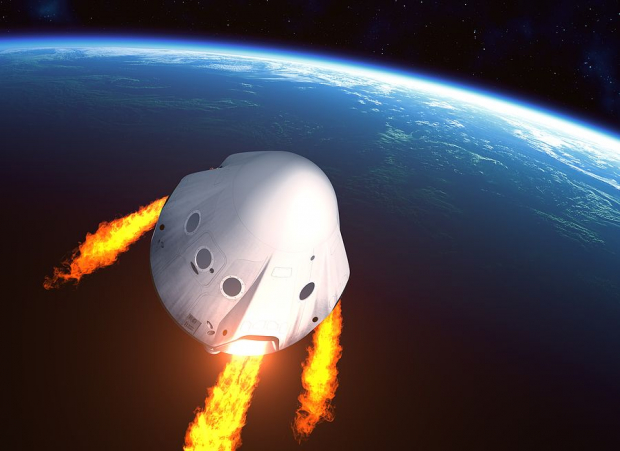
SpaceX's Starship achieved its first orbital insertion on Sept. 28, deploying 26 Starlink V3 satellites, while private investment in space companies more than doubled year over year to $23 billion by June 2026. Declining launch costs—projected to fall 58% from $3,868/kg to $1,569/kg by 2030—and consolidation including Rocket Lab's $8 billion Iridium acquisition support the long-term case for the sector. However, space equities remain highly speculative: Goldman Sachs estimates the group is twice as volatile as AI stocks and five times as volatile as the S&P 500, while SpaceX remains more than 30% below its post-IPO peak.
Analysis
The investable implication is not a broad "space" beta trade: falling launch costs shift value toward operators with durable spectrum, government contracts, and utilization leverage, while commoditizing launch and imagery capacity. IRDM and LHX should monetize incremental network/defense demand with less dependence on repeated equity issuance than RKLB or PL; RKLB requires a sustained cadence of profitable launches and satellite-system wins to justify a premium multiple. Lower orbital access costs can ultimately compress PL's pricing unless volume growth materially outpaces data-supply expansion.
Near-term, this remains a high-duration, retail-flow-sensitive group. A successful technical milestone can support momentum for days to weeks, but the 1-3 month catalyst path is earnings guidance, launch cadence, backlog conversion, and financing terms—not another sector narrative. Higher real yields, launch anomalies, or a secondary offering would likely re-price the pre-profit names disproportionately; watch RKLB cash burn and contracted backlog, PL net-retention/revenue growth, and IRDM service-revenue growth as falsification points.
The contrarian view is that consolidation is not automatically accretive. Acquirers can inherit capex-heavy constellation obligations and integration risk, while targets' scarcity premia may already discount strategic interest. Any reported M&A or ownership changes involving AMZN, GSAT, IRDM, or private SpaceX-related vehicles should be verified through company filings before trading: the article provides no transaction terms, closing status, or pro-forma leverage data. Broad thematic ETFs also appear concentrated in the most momentum-sensitive names, reducing their diversification benefit precisely during a sector drawdown.
AllMind Terminal
AI-powered research, real-time alerts, and portfolio analytics for institutional investors.
Request TrialMarket Sentiment
Overall Sentiment
mildly positive
Sentiment Score
0.18
Ticker Sentiment
Key Decisions for Investors
- Prefer a 6-12 month quality pair: long IRDM / short RKLB in equal dollar size. The thesis is recurring service revenue and cash-generation resilience versus financing- and execution-sensitive launch economics; exit if IRDM service-revenue guidance weakens or RKLB demonstrates sustained positive free cash flow and backlog conversion.
- Maintain PL as underweight/short-on-strength over the next 1-3 months rather than chase a space-sector rebound. Image-data supply growth is a margin risk; cover if PL shows accelerating government-contract awards plus improving gross margin and cash-burn trajectory for two consecutive quarters.
- Use LHX as the lower-volatility expression of the theme for 6-18 months, preferably funded against a basket of pre-profit space equities. Defense and classified-space exposure should be less sensitive to retail sentiment and funding windows; reassess on defense-budget disruption or segment-margin compression.
- Do not initiate positions in NASA, ARKX, UFO, or WARP from this article alone. Verify holdings, liquidity, creation/redemption capacity, and concentration first; use limit orders only where average daily dollar volume supports institutional execution.
- Set an event-driven alert—not a trade—for any confirmed AMZN/GSAT transaction. Evaluate only after terms disclose spectrum valuation, assumed capex, regulatory conditions, and financing; those variables determine whether GSAT is merger-arbitrage, a standalone spectrum rerating, or an acquirer-margin headwind.
More News
- California Gov. Gavin Newsom bans AI 'robo bosses' in landmark state law, reversing his earlier veto
- Trump’s AI lunch included every major tech company. Except Apple
- FTC is investigating OpenAI, Anthropic and other AI companies over product risks
- Goldman Sachs pushes rate hike expectation to December
- Elon Musk, Palmer Luckey and Newt Gingrich to help Pentagon with warfare initiative, Hegseth says
- Trump's meeting with tech leaders leaves AI safety more unsettled than ever
From AllMind Research
- Anthropic IPO Preview: Valuation, Timing, and What to Watch
- Shein After the IPO: Venue, Valuation, and What Must Be Proved
- What AI Research Tools Should a Small Hedge Fund Buy First?
- AI Software for Buy-Side Teams: Build the Research Stack
- Augmented Intelligence: AllMind, Elevate Human Judgement With an Accessible, Powerful, Data-Driven Financial AI Toolkit