
L'essai LIPSIA-STRATEGY démontre la non-infériorité de la revascularisation guidée par CAAS vFFR par rapport à la revascularisation FFR basée sur le fil de pression.
Source: PR Newswire
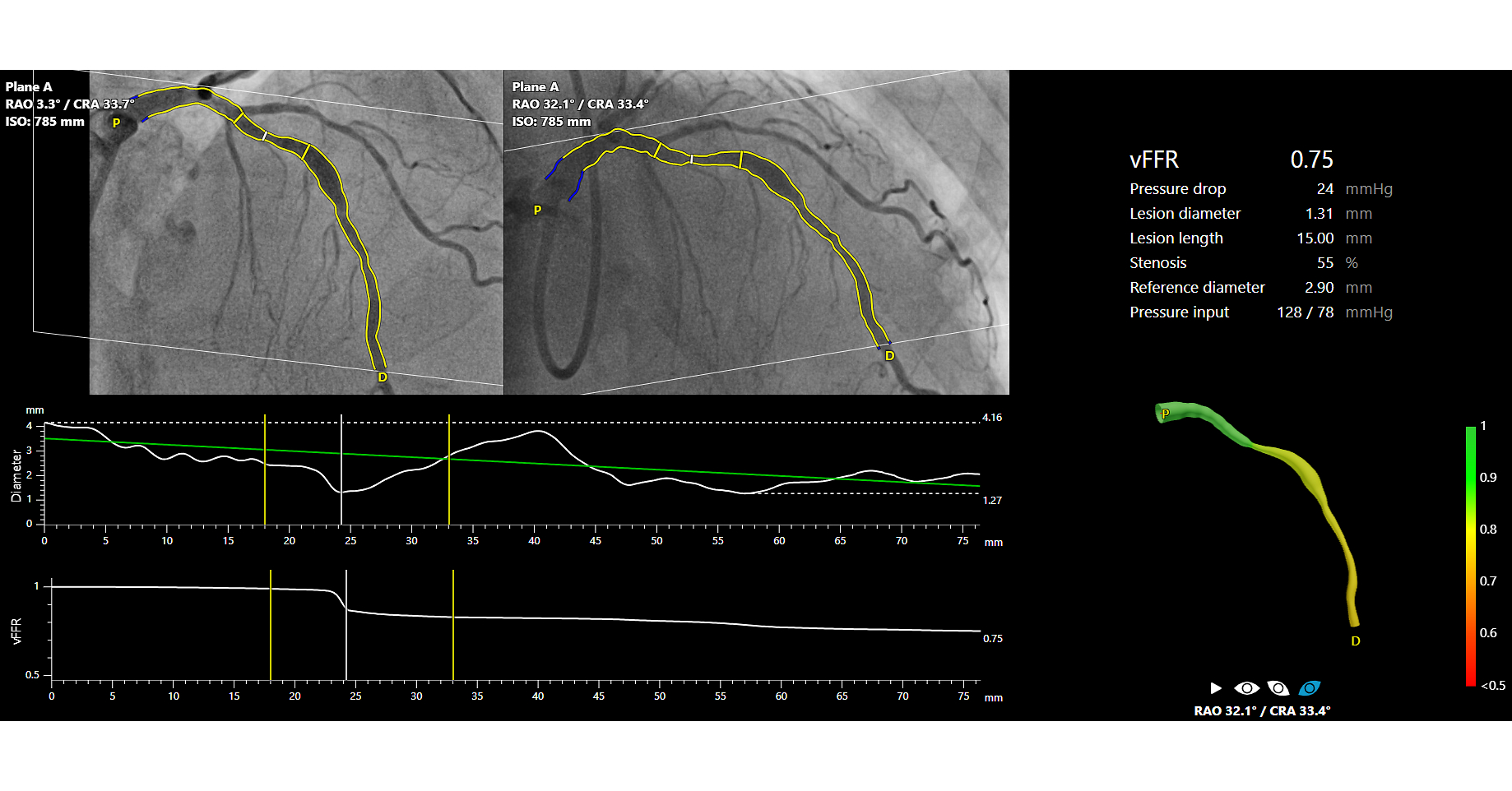
The randomized LIPSIA-STRATEGY trial, involving 1,053 patients with intermediate coronary stenoses, found CAAS vFFR-guided revascularization non-inferior to conventional pressure-wire FFR guidance on its primary clinical endpoint. The results add clinical evidence for the angiography-derived approach; the article also cites a faster, less invasive workflow and lower radiation exposure, but provides no numerical outcome rates or market reaction.
Analysis
Validation is not commercialization. Randomized non-inferiority evidence reduces a key clinical objection to angiography-derived physiology, but does not establish that hospitals will switch workflows, that the software is reimbursed or purchased separately, or that it improves provider economics. The release omits the absolute event rates, non-inferiority margin, subgroup results, and adoption or revenue data; verify these in the JACC paper before changing estimates. The claimed reductions in procedure time and radiation are plausible adoption levers, not yet quantified financial outcomes.
Competitive read-through: If adoption scales, pressure-wire use per eligible case could face gradual substitution. That is a watch item for Abbott and other suppliers of invasive physiology tools, not an immediate short thesis: a single software workflow is unlikely, without evidence of material exposure, to outweigh broader device portfolios. Angiography-platform vendors could benefit if validated physiology increases the value of installed systems, though Pie Medical Imaging’s ownership and distribution economics need verification. Competing image-analysis and coronary-physiology vendors face a higher evidence bar, but the trial does not establish a winner across products.
Horizon and reversal: Near term, expect limited read-through until full data and guideline or purchasing responses emerge. Over 1–3 months, monitor independent appraisal, reimbursement, and named-site adoption. Over 6–18 months, the upside case requires repeatable deployment and measurable software penetration; clinician preference, integration friction, or safety/effectiveness concerns could stall it. Non-inferiority should not be mistaken for superiority or a change in standard of care.
AllMind Terminal
AI-powered research, real-time alerts, and portfolio analytics for institutional investors.
Request TrialMarket Sentiment
Overall Sentiment
moderately positive
Sentiment Score
0.45
Key Decisions for Investors
- No immediate public-equity trade: the product sits within Pie Medical Imaging, and the supplied data do not establish a directly investable listed exposure or commercial materiality.
- Set an alert for the full JACC results: review absolute MACE rates, confidence intervals, non-inferiority margin, protocol deviations, and prespecified subgroups. Any weakness in these details would undermine the adoption thesis.
- Track 1–3 month catalysts: guideline commentary, reimbursement decisions, and hospital procurement or utilization evidence. Treat management adoption claims as unverified until supported by independent site or sales data.
- Watch Abbott and other invasive-physiology suppliers for evidence that pressure-wire volumes or guidance change; consider a relative-value position only if material product exposure and an actual volume/guidance impact are confirmed.
More News
- Binance co-CEO Richard Teng says hackers used fake job interviews, AI tool to steal $6.3 billion in crypto 108511116
- AMD stock jumps 7% on earnings as data center revenue nearly doubles
- Marvell-Lumentum Deal Puts Optical Networking at the Center of the AI Boom
- Marvell Technology could plunge on latest multibillion-dollar acquisition
- Disney Plans Thousands of Layoffs Companywide
- AI Inference Startup Fal Raises Capital at $16 Billion Valuation
From AllMind Research
- AllMind Platform Feature Updates - Fall 2026
- AI Credit Covenant Monitoring: From Clause to Review
- AI-Led Expert Interviews vs. Transcript Libraries
- Stop Treating AI Like a Chatbot: What Are Agents, SubAgents, MCP, and Skills, and How Do They Actually Work?
- Equity Research Automation Statistics: A 2026 Evidence Check