
Jeonbuk National University Study Reveals Path to Carbon-Negative Hydrogen Production
Source: PR Newswire
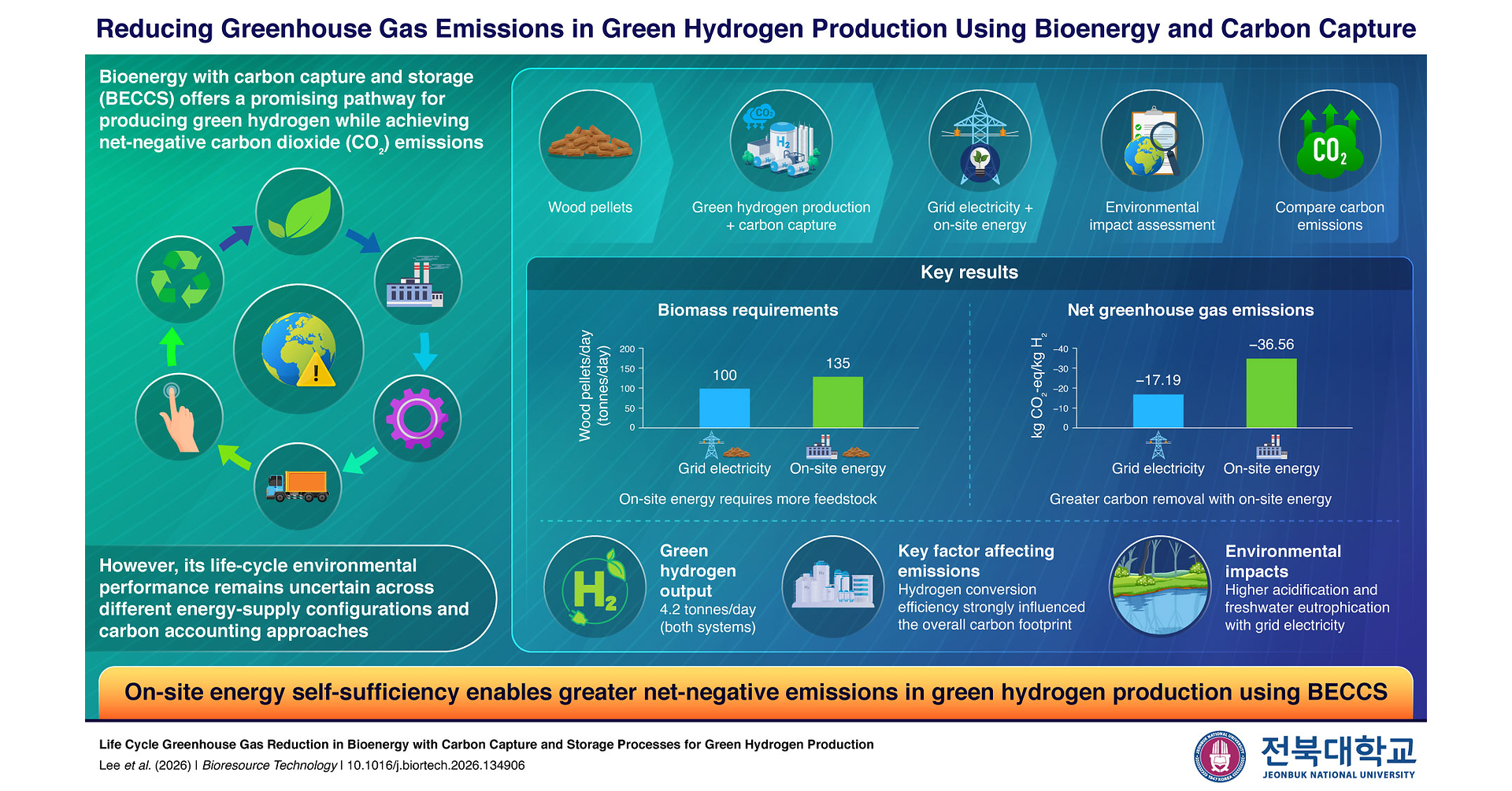
A Jeonbuk National University life-cycle analysis found that both biomass-based hydrogen systems with carbon capture and storage could achieve net-negative greenhouse gas emissions. Generating electricity on-site from biomass and recovered heat delivered substantially greater climate benefits than using grid power under the study’s assumptions, though soil and freshwater impacts, production efficiency, and sustainable biomass sourcing remain considerations. The findings offer guidance for future hydrogen plants but do not report commercial deployment or financial results.
Analysis
This is a pathway-design signal, not yet an investable demand signal. The potential advantage of on-site power is conditional: it trades grid-emissions exposure for additional biomass use, equipment and operating complexity, and foregone alternative uses of that feedstock. The commercial winner would therefore be a project with access to genuinely sustainable, low-cost residues and credible CO₂ transport, storage and measurement—not simply a hydrogen producer adding capture equipment. That creates a second-order constraint: scaling pellet demand could raise feedstock costs and weaken lifecycle claims, while competition for biomass may shift emissions elsewhere.
The study’s assumptions matter more than the “carbon-negative” label. Soil and freshwater impacts, biomass sourcing, transport distances, capture performance and durable storage all affect whether modeled removals survive independent lifecycle review. On-site generation may also perform less favorably where grid power is already low-carbon. No company identities or investable exposures are supplied, and the paper predates this release; absent project-level economics or policy changes, the news alone is unlikely to support a directional single-name trade.
Over 1–3 months, watch for project announcements, offtake terms, lifecycle certification and carbon-removal credit rules. Over 6–18 months, deployment economics and feedstock availability—not the modeled emissions result alone—will determine whether BECCS hydrogen can compete with electrolysis or conventional hydrogen with capture. A thesis based on premium carbon-removal value is falsified if independent MRV cannot verify durable net removals, or if sustainable feedstock and storage costs prevent viable project economics.
AllMind Terminal
AI-powered research, real-time alerts, and portfolio analytics for institutional investors.
Request TrialMarket Sentiment
Overall Sentiment
mildly positive
Sentiment Score
0.30
Key Decisions for Investors
- No immediate trade: the publication is not evidence of commercial deployment, contracted offtake, or improved earnings for a specific issuer.
- Build a watchlist across biomass-residue suppliers, carbon transport and storage, hydrogen project developers, and electrolyzer suppliers; assess exposure only when project-level feedstock, power, storage and offtake economics are disclosed.
- Treat any future BECCS-hydrogen investment case as conditional on independently verified lifecycle accounting, sustainable sourcing and durable CO₂ storage. Reassess if certification or policy rules exclude key feedstocks or do not reward verified removals.
- Catalyst check over the next 1–3 months: look for project commitments and offtake or carbon-credit terms. If announcements cite modeled removals without auditable supply-chain and storage data, do not underwrite a carbon-removal premium.
More News
- Magnificent 7 loses $1 trillion. The most eye-popping stats from Thursday's tech stock plunge
- Tech stocks are suffering their biggest selloff since Covid, as investors see premature end to AI datacenter boom
- Wall Street’s best post-midterm rally in 44 years lasted just one day—then $3 trillion vanished as chip stocks plunged over AI fears
- AI stocks plunge after election, driving down US markets
- Shield AI To Hit $28.8 Billion Value With $5.3 Billion Radar Acquisition
- Stocks Tank Amid Tech Sell-Off, Reversing Post-Election Rally