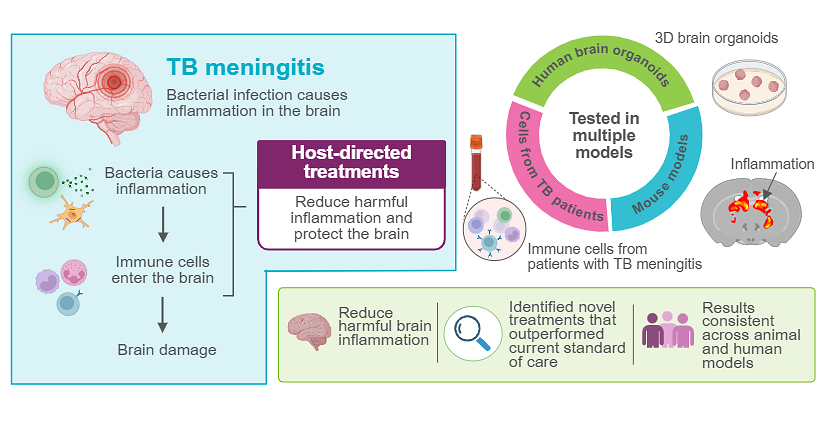
Study in Nature Communications (July 21, 2026) suggests host-directed immune-modulating therapies can outperform corticosteroids for TB meningitis inflammation control. Across mouse, human brain organoid, and patient-derived immune-cell models, therapies reduced neuroinflammation (and in mice improved mortality/neurological deficits) while keeping brain/organ bacterial loads unchanged, preserving antibiotic effectiveness. Notably, the paper highlights FDA-approved/late-stage drugs (including semaglutide) as candidates, supporting faster potential translation into clinical trials, though efficacy on survival and long-term neurological outcomes still needs confirmation.
This is not a near-term revenue event for public equities; the commercial relevance only emerges if a repurposed regimen survives a clinical proof-of-concept cycle in a rare, high-acuity indication. The main market mechanism is optionality: approved GLP-1s with broad safety databases gain incremental narrative support as multi-use anti-inflammatory platforms, which slightly improves the terminal value of the franchise but is too small to move the stock on its own.
The second-order winner set is narrower than it looks. Generic corticosteroid incumbency is not investable, but any company with an approved CNS-penetrant anti-inflammatory or host-directed asset could see a modest increase in partnering interest. The bigger implication is for academic/NIH-backed translational programs and small biotechs in infectious neurology: this kind of multi-model validation can unlock grant flow and BD conversations, but only after human outcome data proves that biomarker improvements translate into mortality or disability gains.
Contrarian view: the market may overread the semaglutide angle and underread the biology. The real signal is that host-directed therapy may become a legitimate adjunct paradigm in infectious disease, but the path is long, messy, and likely limited by trial size, endpoint selection, and low absolute prevalence. Near-term reversal risks are high: if early human data fails on neurologic outcomes, the whole story compresses back to academic interest within 6-18 months.
For PLCE specifically, there is no fundamental linkage; any move would be noise. The only actionable setup is as a watch item on GLP-1 platform optionality, not a day-trade catalyst.
AI-powered research, real-time alerts, and portfolio analytics for institutional investors.
Request TrialOverall Sentiment
moderately positive
Sentiment Score
0.35
Ticker Sentiment
