
AMD Is Not Expensive, It Is Early
Source: seekingalpha.com
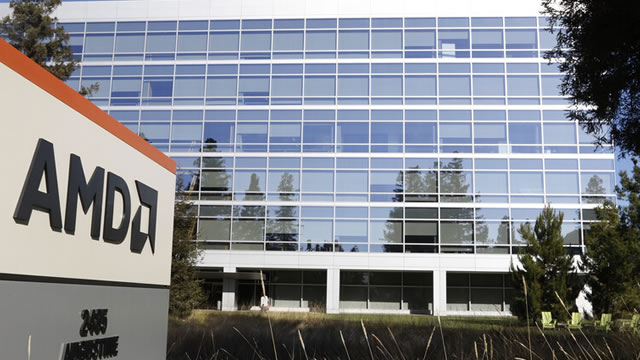
AMD is initiated at Strong Buy as Data Center revenue reached 58% of the business and grew 107% year over year, reinforcing its positioning as an AI infrastructure company. The bullish thesis cites confirmed large-scale Anthropic and Microsoft orders, Dell validation, robust guidance, and accelerating inference-workload demand. At 31x 2027 consensus forward earnings, the analyst sees valuation support for continued AI-driven growth.
Analysis
The investable question is not whether AMD can sell accelerators, but whether it can sustain software-enabled utilization and gross-margin progression as deployments move from qualification to repeat orders. Large cloud and model-provider wins can create a powerful reference-customer flywheel for enterprise buyers and OEMs, but they also increase customer-concentration risk: a delayed cluster acceptance, firmware issue, or weaker-than-expected inference token economics would be disproportionately visible in quarterly data-center guidance. The key 1-3 month checks are disclosed accelerator backlog conversion, cloud-instance availability, and management commentary on gross margin versus mix.
AMD's strongest second-order beneficiaries are likely DELL and SMCI on rack-scale attach, plus VRT on power and cooling content; TSM captures wafer demand but has less incremental upside given broad AI exposure. The more consequential competitive dynamic is versus NVDA: inference workloads are less software-sticky than frontier training, so a credible price/performance advantage could force NVIDIA to use pricing, bundled networking, or roadmap timing to defend share. That would be positive for buyers such as MSFT but could cap sector-wide accelerator margins over the next 6-18 months.
Consensus may be underestimating the execution discount required for a challenger platform: hardware availability alone does not establish a durable ecosystem, and reported revenue can precede production utilization. Conversely, if independent cloud benchmarks show comparable total cost per token and major customers expand beyond initial clusters, AMD's earnings estimates likely remain too low because market-share gains would be valued as structural rather than cyclical. Falsify the constructive view on a material data-center guide-down, flat-to-down AI gross margin, or evidence that deployments remain pilot-scale rather than recurring capacity additions.
AllMind Terminal
AI-powered research, real-time alerts, and portfolio analytics for institutional investors.
Request TrialMarket Sentiment
Overall Sentiment
strongly positive
Sentiment Score
0.72
Ticker Sentiment
Key Decisions for Investors
- Initiate a 6-12 month long AMD / short NVDA dollar-neutral pair only after the next earnings call confirms accelerator revenue conversion and stable-to-improving gross margin. Target 15-20% relative outperformance; exit if AMD reduces data-center outlook or NVIDIA's pricing commentary indicates no competitive concession.
- Add a smaller long DELL position into enterprise-server order data and earnings, with a 3-6 month horizon. The upside is operating leverage from AI rack attach; cap risk if infrastructure revenue growth fails to translate into backlog or if working-capital consumption accelerates.
- Use VRT as the lower-single-name-risk AI infrastructure expression over 6-18 months, funded by an underweight in broad semiconductor beta such as SMH. Accelerators require disproportionate power-density investment regardless of chip-share outcomes; reassess if hyperscaler capex guidance rolls over materially.
- Do not buy AMD upside options without implied-volatility and post-earnings move data. Set an alert for third-party inference cost-per-token benchmarks and cloud-instance utilization disclosures; a verified advantage is the catalyst for increasing gross exposure, while absent evidence argues for keeping the position relative rather than outright.
More News
- Next week brings major risks for the stock market, just as the AI trade keeps faltering
- CrowdStrike CEO's alarming prediction — plus, the sell-off spreads beyond tech
- What we want to see when this data center stock reports earnings next week
- Wall Street futures edge lower after AI selloff, telecom slide
- Goldman Sachs sees US stocks dip on tech earnings and macro shifts
- After previous day’s slump, trading is quieter among AI shares
From AllMind Research
- Anthropic IPO Preview: Valuation, Timing, and What to Watch
- Shein After the IPO: Venue, Valuation, and What Must Be Proved
- What AI Research Tools Should a Small Hedge Fund Buy First?
- Palantir (PLTR) Q4 2025 Earnings: 70% Revenue Growth, Then an 11% Single-Day Crash
- AlphaSense Pricing: What Public Contract Data Shows in 2026