
Global Veterinary Drugs Market to Reach USD 53.05 Billion by 2034 at 6.44% CAGR as Animal Disease Prevention and Pet Healthcare Spending Rise, Says Maximize Market Research
Source: PR Newswire
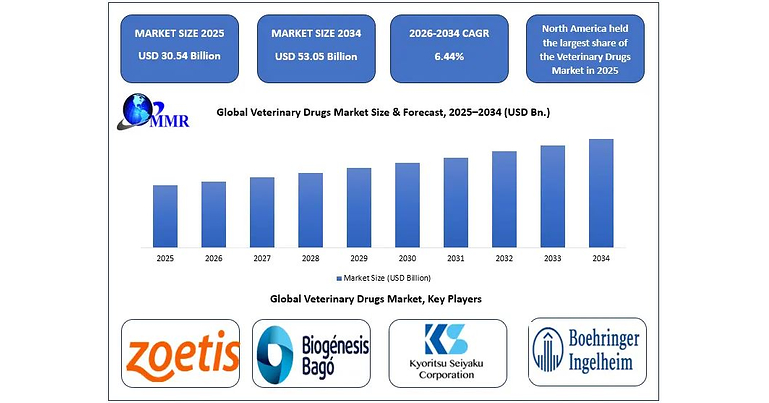
The global veterinary-drugs market is projected to grow from $30.54 billion in 2025 to $53.05 billion by 2034, a 6.44% CAGR, driven by preventive animal healthcare, rising companion-animal spending and livestock disease-control needs. Long-acting and specialty therapies are expanding, including Elanco's May 2026 launch of Befrena for canine dermatitis and new FDA authorizations targeting New World screwworm. Growth is tempered by stringent approval requirements and antimicrobial-resistance policy, with animal antimicrobial use declining 5% from 2020 to 2022.
Analysis
This is not a sector-growth surprise; the investable read-through is mix. ZTS and ELAN have the most operating leverage to the higher-value companion-animal shift toward dermatology, parasiticides and long-duration biologics, where compliance and pricing can sustain gross margins better than commodity livestock products. A disease-driven regulatory response can also extend the commercial life of installed brands through new species or indication labels, lowering customer-acquisition cost relative to de novo launches.
The offset is that antimicrobial stewardship is structurally unfavorable for anti-infective volume growth. PAHC's livestock-heavy exposure is more vulnerable to lower antibiotic intensity and producer-income cycles, while vaccines, diagnostics and parasiticides gain share; this creates a relative-margin advantage for ZTS over PAHC even if aggregate animal-health demand remains steady. Emerging-market expansion is not automatically accretive: local generics, distributor economics and FX can dilute realized pricing, particularly for ELAN.
Near term, the cited screwworm authorizations are too small to alter earnings estimates absent evidence of geographic spread or recurring prophylactic protocols. Over 1-3 months, FDA labeling, launch uptake and management commentary on specialty-product persistence are the relevant catalysts; over 6-18 months, the key question is whether biologics and extended-duration therapies expand the revenue pool or cannibalize recurring-dose sales. The market-research forecast itself is not independently investable and should not drive estimate changes.
Contrarian risk: long-acting products can reduce annual unit frequency, so headline innovation may be revenue-neutral unless premium pricing and new-patient penetration exceed cannibalization. A discretionary-spending slowdown would first show up in clinic visits and prescription compliance, pressuring ELAN more than ZTS given ZTS's superior scale and portfolio breadth. Thesis is falsified by companion-animal organic growth falling below mid-single digits, worsening product mix, or guidance signaling incremental promotional spend without corresponding net-price realization.
AllMind Terminal
AI-powered research, real-time alerts, and portfolio analytics for institutional investors.
Request TrialMarket Sentiment
Overall Sentiment
mildly positive
Sentiment Score
0.32
Ticker Sentiment
Key Decisions for Investors
- Maintain a 6-12 month long ZTS / short PAHC pair: ZTS offers higher-quality companion-animal and parasiticide/biologic mix while PAHC faces greater antimicrobial and livestock-cycle sensitivity. Enter on relative underperformance rather than this release; reassess if ZTS companion-animal organic growth drops below 5% or PAHC delivers two consecutive quarters of improving livestock margins.
- Place ELAN on a 1-3 month catalyst watch around specialty-dermatology launch metrics and FY guidance, rather than initiate on the market forecast. Upgrade to long only if prescription persistence, net pricing and launch contribution demonstrate that specialty growth offsets legacy-product pressure; cut if incremental commercialization expense rises faster than revenue.
- Avoid using MRK or BAYN as primary expressions: animal health is immaterial to consolidated earnings, making any positive veterinary read-through unlikely to overcome their larger pharmaceutical and agricultural-chemical drivers.
- Monitor FDA antimicrobial implementation and livestock producer margins as sector risk alerts. A tighter-than-expected enforcement timeline or falling cattle/poultry economics supports adding PAHC downside protection; broad-based outbreak expansion with mandated prophylaxis would favor ZTS and, secondarily, ELAN.
More News
- Evonik shares rise 3% on restructuring plan
- Cantor Fitzgerald reiterates Neutral rating on Merck stock at $120
- BioNTech Stock Recently Got Downgraded. But Is Wall Street Underestimating Its Cancer Pipeline?
- South Korean solar stocks jump as curbs on Chinese sector expected to remain in place
- Paramount will need to release way more movies to make this merger work
- Sullivan: Wall Street admits it doesn't know where oil is headed. There's one stock they do agree on