
Is DLTR a Buy as Earnings Improve but Margin and Tariff Risks Remain?
Source: zacks.com
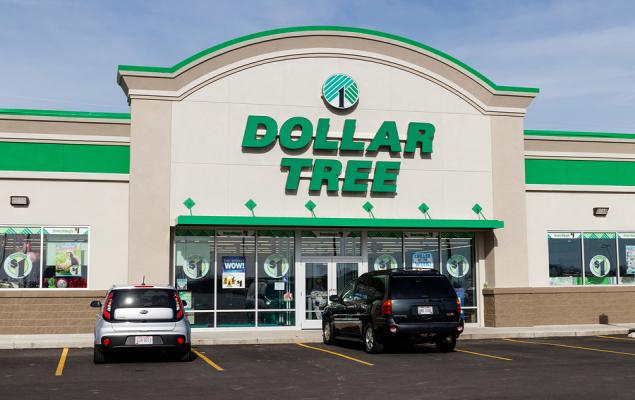
Dollar Tree's Q2 sales rose 7% to $4.89 billion, comparable sales increased 3.7%, and adjusted EPS of $1.39 exceeded the $1.13 consensus estimate, excluding a $1.31-per-share tariff-refund benefit. The company raised fiscal 2026 adjusted EPS guidance to $7.70-$8.05, including a 60-cent tariff-refund benefit, while maintaining revenue guidance of $20.5-$20.7 billion and 3-4% comp growth. Gross margin expanded 850bps to 42.9%, but 680bps reflected tariff refunds; Dollar Tree plans to reinvest about $210 million and expects a 50-cent Q3 EPS headwind, leaving the margin recovery vulnerable to spending, fuel, inflation and sales-mix pressures.
Analysis
The key underwriting issue is normalization, not the headline earnings beat: a large portion of current-year EPS is non-recurring, while the reinvestment program creates a lag between expense recognition and any traffic/productivity payoff. DLTR can still rerate over the next 1-3 months if estimate revisions continue, but the market will likely value it on its post-refund earnings power; absent sustained discretionary comp acceleration and SG&A leverage, the apparent forward P/E discount is materially less compelling than it screens.
Multi-price penetration is strategically constructive because it expands assortment and gross-profit dollars per transaction, but it also moves DLTR closer to a conventional value retailer rather than a pure $1.25 concept. The second-order risk is that price architecture broadening increases SKU complexity, markdown exposure and labor demands just as management is funding store-condition and marketing initiatives. DG is the cleaner beneficiary if lower-income consumption remains resilient, given stronger traffic momentum; TJX retains the superior defensive setup if consumers trade down in discretionary categories because its opportunistic buying model is less exposed to direct import-cost swings.
Contrarian view: the selloff may already discount a weak third quarter, making the next earnings print a low bar if reinvestment costs are phased more slowly than guided. But a durable long requires proof that traffic—not ticket—drives comps and that gross margin excluding tariff effects holds near the newly improved run-rate. Watch the next quarter for traffic growth above 1%, discretionary comp above 2%, and no further deterioration in the SG&A rate; failure on any two would likely trigger FY EPS de-risking and renewed multiple compression over 6-12 months.
AllMind Terminal
AI-powered research, real-time alerts, and portfolio analytics for institutional investors.
Request TrialMarket Sentiment
Overall Sentiment
mildly positive
Sentiment Score
0.20
Ticker Sentiment
Key Decisions for Investors
- Maintain DLTR on watch rather than initiate ahead of the next print; buy only after evidence of >1% traffic growth and ex-refund gross-margin stability. Target a 15-17x multiple on normalized EPS if confirmed, with a stop/reassessment on a guidance cut or SG&A deleverage.
- Express relative value over 3-6 months: long DG / short DLTR in equal dollar amounts. DG offers stronger traffic-led demand validation, while DLTR carries greater risk that reported earnings power normalizes lower; close if DLTR's traffic exceeds DG's for two consecutive quarters or DG guides margins down.
- For a tactical DLTR rebound trade, use a defined-risk call spread dated beyond the next earnings release only after consensus has reset to the low end of guidance. The trade depends on reinvestment being viewed as temporary; avoid naked calls because tariff-policy and import-cost volatility can overwhelm operational upside.
- Prefer TJX as the defensive retail long if macro data weaken over the next 1-3 months; it is better positioned for trade-down in apparel/home while avoiding DLTR's tariff-refund comparability problem. Reassess if consumer discretionary spending inflects sharply higher, which would reduce off-price share-gain potential.
More News
- These 2 stocks are 'a cornerstone part of our portfolio' as AI security risks grow
- South Korean solar stocks jump as curbs on Chinese sector expected to remain in place
- Trump Says US Team Met With Iranians at UNGA
- Paramount will need to release way more movies to make this merger work
- Meta is breaking out after introducing Muse AI agent. Where the stock is going, according to the charts
- The 10-year Treasury yield just hit 5% for the first time since 2007 — is a 1970s-style ‘stagflation’ on the return?
From AllMind Research
- Anthropic IPO Preview: Valuation, Timing, and What to Watch
- Shein After the IPO: Venue, Valuation, and What Must Be Proved
- What AI Research Tools Should a Small Hedge Fund Buy First?
- Weekly Update: New Reporting Features and More Sources for Document Search
- How to Evaluate AI Report Writers for Financial Analysis