
Anti-AI Politics is about to Get Big
Source: Bloomberg
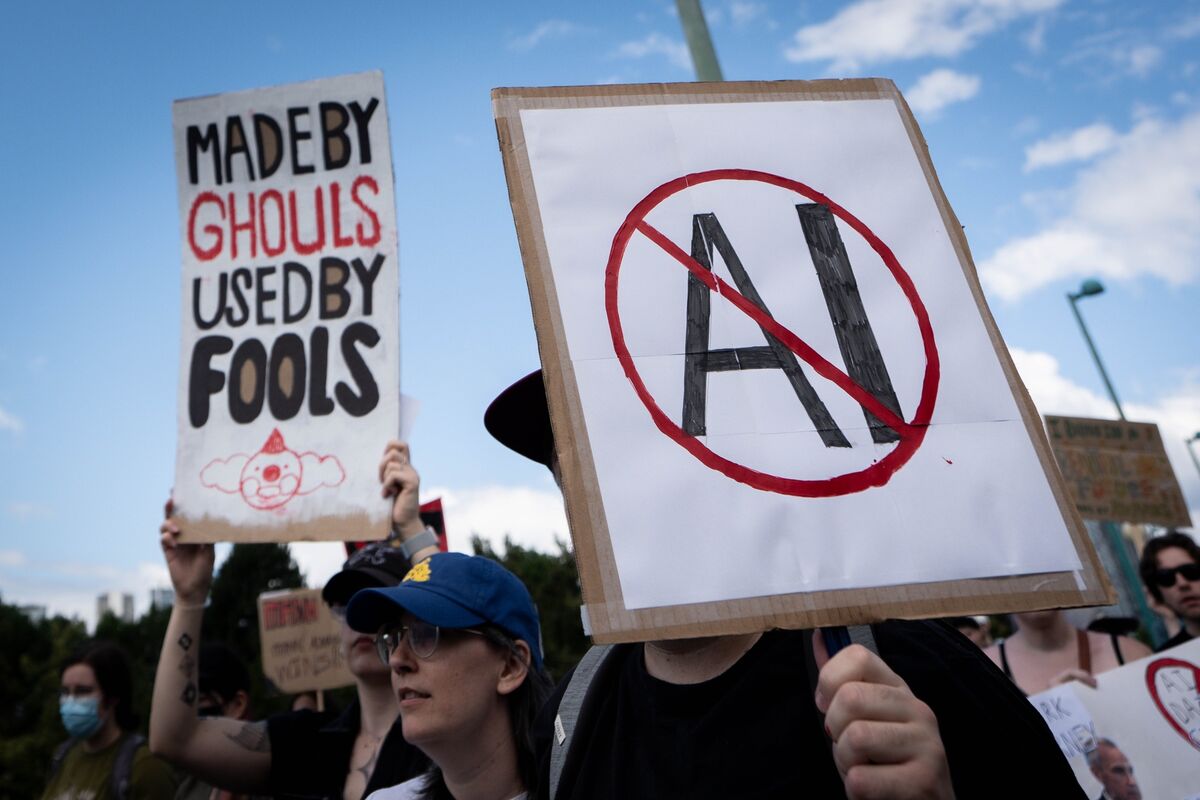
The article headline argues that political opposition to artificial intelligence is poised to grow, drawing a comparison between AI fears and climate-change concerns. No supporting news content, financial data, policy actions, or company-specific developments are provided in the available text.
Analysis
The investable transmission channel is not broad "AI regulation," but local power, labor, and permitting constraints. Political backlash is most likely to surface first through data-center siting delays, electricity-rate disputes, water-use restrictions, and disclosure mandates rather than an immediate federal model-development ban. That creates a 6-18 month risk premium for hyperscaler capex beneficiaries whose valuations assume uninterrupted deployment: NVDA, AVGO, VRT, ETN and power-intensive data-center operators could face multiple compression if announced capacity cannot be energized on schedule.
The less obvious beneficiary is regulated utility infrastructure with credible transmission and generation build-out plans, including CEG, NRG and select regional utilities, provided regulators permit rate-base recovery. A populist framing around household power bills could instead cap allowed returns or impose cost-sharing on large-load customers; this is a material tail risk for utilities serving major data-center corridors. Near term, this is not a standalone trading signal: policy rhetoric has low earnings relevance until it translates into permit denials, interconnection queues, tariff filings, procurement restrictions, or hyperscaler capex-guide changes.
Consensus may overestimate the chance of a single nationwide anti-AI legislative outcome and underestimate fragmented state and municipal friction. Fragmentation favors incumbent hyperscalers—MSFT, AMZN, GOOGL and META—because they can shift workloads geographically, secure long-term power contracts, and absorb compliance costs, while smaller GPU-cloud and data-center developers have concentrated site risk. The key falsifier is sustained evidence that large-load projects continue receiving timely interconnection approvals and hyperscaler capex guidance rises without incremental power-cost pressure.
AllMind Terminal
AI-powered research, real-time alerts, and portfolio analytics for institutional investors.
Request TrialMarket Sentiment
Overall Sentiment
neutral
Sentiment Score
0.00
Key Decisions for Investors
- No new directional AI-policy position on this signal alone; treat it as a monitoring thesis over the next 1-3 months, given the low immediate earnings visibility.
- Maintain a quality tilt within AI infrastructure: prefer MSFT, AMZN, GOOGL and META over more concentrated data-center developers and GPU-cloud operators until project-level power and permitting exposure is verified.
- Create alerts for utility commission filings, large-load tariff proposals, and data-center permit/interconnection decisions in Virginia, Texas, Arizona and Ohio; a material adverse ruling would support a tactical short basket in VRT/ETN versus long CEG or NRG.
- Before initiating any AI-infrastructure hedge, require confirmation from either a hyperscaler capex reduction, a delayed energized-capacity milestone, or a utility tariff that shifts grid-upgrade costs to large-load customers; absent one of these, policy concern is more narrative than tradeable.
More News
- France’s latest debt warning describes a country where governance is breaking down — and even doing too little, too late is barely possible
- Here’s the ‘core economic flaw’ in the AI bull case as stock and bond trades unravel, according to a top economist
- Lula, Bolsonaro rally supporters on final day before Brazil presidential runoff
- Israelis hold final rally against Netanyahu ahead of what may be the most consequential election in the country’s history
- 5 big analyst AI moves: ’Uniquely catalyst-rich’ months ahead for SpaceX
- Brookfield to open Qatar office as it expands Middle East operations
From AllMind Research
- Anthropic IPO Preview: Valuation, Timing, and What to Watch
- Shein After the IPO: Venue, Valuation, and What Must Be Proved
- What AI Research Tools Should a Small Hedge Fund Buy First?
- AI Portfolio Monitoring: Build an Alert Policy Analysts Can Audit
- The Great Divergence: North American Banking at the Crossroads of Monetary Policy and Agentic AI (Q4 2025 Bank Earnings)