
OncoLens' AI-Powered Analytics Platform Helps Large Academic Cancer Center in Florida Cut Referral Delays and Surface Care Gaps Hidden in Clinical Notes
Source: PRWeb
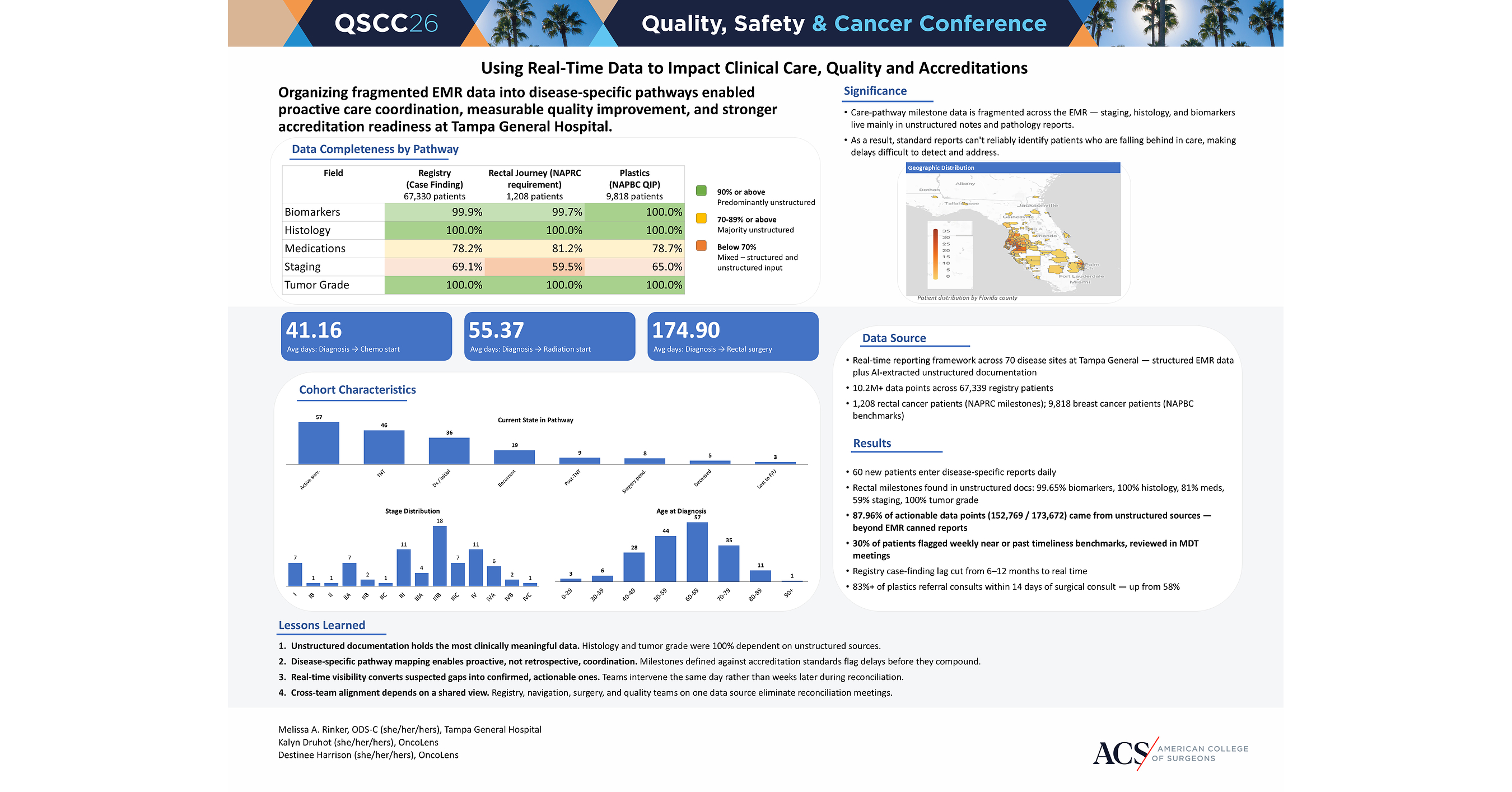
A case study of OncoLens Analytics at a Florida academic cancer center analyzed 10.2M data points across 67,339 patients and found 87.96% of actionable cancer data came from unstructured text that standard EMR reports could not surface. After adoption, on-time plastic surgery referrals rose from 58% to >83% (a +25pp improvement) and registry case-finding lag was eliminated versus a prior 6–12 month delay. The AI platform also reduced manual chart review burden (previously ~75 minutes per patient) by extracting milestones from narrative notes in real time.
Analysis
This is a demand-validation datapoint for AI that extracts meaning from clinical text, not a near-term earnings event. The economic read-through is strongest for vendors that sit between the EMR and the care pathway: if they can reliably surface referral timing, staging, and genetics triggers, they can convert hidden data into measurable throughput gains, which is what drives renewals and expansion in provider software. The bigger implication is not just workflow savings; it is capture of downstream revenue for oncology-adjacent testing and consult services when missed eligibility is found earlier.
The main second-order winner is oncology diagnostics and precision-medicine platforms that benefit from better identification of patients eligible for molecular/genetics workups. That supports names like TEM more than broad hospitals, because the value chain reward comes from increased test volume and data network effects, not from a marginal improvement in hospital operating expense. By contrast, legacy reporting modules inside large EMR stacks face a subtle headwind: if point solutions prove they can out-detect native reports, procurement teams may carve out budget for specialized analytics instead of upgrading the core stack.
The contrarian risk is that this remains a pilot-style story until there is durable ARR disclosure, multi-site expansion, and evidence that false-positive/false-negative rates don’t create clinician distrust. The headline productivity improvement is real, but the market may be overestimating how much of that translates into software revenue versus just labor reallocation inside the health system. Time horizon matters: no immediate market reaction, 1-3 month catalyst is customer proof points or contract wins, and 6-18 month upside depends on whether EMR incumbents respond with native AI extraction that compresses the standalone moat.
AllMind Terminal
AI-powered research, real-time alerts, and portfolio analytics for institutional investors.
Request TrialMarket Sentiment
Overall Sentiment
mildly positive
Sentiment Score
0.35
Key Decisions for Investors
- No immediate trade in POELF or TSTS; the names are too illiquid and the case study is not a monetization event. Treat as a watch item for contract announcements, not a catalyst-driven entry.
- Add TEM to a 1-3 month watchlist as the cleanest public-market beneficiary of earlier genetics-testing capture; initiate only if management shows accelerating oncology data revenue or provider/customer expansion. Upside is better than broad healthcare software if referral conversion lifts test volumes, but thesis fails if growth decelerates next quarter.
- Keep ORCL on the short list as a potential incumbent beneficiary/competitor tell: if Oracle Health starts disclosing comparable unstructured-data extraction traction, it would imply the moat is moving into the core EHR rather than staying with point solutions. No short unless evidence shows share loss in provider analytics.
- If you want a low-conviction expression, use VHT as a hedge against over-interpreting the story: the workflow savings are real but too small to move hospital multiples in the near term. This is more likely to be a stock-picker event than a sector rerating.
- Set a 90-day alert for evidence of multi-site ARR conversion or registry/quality-market expansion. Without that, the right posture is flat: the gap between clinical utility and public-equity earnings impact is still too wide.
More News
- Nvidia GPUs are everywhere. Here are the ways companies are accessing them
- Bank of America is bullish on these top stocks ahead of earnings
- As companies pour billions into Earth-based AI infrastructure, Google is taking the data center race off-planet
- AI's Supercharging a Scam Economy Bigger Than the Cocaine Trade
- Verizon stock heads for worst day since 2002 as SpaceX U.S. network plans whack telcos
- Big Tech is betting $700 billion on AI. Healthcare will decide whether the bet pays off