
Global Boiler Market to Grow at 6.67% CAGR as Industrial Heat Demand, Energy-Efficient Boiler Technologies and Low-Emission Heating Solutions Gain Momentum, says Maximize Market Research
Source: PR Newswire
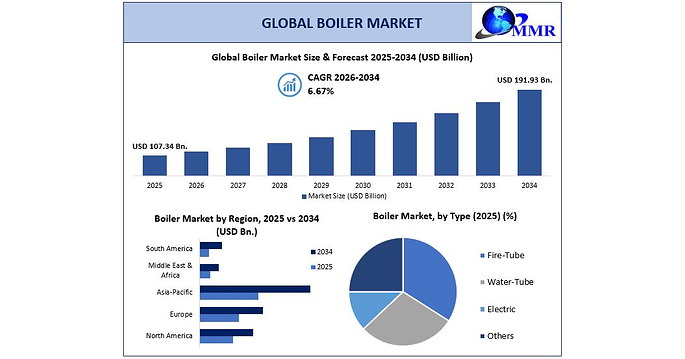
The global boiler market is forecast to grow from USD 107.34 billion in 2025 to USD 191.93 billion by 2034, a 6.67% CAGR for 2026–2034; Asia-Pacific accounted for about 45% of global installations in 2025. The report cites demand for industrial heat and energy-efficient systems, including electric, biomass and low-emission boilers. Separately, Thermax, through subsidiary TBWES, secured an approximately INR 1,600 crore boiler-package order for an 800 MW ultra-supercritical power plant in Madhya Pradesh.
Analysis
This is weak evidence for a sector-wide earnings revision: the forecast comes from a market-research vendor, gives little segment-level economics, and does not establish what share of spending reaches listed suppliers. The useful signal is mix, not headline market growth. Electrification, controls and heat recovery can shift value toward power-management and automation vendors, while reducing demand for conventional combustion equipment in some applications. But industrial electric heat depends on grid capacity, delivered power prices and retrofit economics; biomass adds fuel-supply and permitting constraints. Those bottlenecks could preserve conventional boiler demand longer than decarbonization narratives imply.
The Thermax order is a subsidiary-level project award, not evidence of consolidated earnings conversion or a read-through to all boiler makers. For Babcock & Wilcox Enterprises (BW), it is competitive context—not a disclosed loss or gain. The key diligence is project backlog conversion, margin, cash collection and warranty exposure. Avoid mapping the report’s generic growth forecast onto A. O. Smith (AOS), Carrier (CARR) or Lennox (LII): their listed identities and product exposure do not establish material sensitivity to industrial boiler demand. Siemens (SIE) and ABB (ABBN) may benefit indirectly if electrification and controls investment accelerates, but the article provides no company-specific order evidence.
Near term, likely little durable price signal. Over 1–3 months, watch company orders and guidance for industrial heating, controls and power equipment. Over 6–18 months, the main risk is that electrification grows slower than projected because of grid, power-cost and retrofit constraints; conversely, tighter emissions rules could accelerate replacement. The consensus-style growth narrative underweights technology substitution and project execution, making total-market CAGR a poor proxy for incumbent returns.
AllMind Terminal
AI-powered research, real-time alerts, and portfolio analytics for institutional investors.
Request TrialMarket Sentiment
Overall Sentiment
mildly positive
Sentiment Score
0.30
Key Decisions for Investors
- No trade on the market-size forecast alone. Treat it as a low-confidence demand backdrop, not an earnings catalyst; the report lacks segment revenue, pricing, regional profitability and independent order validation.
- Put BW on a watchlist rather than buying the Thermax read-through. Verify BW’s relevant backlog, new awards, segment margins and cash conversion; reconsider only if reported orders and guidance show durable improvement. Falsifier: backlog growth without margin or cash-flow conversion.
- Monitor SIE and ABBN as indirect electrification/controls exposures, not pure-play boiler beneficiaries. Upgrade the thesis only on disclosed order acceleration tied to industrial heating, grid connection or automation; reassess if power costs or project delays weaken customer economics.
- Track policy, industrial power prices, grid interconnection and retrofit paybacks over the next 6–18 months. A sustained acceleration in electric-boiler orders would support the substitution thesis; continued conventional boiler awards alongside stalled electrification would falsify it.
More News
- The AI race may be decided by financing—not just better chips
- Hexagon jumps 3% as J.P. Morgan sees earnings upside from recovering demand
- Sweden’s startups will raise $5 billion in 2026. Our secret sauce is 150 years old
- Why Park Aerospace Stock Is Plunging Today
- The world needs Ukraine’s grain. Its farmers are running out of reasons to plant
- Israel’s economy prospers despite years of war, but prices worry voters