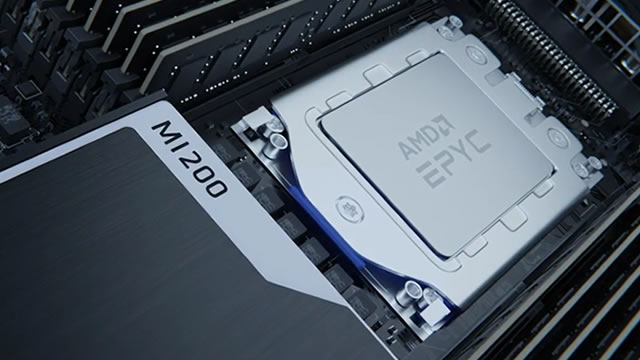
AMD is positioned for a major AI catalyst, with expectations of another large AI customer announcement after Microsoft and existing OpenAI/Meta deals. Speculation around a possible Anthropic agreement, alongside the Helios rack launch and Microsoft partnership, could further lift AI chip revenue. The article frames valuation at roughly $500 as reasonable versus consensus for ~$19 EPS in 2028, arguing internal targets and potential new deals could push $20–30 EPS.
AMD’s real upside here is not the headline count of logos; it is the optionality that comes from being treated as a credible second source in AI accelerators. That can reduce the valuation haircut tied to customer concentration and raise confidence that AI revenue is not purely a one-cycle, one-customer story, which matters more for the multiple than for next quarter’s EPS.
The first-order beneficiary is AMD, but the second-order winners are hyperscalers that can bargain harder on pricing and availability. If Microsoft and Meta continue multi-sourcing, the competitive pressure is on NVIDIA’s mix and gross margin, not just its unit share; the catch is that this only matters if AMD can prove deployment scale and software adoption, not just announce pilots.
Consensus may be overestimating how much a new customer announcement changes 2028 earnings, because the market is likely to pay for proof of sustained utilization, not press-release optionality. The tradeable catalyst is a 1-3 month rerating if the next event includes volume, rack-level deployment, or margin-friendly product detail; the thesis breaks if the announcement is vague, if hyperscaler capex rolls over, or if advanced-packaging supply remains the bottleneck. Over 6-18 months, the key question is whether AMD earns a persistent share of AI spend or just a series of episodic wins.
AI-powered research, real-time alerts, and portfolio analytics for institutional investors.
Overall Sentiment
mildly positive
Sentiment Score
0.35
Ticker Sentiment
