
Salesforce’s stock has been riding a wave of AI optimism. Here’s what Wall Street wants to see next.
Source: MarketWatch
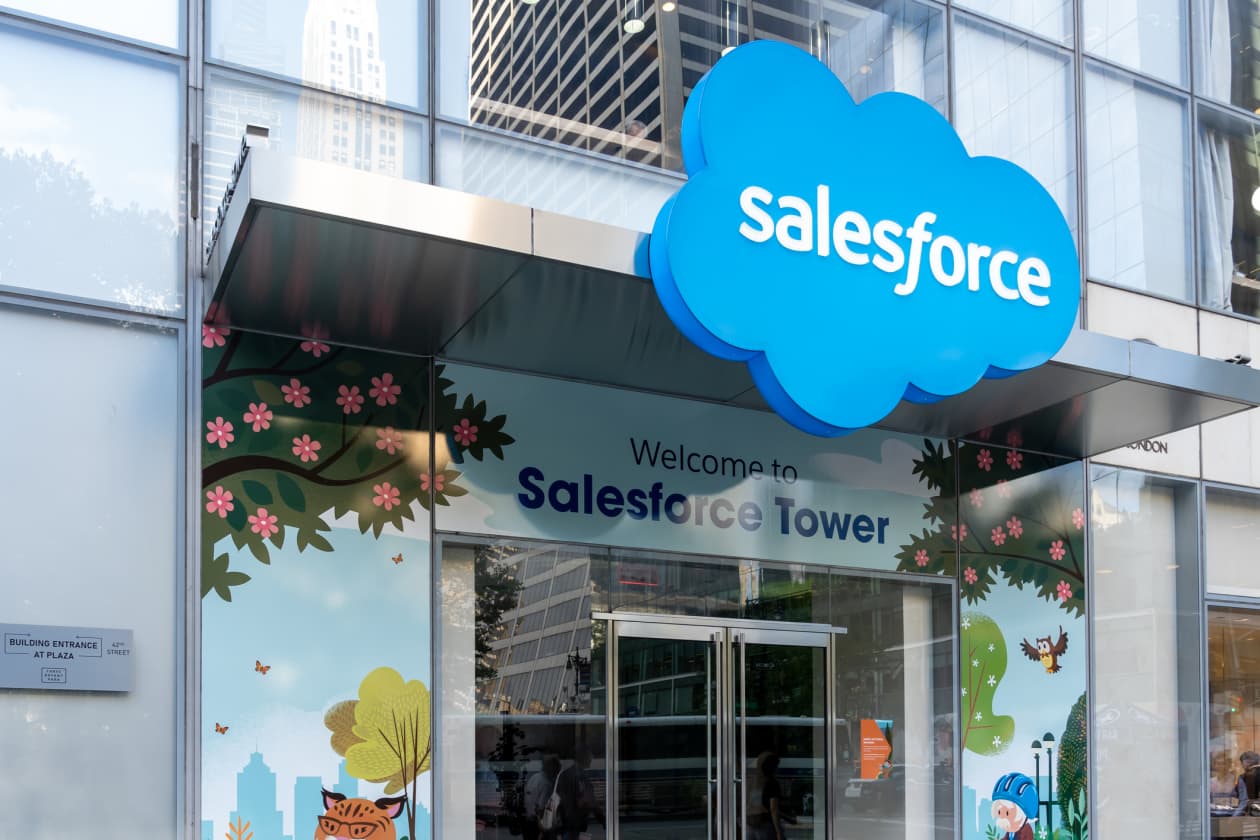
Salesforce shares surged 23% following its latest earnings report, driven partly by investor confidence in its AI strategy. The company’s Dreamforce conference next week will be a key test of whether it can sustain that momentum, particularly through details on its recently announced Claudeforce partnership with Anthropic. Analysts see the event as pivotal for validating Salesforce’s increasingly prominent AI narrative.
Analysis
CRM now needs to convert AI enthusiasm into a measurable monetization bridge: paid-seat attach rates, incremental net revenue retention, and implementation demand rather than product demonstrations. The key issue is whether AI lifts average contract value enough to offset potential seat rationalization as customers automate service, sales, and support workflows. A credible disclosure of AI-related bookings or a distinct premium SKU trajectory could support another multiple leg-up; generic adoption metrics would likely expose the post-earnings move as positioning-driven.
Near term, Dreamforce is a high-expectation event, creating asymmetric downside if pricing, customer references, and partner economics are vague. Over the following 1-3 months, channel checks on Accenture (ACN), Deloitte implementation demand, and CRM's remaining-performance-obligation growth should determine whether AI is creating incremental budgets or merely reallocating existing cloud spend. Microsoft (MSFT), ServiceNow (NOW), and HubSpot (HUBS) are the relevant competitive read-throughs: CRM wins if its data layer and workflow integration reduce switching friction, but loses pricing power if customers view foundation-model access as commoditized.
The contrarian view is that CRM's installed base makes it one of the better enterprise-AI distribution vehicles, but distribution alone does not ensure margin expansion. Higher inference, cloud, and revenue-share costs could delay operating leverage if AI is bundled to protect renewals rather than sold as a premium product. The thesis is falsified by a deceleration in cRPO/RPO, weak large-deal commentary, or guidance that implies AI revenue is offsetting—not adding to—core subscription growth.
AllMind Terminal
AI-powered research, real-time alerts, and portfolio analytics for institutional investors.
Request TrialMarket Sentiment
Overall Sentiment
mildly positive
Sentiment Score
0.22
Ticker Sentiment
Key Decisions for Investors
- Do not chase CRM into Dreamforce after the sharp re-rating; use a post-event pullback of 8-10% without a reduction in forward revenue guidance to initiate a 3-6 month long. Upside requires quantified AI bookings and sustained double-digit cRPO growth; exit if management frames AI primarily as a retention tool.
- For event exposure, buy a defined-risk CRM call spread 3-6 months out rather than near-dated calls: target a 5-8% out-of-the-money long call financed by selling a 15-20% out-of-the-money call. This captures a monetization surprise while limiting exposure to post-conference implied-volatility compression.
- Run a 1-3 month relative-value watch: long CRM versus short NOW only if CRM discloses premium AI pricing, paid customer conversion, and no margin dilution. Without those disclosures, favor NOW as the cleaner workflow-AI monetization expression and avoid the pair.
- Monitor ACN bookings and CRM cRPO at the next reporting cycle as confirmation signals. A rising implementation pipeline plus accelerating cRPO supports adding exposure; either metric weakening would indicate AI spend is being funded from existing IT budgets rather than expanding them.
More News
- From Wall Street to Silicon Valley, Anthropic IPO poised to have massive 'trickle-down effect'
- +52%, +39%, +22%: Our AI just called these blue-chip breakouts
- Mastek Q2 FY27 presentation: revenue tops ₹1,000 cr as AI shift accelerates
- Microsoft offers buyouts to nearly 30% of workforce in ongoing AI shift
- Anthropic’s IPO filing shows explosive growth, risks and staggering costs
- EQT becomes the nation’s leading natural gas ‘juggernaut’ with a $13B deal as data center, export demand surges