
NX3 Commercial Group's Marco Zando Closes Back-to-Back Net Lease Deals Totaling $6.9 Million
Source: Newswire
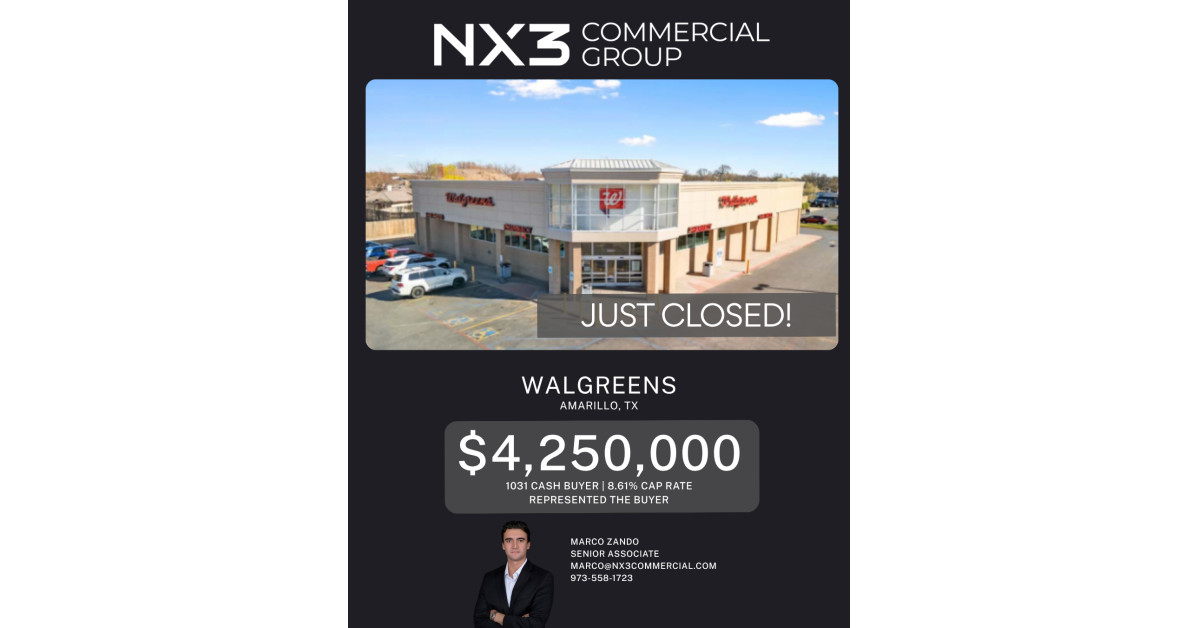
NX3 Commercial Group reported back-to-back net lease deal closings totaling $6.911 million, featuring a Jacksonville Starbucks at $2.661 million (6.14% cap rate) and a Amarillo Walgreens at $4.25 million (8.61% cap rate). The pair closed within weeks and produced a blended cap rate of ~7.66%, highlighting solid buyer demand for well-located, credit-tenant net lease product, particularly for 1031 exchange timelines.
Analysis
This reads more like a liquidity check on private-capital appetite than a fundamental signal for the underlying operating companies. The important mechanism is that well-located, single-tenant real estate is still clearing because 1031 capital needs yield and speed, which keeps a floor under quality net-lease cap rates even when financing costs are elevated. That is supportive for the public net-lease complex over 1-3 months, but it is not a broad green light for retail fundamentals.
The second-order winner is the corridor ecosystem: assets near strong daily-need traffic nodes tend to retain value because adjacent tenants reduce vacancy and re-tenanting risk. That helps names with long-duration, investment-grade lease books more than it helps cyclical retailers, and it can indirectly support suburban/home-improvement traffic proxies like HD at the margin. The loser is lower-liquidity, older pharmacy real estate, where buyers are effectively demanding a higher risk premium; that keeps obsolete-box repricing pressure alive and limits how much private-market comps can expand.
Risk is mostly rates and credit spreads. If the 10-year pushes materially higher or investment-grade spreads widen, the 1031 bid can evaporate quickly and cap-rate compression will reverse within weeks, not quarters. Contrarian view: the market may be overreading this as a bullish read-through for SBUX; the asset premium is about site format and tenant credit, not an impending step-change in earnings power. The more actionable takeaway is to watch whether net-lease volume stays firm into month-end; if it does, public REIT multiples may get a small valuation tailwind, but if transaction velocity slows, this becomes a noisy one-off rather than a trend.
AllMind Terminal
AI-powered research, real-time alerts, and portfolio analytics for institutional investors.
Request TrialMarket Sentiment
Overall Sentiment
mildly positive
Sentiment Score
0.25
Ticker Sentiment
Key Decisions for Investors
- Long O / short VNQ on a 1-3 month horizon if Treasury yields stay range-bound; thesis is that quality net-lease valuation should outperform broad REIT beta as private demand remains intact. Risk: if the 10-year breaks higher or REIT debt spreads widen, cover quickly.
- Use any sympathy strength in SBUX to fade rather than chase; this is not an earnings inflection signal. Better entry is on a broader consumer selloff, where the stock can be held for its operating leverage rather than this real-estate data point.
- Buy HD only on pullbacks as a secondary beneficiary of strong suburban traffic nodes; treat it as a low-conviction support trade, not a core call. Falsifier: if housing data weakens sharply or consumer traffic rolls over, the read-through disappears.
- Set a watch alert on 10-year yields and BBB/REIT spreads; if either moves 50 bps or more adverse from here, assume the private-market bid for net lease assets is fading and reduce exposure.
- No direct trade on the transaction itself; if you need exposure, express it through public net-lease landlords rather than the brokerage/newsflow names.
More News
- Stocks saw new highs and big declines: How the volatile AI trade moved last week's market
- After France, is Italy next? Goldman Sachs flags bond risks as Rome's deficit widens
- Musk says Terrafab chip factory could outperform rivals despite challenges
- Will Warner Bros. kill Skydance — or will David Ellison kill Warner Bros?
- Last-Minute Lawsuit Upends Cable One’s $480 Million Mega Broadband Deal
- Nvidia GPUs are everywhere. Here are the ways companies are accessing them