
The Longevity Market Is Leaving $350 Billion on the Table in Unmet Demand From Women in Perimenopause and Menopause
Source: PR Newswire
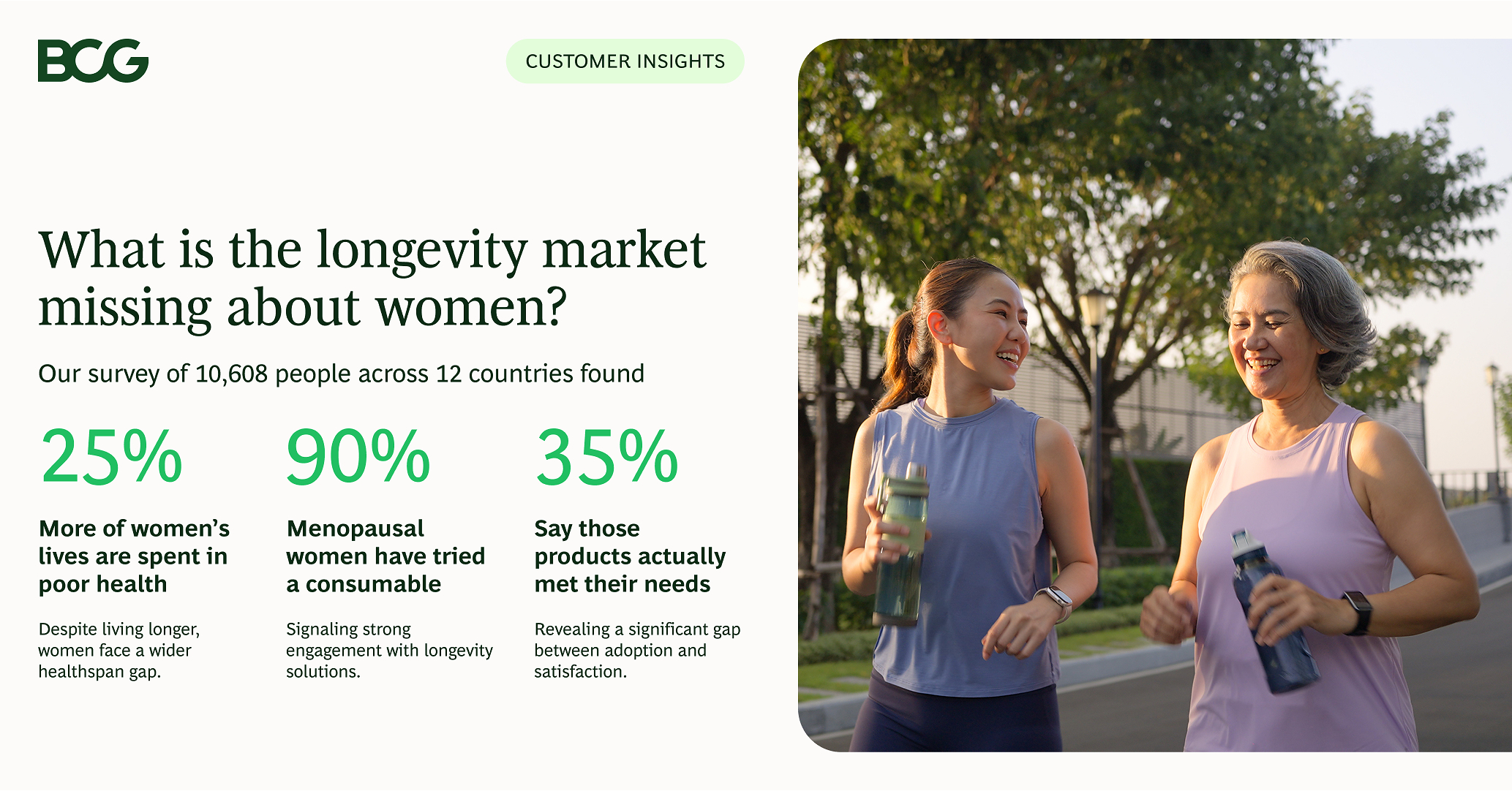
BCG estimates an underserved $350 billion global longevity-health opportunity for the roughly 1 billion women in menopause already spending on longevity solutions. Perimenopausal and menopausal women spend a median $84 per month, versus $68 for other women and $73 for men, while roughly one-third would raise spending to $108 monthly for proven offerings. Despite adoption rates 15-22 percentage points above other groups, satisfaction remains near 50%, highlighting an opportunity for healthcare and consumer-health companies to address unmet needs beginning in women’s mid-30s.
Analysis
This is not a near-term earnings catalyst, but it sharpens the investable distinction between menopause as a low-value OTC/supplement category and clinically validated, longitudinal care. The largest value capture should accrue to companies that can combine diagnosis, prescribing, monitoring, and employer or payer distribution—not brands simply adding “women’s wellness” SKUs. Public-market beneficiaries with credible exposure are Astellas (ALPMY), through Veozah adoption, and Organon (OGN), whose women’s-health commercial infrastructure could become more valuable if providers increasingly treat midlife hormonal care as a recurring clinical category.
The underappreciated bottleneck is care delivery rather than consumer willingness to pay. Telehealth platforms such as Hims & Hers (HIMS) and Doximity (DOCS) could benefit only if they demonstrate compliant clinician supply, retention, and prescription conversion; otherwise customer-acquisition costs and regulatory scrutiny will prevent attractive unit economics. Diagnostics firms Quest (DGX), Labcorp (LH), and Thermo Fisher (TMO) have optionality from expanded hormone and cardiometabolic screening, but broad hormone-testing demand is not equivalent to reimbursed, high-margin testing volume.
Over 6-18 months, employer-benefit adoption and clinical-guideline changes are more important than survey-driven consumer demand. The risk to the thematic bull case is that treatment remains fragmented, evidence standards tighten around compounded hormones and supplements, and branded therapy uptake is constrained by payer utilization management. Consensus may overestimate the addressable market by treating stated spending intent as incremental health-care spend; conversion will depend on measurable symptom improvement, safety data, and reimbursement rather than marketing.
AllMind Terminal
AI-powered research, real-time alerts, and portfolio analytics for institutional investors.
Request TrialMarket Sentiment
Overall Sentiment
mildly positive
Sentiment Score
0.18
Key Decisions for Investors
- Maintain a 6-12 month watch on ALPMY rather than initiate solely on this survey: look for sequential Veozah prescription growth, payer-formulary expansion, and management disclosure that supports durable uptake. Thesis is falsified by slowing new-patient starts or material price/rebate pressure; the catalyst is quarterly prescription and reimbursement data.
- Screen OGN for a tactical long only if management identifies menopause-related product, partnership, or provider-channel expansion with funded guidance support. OGN has the relevant commercial adjacency, but its broader leverage and execution profile mean the theme alone does not justify a position.
- Avoid treating HIMS as a clean menopause trade until it discloses product-specific retention, clinician capacity, and contribution-margin data. A long could be considered after evidence of recurring-care economics; absent that, the likely outcome is incremental marketing spend with limited multiple support.
- Use DGX/LH as confirmation indicators, not primary longs: sustained growth in women’s-health or endocrine testing volumes over two consecutive quarters would validate a diagnostic spillover. Without reimbursed test-volume evidence, the impact on consolidated revenue is likely immaterial.
- Do not add broad consumer-health exposure on this signal. OTC supplement brands face the highest risk of commoditization, claims scrutiny, and low switching costs, while the survey provides no evidence that demand will translate into branded pricing power.
More News
- South Korean solar stocks jump as curbs on Chinese sector expected to remain in place
- Trump Says US Team Met With Iranians at UNGA
- Meta is breaking out after introducing Muse AI agent. Where the stock is going, according to the charts
- Australia’s IDP shares drop after rejecting $494 mln Blackstone offer
- Meta’s Muse AI is exploding in popularity—and already drawing heated backlash from another tech giant
- Lennar shares pop as Berkshire builds almost a 10% stake in beleaguered homebuilder