
Turnkey Restaurant Demand Jumps 400% as Franchise Resales Gain Ground, New Report Finds
Source: PR Newswire
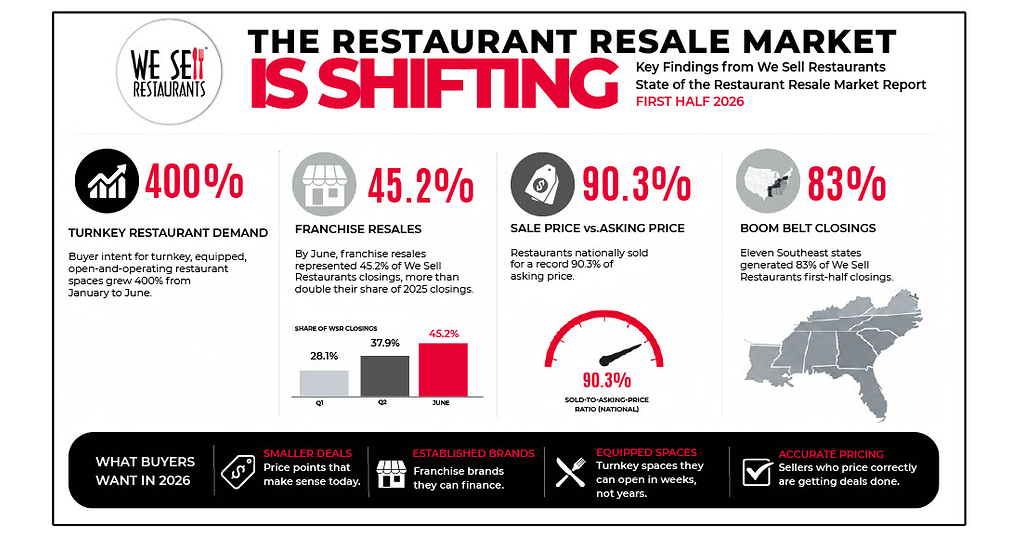
We Sell Restaurants’ H1 2026 report flags a contracting resale market: restaurant sales fell 5.8% YoY in Q1 and 11.7% in Q2, and the national median sale price dropped 11.8% to $205,000. Despite lower volumes, economics haven’t deteriorated materially—cash flow multiples rose to 2.41 and sold-to-asking-price reached 90.3%, suggesting buyers are shifting to smaller, turnkey/equipped and established franchise deals amid higher rates (prime 6.75%, SBA 7(a) ~9–11.5%). The firm reports strength vs the market with Q1 closings up 17.5% YoY and Q2 closings flat as the broader market fell nearly 12%.
Analysis
The important signal is not simply weaker transaction volume; it is a forced mix shift toward financeable, turnkey assets. That tends to advantage low-overhead intermediaries and mature franchise systems that can recycle existing units cheaply, while pressuring the broader ecosystem that depends on expensive build-outs, tenant improvements, and new-concept openings. Second-order losers are commercial contractors, FF&E suppliers, and landlords underwriting big TI packages; the hidden winner is any platform that monetizes turnover rather than brand-new unit creation.
Near term, this is a price-discovery regime, not a clean demand recession. If credit stays tight, smaller deals can keep closing even as headline activity falls, so share gains for the best-positioned broker/franchise networks can persist over the next 1-3 months. The reversal risk is financing: a 50-75 bp easing in acquisition lending rates or a sharp drop in Treasury yields would quickly reopen larger-ticket transactions and reduce the scarcity premium for turnkey assets.
Over 6-18 months, the structural tailwind is inventory: retiring owners and Southeast migration keep feeding the pipeline. The contrarian miss is that lower median prices are not automatically bearish for the broker model; if conversion remains high, lower deal size can still mean stable or rising commission dollars. The best public-market expression is to favor asset-light, franchise-heavy operators (YUM, DPZ, QSR, MCD) over capex-intensive growth concepts and any trade tied to new-store rollout velocity. Falsify the thesis if closings stall while inquiry volumes remain elevated, or if lower financing costs trigger a broad re-acceleration in larger transactions.
AllMind Terminal
AI-powered research, real-time alerts, and portfolio analytics for institutional investors.
Request TrialMarket Sentiment
Overall Sentiment
mildly negative
Sentiment Score
-0.12
Ticker Sentiment
Key Decisions for Investors
- Long YUM / short SHAK for 1-3 months: the pair expresses the view that financeable, asset-light franchise economics outperform capex-sensitive expansion. Risk/reward is attractive if rates stay high; invalidate the trade if 10Y yields and SBA borrowing costs roll over sharply.
- Watchlist only on FCD.UN.TO: do not chase the headline activity. Add only if the next quarterly disclosure shows transaction-related revenue or close rates continuing to outgrow the market, confirming share gains rather than a one-off data point.
- Set an alert on SBA 7(a) spreads and Fed-cut expectations: if acquisition financing falls by 50 bp or more, reduce or exit the franchise-vs-buildout pair because larger deals and new development can rebound faster than expected.
More News
- Pilot killed in attacks by Iran-backed Houthis on Riyadh airport; Saudi-led coalition vows 'firm' response
- Delta Air Lines cuts 2026 forecast on fuel surge, but CEO says demand is still strong
- Is AI the new China Shock?
- Why is T-Mobile stock tumbling today?
- The AI race may be decided by financing—not just better chips
- Why is Verizon stock sliding today?
From AllMind Research
- Anthropic IPO Preview: Valuation, Timing, and What to Watch
- Shein After the IPO: Venue, Valuation, and What Must Be Proved
- What AI Research Tools Should a Small Hedge Fund Buy First?
- AllMind's Data Standardization Methodology: Our Approach to Fundamentals
- What Makes Financial Data Ready for AI Research?