
New Report Reveals Profound Divide Between U.S. and Global Public Perceptions of Data Centers
Source: PR Newswire
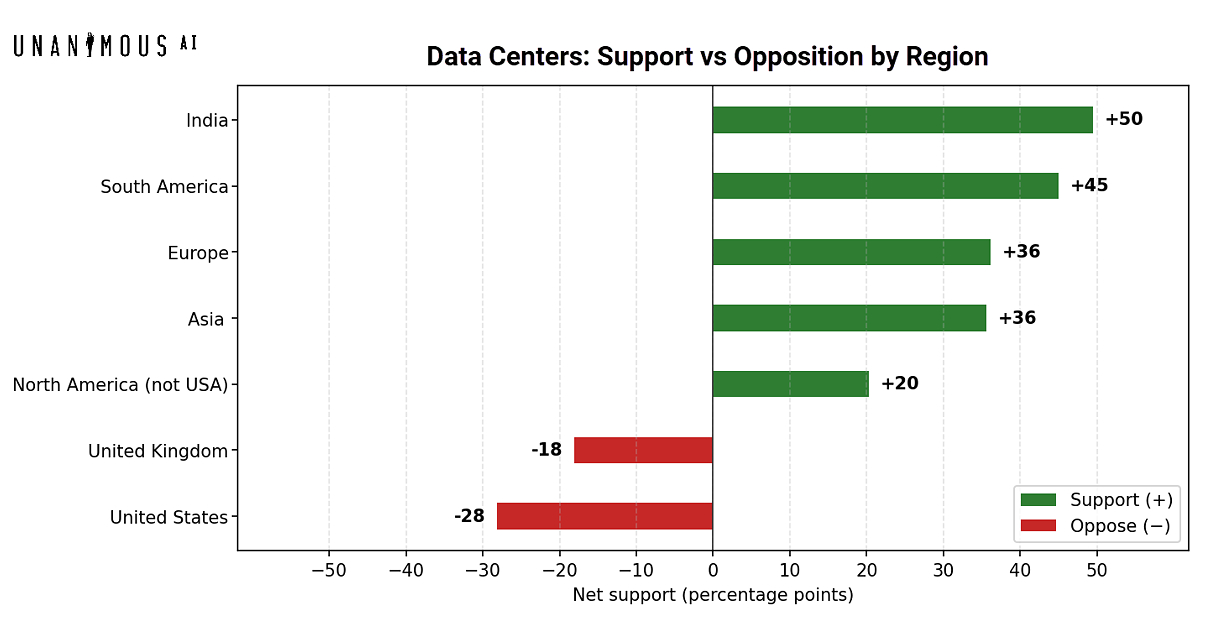
A Unanimous AI study found 80% of U.S. respondents initially oppose local AI data-center construction, versus 57% globally. Even with assurances on water, power rates, environmental impact, noise and tax revenue, 64% of Americans remained opposed while global support rose to 63%; 39% of U.S. opponents cited corporate deception or broken tech-company promises. The findings signal permitting and community-relations risks for U.S. data-center expansion, although 79% of Americans and 81% globally expect construction to accelerate over the next three years.
Analysis
This is not a near-term earnings signal—an unrepresentative, sponsor-produced survey does not establish permitting outcomes—but it reinforces the direction of travel: U.S. AI capacity economics are increasingly governed by local approval, interconnection, and power-cost politics rather than GPU availability. The first-order impact is longer development lead times and higher mitigation spend, which favors scaled operators with land banks, utility relationships, and contractual power access (EQIX, DLR, CORZ) over speculative campus developers and merchant power-dependent projects.
The more material second-order exposure sits with hyperscalers. If domestic campuses face multi-quarter delays, MSFT, AMZN, GOOGL and META can preserve compute growth through overseas deployment and leased capacity, but the outcome is less favorable for U.S.-centric AI infrastructure: slower asset turns for data-center REITs and greater pressure on utilities to fund transmission before load is fully contracted. Regulated utilities with explicit large-load tariff mechanisms—such as DUK, SO and D—can recover capital investment, while utilities lacking ratepayer protections face political risk that can cap authorized returns or delay incremental load approvals.
Over the next 1-3 months, the relevant catalysts are state commission rulings on large-load tariffs, municipal zoning decisions, and utility interconnection queues—not further sentiment surveys. Over 6-18 months, recurring opposition could create regional scarcity value for already-entitled powered sites, supporting DLR/EQIX pricing, while shifting incremental AI capex toward jurisdictions with faster permitting and more reliable generation. The contrarian point is that opposition may ultimately be bullish for incumbents: constrained new supply can raise colocation rents and the value of secured power, provided hyperscaler demand remains intact.
The thesis is falsified if utilities broadly adopt cost-allocation frameworks that insulate households while accelerating interconnection, or if AI capex guidance moderates enough to relieve regional power scarcity. Watch announced data-center lease commencements, utility large-load pipeline conversion, and any material reduction in hyperscaler 2027 capex plans.
AllMind Terminal
AI-powered research, real-time alerts, and portfolio analytics for institutional investors.
Request TrialMarket Sentiment
Overall Sentiment
mildly negative
Sentiment Score
-0.32
Key Decisions for Investors
- No directional trade solely on this survey; treat it as an alert to monitor permitting and tariff developments in DLR, EQIX, CORZ, DUK, SO and D service territories over the next 1-3 months.
- Favor a 6-18 month long DLR / short a broad U.S. office-REIT proxy (IYR) pair only if quarterly leasing and pricing show continued constrained-supply benefits; target relative upside from rent repricing, with exit if DLR backlog or renewal spreads weaken for two consecutive quarters.
- Maintain preference for hyperscalers with geographic deployment flexibility—MSFT and AMZN—over domestically concentrated AI infrastructure developers; the hedge is that foreign capacity and leased deployments can absorb U.S. delays, though this advantage disappears if global power constraints broaden.
- For utility exposure, require evidence of approved large-load cost recovery before adding DUK, SO or D. A rejected tariff, mandated ratepayer subsidy, or interconnection-delay guidance would be a catalyst to reduce exposure rather than buy the headline dip.
More News
- Wall Street’s Nasdaq hits all-time high as AI frenzy gathers pace
- Data-Center Bet Makes ESDS One of India’s Best New Listings
- Asia stocks ride tech wave higher, oil stays subdued
- South Korean solar stocks jump as curbs on Chinese sector expected to remain in place
- ‘I have a big decision to make’: Trump had a ‘good meeting’ with Iranian officials warning he may ‘annihilate the Islamic Republic’
- Zelenskyy says Ukraine ready for energy truce with Russia after Trump talks