
Eagle Plains' Partner Xcite Uranium Commences Drill Program at the Lorado Uranium Project, Saskatchewan
Source: Newswire
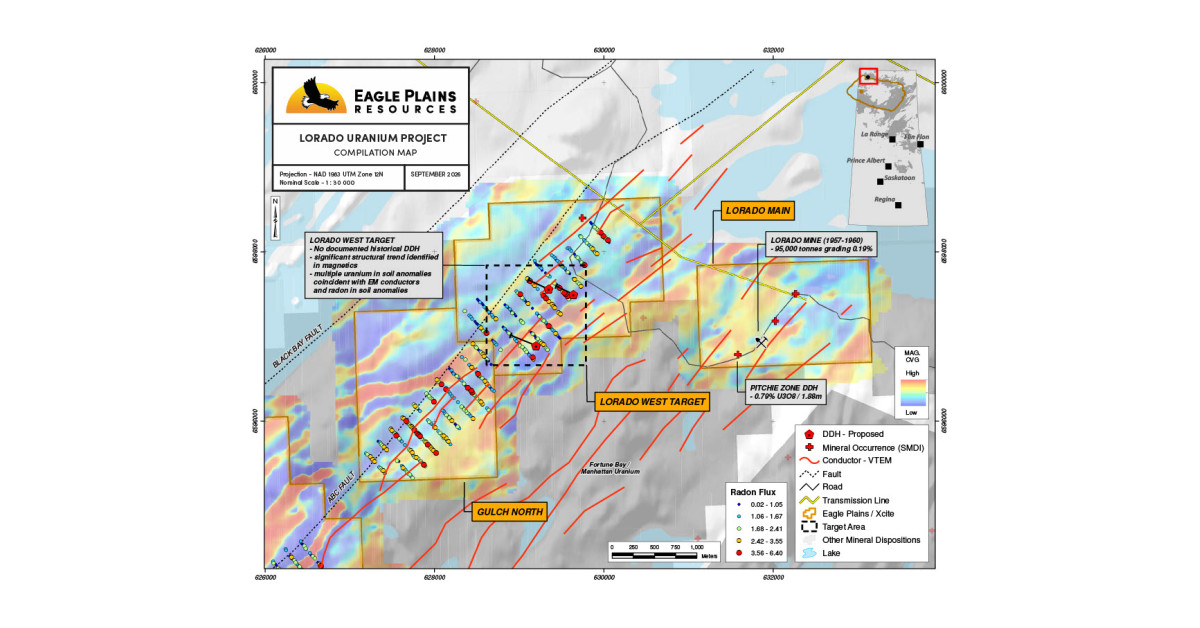
Eagle Plains Resources’ partner Xcite Uranium has commenced a 1,200m diamond drilling program (3 holes) at the Lorado uranium project in Saskatchewan to test near-surface mineralization using EM/radon/soil anomaly targets. The approved 2026 Lorado budget is ~C$1.1M, including C$875k allocated for drilling (C$225k fieldwork already completed). While the program is a positive operational update, it provides no new assay results, keeping near-term impact largely limited.
Analysis
This is more a financing/de-risking event than a fundamental discovery update. In microcap uranium, the market usually pays for two things only: proof of mineralization and proof that someone else will fund the next hole. Here the funded partner structure matters more than the drill start itself, because it lowers Eagle Plains’ near-term cash burn while preserving upside optionality if the target works; that asymmetry is the main reason the stock can outperform on a weak tape even before assays.
Second-order, the real winner is the project-generator model: every successful partner-funded campaign can incrementally de-risk the wider portfolio and improve the implied value of the royalty/option stack. If the first holes are encouraging, the follow-on catalyst is not just geological — it is a higher probability of a larger earn-in, which can re-rate the retained interest and NSR faster than the direct exploration spend would imply. If results disappoint, the downside is likely compressed to sentiment because the funding burden sits mostly with the partner.
The consensus mistake is treating drill initiation as signal rather than noise. For this kind of name, the move is usually underwritten by uranium-beta and scarcity value in the district, but that can reverse quickly if assays are barren or if the broader uranium basket rolls over. The key falsifiers are simple: no visible mineralization in the first assays, no meaningful follow-up program, or a sector-wide pullback in URA/URNM that dries up speculative capital over the next 1-3 months.
AllMind Terminal
AI-powered research, real-time alerts, and portfolio analytics for institutional investors.
Request TrialMarket Sentiment
Overall Sentiment
neutral
Sentiment Score
0.10
Ticker Sentiment
Key Decisions for Investors
- EGPLF: keep on catalyst watch, but do not chase the drill-start headline; wait for assay results over the next 4-8 weeks before sizing any position. Risk/reward is poor on announcement alone.
- If uranium beta remains firm, consider a small starter long EGPLF on any post-news pullback, sized as an option on discovery rather than a core position; thesis breaks on weak first assays or no follow-up drilling.
- For cleaner sector exposure, prefer URA or URNM over single-name microcaps if the goal is uranium beta over the next 1-3 months; microcap idiosyncratic risk dominates here.
- Use a relative-value alert: if EGPLF outperforms URA materially into assay release, fade strength unless the technical commentary turns into hard mineralization evidence.
More News
- AI Capex, Gamble or Jackpot?: Market Snapshot
- ‘I told you so’: China’s chip sector is making breakthroughs—and U.S. export controls are the reasons why
- CoreWeave credit default swaps hit distress levels as investors sour on AI debt
- The IPO drought is driving private equity-owned companies to the debt market to pay investors
- Hybe shares jump 10% as K-pop sensation BTS' tour lifts earnings hopes
- Giant Taiwanese chipmaker TSMC confirms it’s in talks with Elon Musk to join ‘Terafab’ complex in Texas: ‘The AI market continues to be very strong’