
Global Exosomes Market to Reach USD 2,250 Million by 2034 at 28.8% CAGR as Expanding Applications in Drug Delivery, Diagnostics, and Regenerative Medicine Fuel Market Growth, Reports Maximize Market Research
Source: PR Newswire
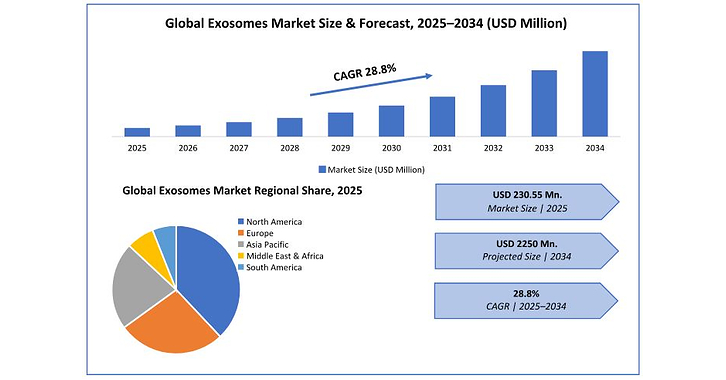
Maximize Market Research projects the global exosomes market to grow from $230.55 million in 2025 to $2.25 billion by 2034, implying a 28.8% CAGR for 2026-2034. Growth is expected to be driven by exosome-based drug delivery, diagnostics, biomarker discovery and regenerative medicine, with North America leading and Asia-Pacific emerging as a high-growth region. Commercialization remains constrained by high R&D costs, manufacturing complexity, limited standardization and regulatory hurdles.
Analysis
This is not an earnings-relevant demand signal for the large life-science tools complex. For TMO, DHR, TECH, QGEN, SRT3 and LONN, exosome workflows are a small, fragmented research-use-only consumables opportunity; even rapid category growth is unlikely to move consolidated revenue or valuation without evidence of durable clinical adoption. The nearer-term economic beneficiaries are vendors with recurring pull-through from sample preparation, characterization and analytics—not therapeutic developers—because research spending precedes, and often fails to convert into, commercial manufacturing demand.
The critical bottleneck is reproducible identity, potency and batch-release testing at scale. That favors incumbents with installed analytical workflows and bioprocess validation relationships—TMO, DHR and SRT3—over single-product exosome platforms, but it also means revenue realization is likely measured in years rather than quarters. A meaningful inflection would require FDA guidance or several well-controlled late-stage datasets that establish exosome-specific CMC standards; absent that, customers are likely to retain internal or bespoke processes and purchasing remains grant- and trial-budget driven.
Consensus may over-extrapolate a high percentage CAGR from a tiny, loosely defined base that mixes instruments, reagents, services and aspirational therapeutic value. The failure of earlier exosome-therapeutics efforts, including Codiak's bankruptcy, illustrates that biological targeting claims do not solve manufacturing consistency or clinical efficacy. CAPR and AEMD carry far greater binary sensitivity than tools suppliers: positive platform headlines can lift sentiment, but neither should be underwritten on broad market-growth forecasts without program-specific human efficacy, safety and scalable CMC disclosure.
AllMind Terminal
AI-powered research, real-time alerts, and portfolio analytics for institutional investors.
Request TrialMarket Sentiment
Overall Sentiment
moderately positive
Sentiment Score
0.42
Ticker Sentiment
Key Decisions for Investors
- No directional position based solely on this report; treat it as a low-impact thematic datapoint rather than a catalyst for TMO, DHR, TECH, QGEN, SRT3 or LONN over the next 1-3 months.
- Maintain any existing life-science-tools exposure tilted toward TMO/DHR versus exosome-pure-play speculation: their installed-base and consumables economics monetize workflow standardization if it occurs, while downside is diversified. Reassess only if management quantifies exosome-related order growth or raises organic-growth guidance.
- Place CAPR on a catalyst watchlist rather than initiating on sector enthusiasm. Consider a defined-risk long only ahead of disclosed clinical or regulatory milestones if data demonstrate durable efficacy plus scalable manufacturing; falsify on a CMC delay, safety signal, or cash runway below 12 months.
- Avoid long AEMD on exosome-market read-through. Its valuation is driven by company-specific clinical validation and financing risk, not broad research-tool demand; any position requires confirmation of trial progress and non-dilutive funding.
- For a 6-18 month thematic expression, monitor SRT3 and LONN for disclosed advanced-therapy capacity utilization and customer GMP exosome contracts. A confirmed multi-year manufacturing award would be a more investable signal than market-size projections; lack of such contracts by 2027 supports the view that commercialization remains delayed.
More News
- Cantor Fitzgerald reiterates Neutral rating on Merck stock at $120
- BioNTech Stock Recently Got Downgraded. But Is Wall Street Underestimating Its Cancer Pipeline?
- Wall Street’s Nasdaq hits all-time high as AI frenzy gathers pace
- Data-Center Bet Makes ESDS One of India’s Best New Listings
- Asia stocks ride tech wave higher, oil stays subdued
- South Korean solar stocks jump as curbs on Chinese sector expected to remain in place
From AllMind Research
- Anthropic IPO Preview: Valuation, Timing, and What to Watch
- Shein After the IPO: Venue, Valuation, and What Must Be Proved
- What AI Research Tools Should a Small Hedge Fund Buy First?
- Research Workflows, Report Format Selection, and Interactive Synthesis
- Can ChatGPT Analyze a 10-K? A Verification Workflow