
ASUS Unleashes Agentic Creativity with ProArt RTX Spark PCs at IFA 2026
Source: PR Newswire
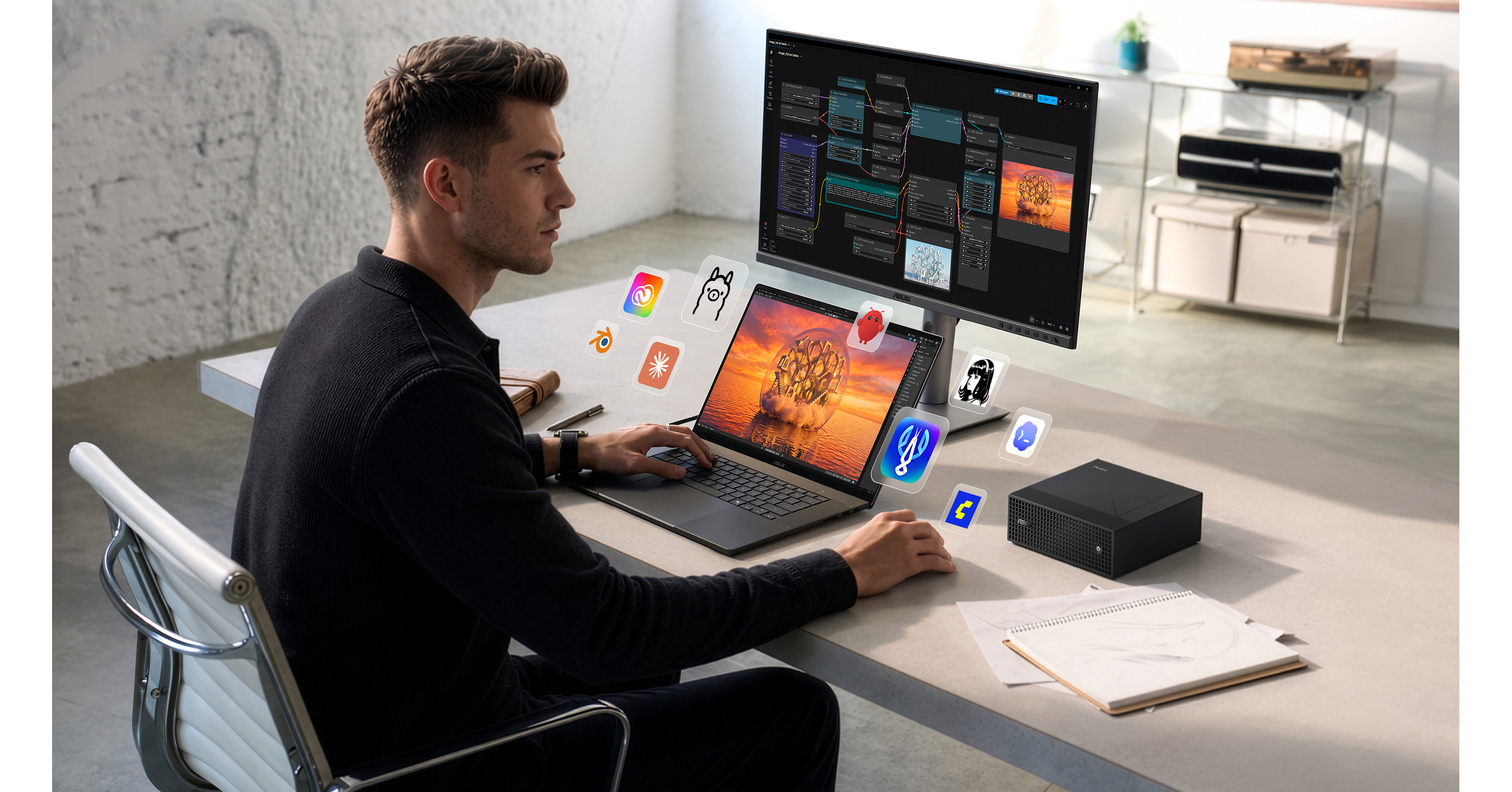
ASUS unveiled the new ProArt RTX Spark lineup at IFA 2026, including the ProArt P16 and P14 laptops (up to 99Wh batteries) and the compact ProArt GR1X mini PC (150 x 150 x 51mm) aimed at on-device agentic AI workflows. The PCs claim RTX Spark capabilities such as running 120B-parameter LLMs, rendering 90GB+ 3D scenes, and generating 4K AI video locally without cloud token limits. The launch is incrementally positive for the AI creator/dev hardware theme, but it is unlikely to be immediately market-moving given it lacks financial or guidance details.
Analysis
This is a validation event for edge AI, not an earnings inflection. The important mechanism is that a premium creator PC can now be marketed as a local inference appliance, which supports higher-end GPU attach and keeps more AI workload in the device layer instead of the cloud. That is structurally constructive for NVDA because it reinforces Blackwell as the default “AI-capable” silicon in both workstation and portable form factors, but the near-term revenue impact is likely de minimis unless channel checks show real replacement demand rather than demo-driven sell-through.
The more nuanced implication is competitive pressure on software monetization. If users can run credible local agents and generative workflows without metered cloud usage, the pricing power migrates away from per-seat AI add-ons and token consumption models; that is a medium-term risk for ADBE and, to a lesser extent, GOOGL’s paid AI layer if the bundle is used more as a subsidy than a growth engine. The first-order headlines are positive for ecosystem adoption, but the second-order effect is that open local workflows can reduce switching costs to non-Adobe creative stacks over 6-18 months.
Contrarian view: the market may be overpricing “AI PC” launches as a demand catalyst when they are mostly a product narrative unless there is evidence of a broader creator/developer refresh cycle. The key falsifier is sell-through: if workstation OEM inventory does not tighten or if users default back to cloud workflows because they are cheaper/faster, the thesis fades quickly. Watch for channel pricing, gross margin mix at OEMs, and whether Adobe can show AI attach without needing heavy discounting.
AllMind Terminal
AI-powered research, real-time alerts, and portfolio analytics for institutional investors.
Request TrialMarket Sentiment
Overall Sentiment
mildly positive
Sentiment Score
0.35
Ticker Sentiment
Key Decisions for Investors
- Maintain a tactical long bias in NVDA versus XLK/SMH on any post-launch weakness; this is a sentiment validation for Blackwell’s workstation narrative, but size it modestly because the revenue linkage is indirect over the next 1-3 months.
- Put ADBE on a 6-18 month relative underweight/watch list versus NVDA: if local agentic workflows gain traction, Adobe’s AI monetization could face pricing pressure; a short-vs-long pair is only attractive if channel checks show adoption of non-Adobe local creative tools.
- No aggressive standalone trade in GOOGL yet; the Google AI Pro bundle is more distribution than incrementality. Use it as an alert item and look for evidence that local-first creator workflows reduce paid cloud usage before expressing a position.
- Trade trigger: if workstation OEM sell-through or NVDA-related creator-PC preorder data beats within the next 1-2 quarters, add to NVDA exposure; if Adobe reports AI attach or Firefly monetization re-accelerating, cover any relative short thesis in ADBE immediately.
More News
- Why did CoreWeave stock get crushed this week? Look to this corner of the debt market for clues
- We're downgrading this retail stock after a big comeback. Plus, AI names slide again
- I watched Nvidia's Jensen Huang work the room in London. He brought big checks — and a blunt message
- Benchmarked: Nvidia's RTX Spark notebook delivers serious local AI compute, at a price
- Microsoft’s Brad Smith says green card curbs could cripple US tech
- A week with RTX Spark: everything we’ve learned using Nvidia’s new laptops